
Cheekbonereduction
Narrows prominent cheekbones by repositioning the bone.
- Type
- Surgical
- Usually by
- Plastic surgeon
- Category
- V-line & face contouring
- First step
- Consultation
Information only. Suitability, risks, recovery and price are assessed by the treating doctor in a consultation.
Side effects and precautionsWhat to know about Cheekbone reduction before you book12
Reactions that usually settle, signs to tell the clinic about straight away, and times to wait. Your doctor goes through the risks that apply to you at the consultation.
Known risks
- Bone that heals poorly or in the wrong position, sagging of the cheek, asymmetry, a dip in the cheek contour, limited mouth opening and sinus infection have been reported.
Usually settles on its own
- Swelling, which a 2017 malarplasty paper describes as subsiding within about 2 weeks.
- Sagging and deeper wrinkles right after surgery; in the 114-patient series this subsided within 3 or 4 months.
- Slight difficulty opening the mouth just after surgery; in 4 of 114 patients it improved in 3 or 4 months.
Tell the clinic promptly
- Bone that does not heal or heals out of place, and cheek drooping; one paper calls these the two most common complications of the operation. In the 114-patient series there were 3 cases of the bone not healing, from pressure after surgery or faulty fixation.
- Cheek drooping in 2 of 114 patients, linked to wide dissection under the bone lining; each had a midface lift.
- A sunken area or sagging when too much bone is removed or the bone is pushed in too far, and jaw-joint problems such as stiffness or pain when opening the mouth.
- In the 700-patient series: slight asymmetry in 13 patients (1.9%), and one case each of sinus infection, skin necrosis (an area of dead skin) about 1 cm across after liposuction of the cheekbone area, and a forehead wrinkle on one side.
- Lower-lip and mouth-corner numbness in 1 of 114 patients, which recovered in 6 months.
Wait or rethink when
- Not yet being sure why you want it; the NHS advises asking yourself why you want a cosmetic procedure, and says a GP or mental health professional might be a good place to start.
- Cheekbones that are flat, if you want more fullness; BAAPS describes building out flat cheekbones with implants, which is a different operation.
- Not being able to stay in Korea for at least 7 to 10 days; the NHS recommends not flying for 7 to 10 days after facial cosmetic procedures.
Sources for this section 12
- Rotation Technique of Reduction Malar Plasty (PMC)
- A New Infracture Technique for Reduction Malarplasty with an L-Shaped Osteotomy Line (PMC)
- Stability of different fixation methods after reduction malarplasty (PMC)
- Lee J, Lee S. Facial Contouring Surgery—Malarplasty — Plastic and Reconstructive Surgery Global Open 2017 (PMC5682157)
- Hong SE et al. Intraoral Zygoma Reduction Using L-shaped Osteotomy — The Journal of Craniofacial Surgery 2014 (PMC4025629)
- Kang SH et al. Reduction malarplasty using a simulated surgical guide for asymmetric/prominent zygoma — Head & Face Medicine 2022 (PMC8962158)
- Kang M. Incidence of Complications Associated with Mandibuloplasty: A Review of 588 Cases over 5 Years — Plastic and Reconstructive Surgery Global Open 2014 (PMC4174213)
- Reshaping chins and cheeks — British Association of Aesthetic Plastic Surgeons (BAAPS)
- Before you have a cosmetic procedure — NHS
- Cosmetic surgery abroad — NHS
- Lee JS. A Revisional Malarplasty: Endoscopic Zygoma Reduction (EZ technique) — Archives of Aesthetic Plastic Surgery 2013 (doi:10.14730/aaps.2013.19.2.95)
- Foreign Patient Attraction Information System — MEDICALKOREA
What is it?
The purpose, the change you can expect and the limits.
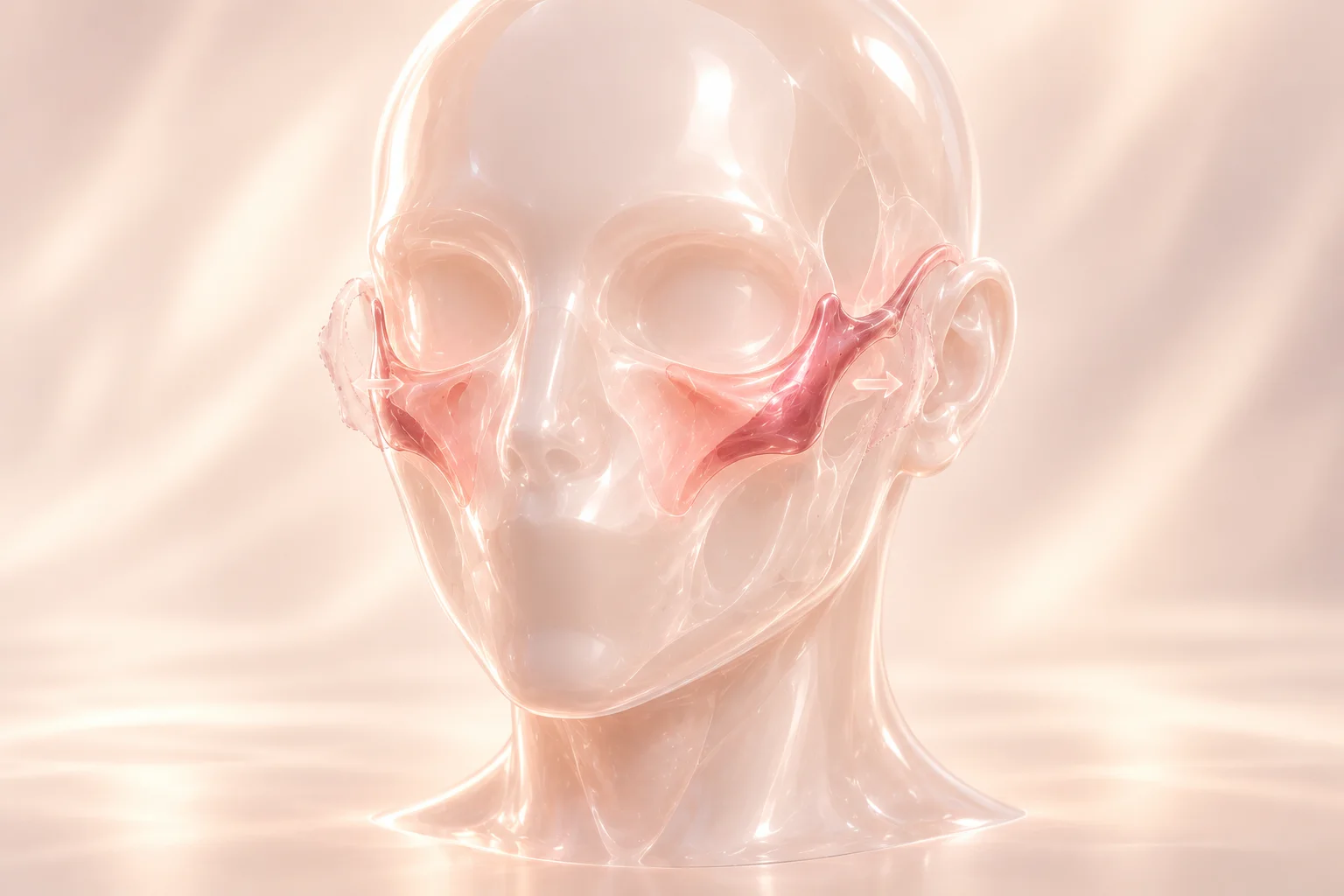
Narrows prominent cheekbones by repositioning the bone.
Zygoma reduction
Techniques & materials
- 01L-shaped osteotomy
The front of the cheekbone is cut in an L shape through the mouth so the bone can be moved inwards.
- 02Intraoral plus sideburn incision
A cut inside the mouth is combined with a small cut (about 1 to 1.5 cm) in front of the ear to reach the back of the cheekbone arch.
- 03Coronal (scalp) approach
The cheekbone is reached through a cut across the scalp, hidden in the hair; it is one of the three main approaches described.
- 04Titanium plate and screw fixation
After the bone is moved, it is commonly held with small titanium plates or screws so the cut surfaces stay in close contact while healing.
- 05No-fixation (greenstick) technique
Some surgeons bend the bone inwards on a partial cut and use no plates; this has been reported in a large single-centre series.
Clinics do not all carry the same devices, products or techniques. Ask which one will be used, by name, before you book.
How it is done, in photos
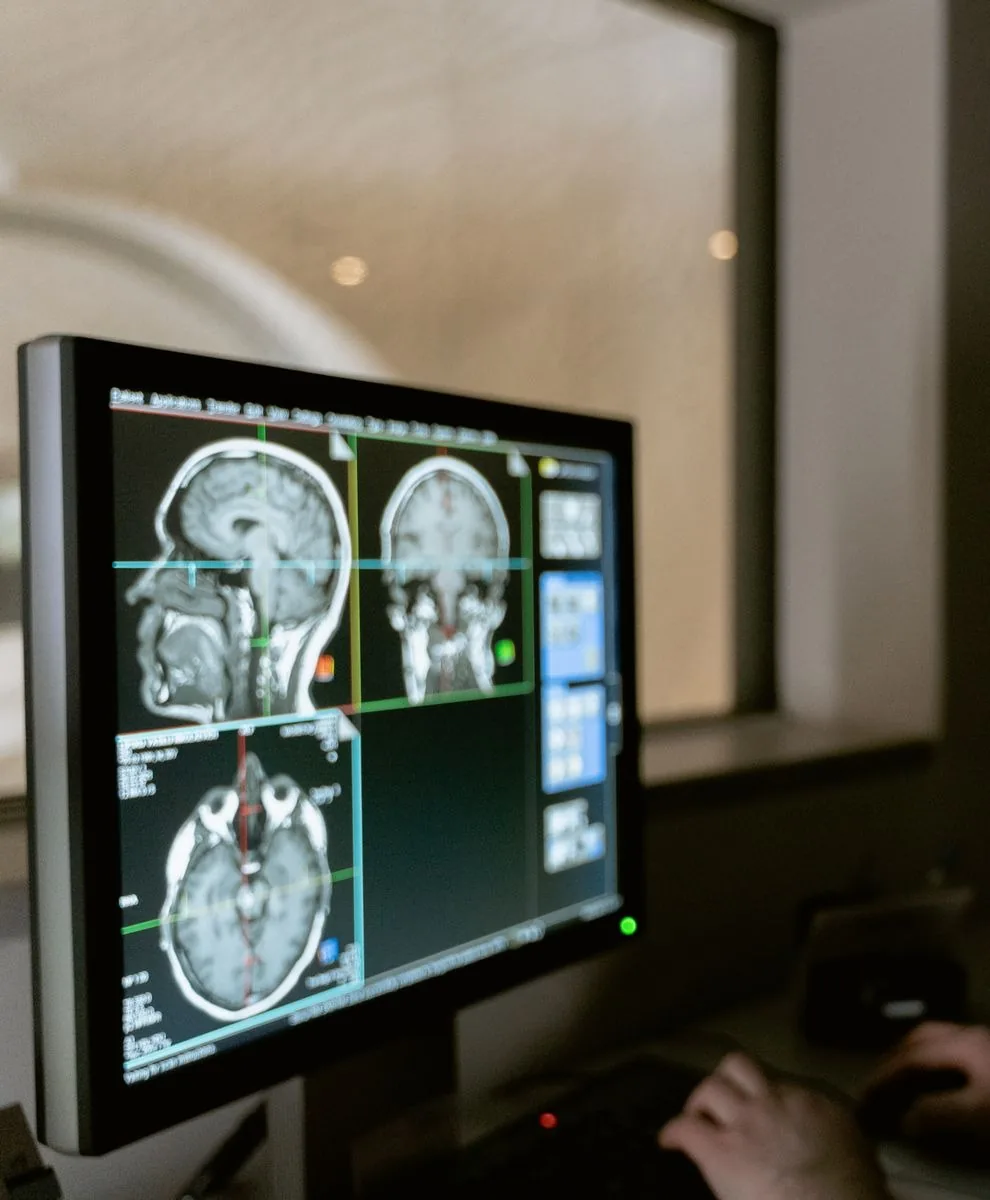
Scans are reviewed on a workstation screen; before cheekbone reduction surgeons examine the face and a 3D CT scan of the cheekbones.
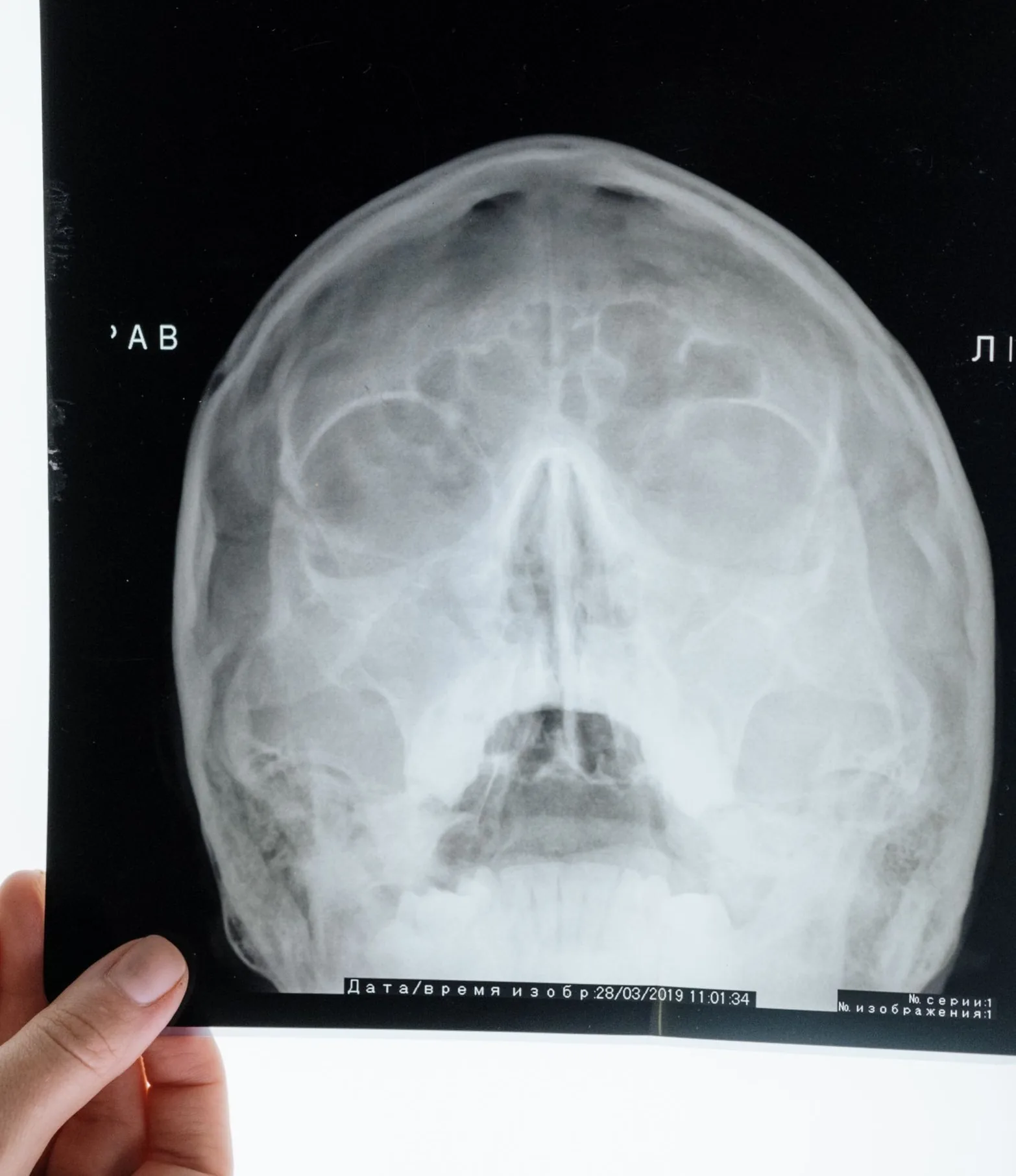
A front-view skull X-ray shows the cheekbones and eye sockets; the amount of bone removed is kept minimal to avoid complications.

The operating team prepares under general anaesthesia; in one Korean series of 588 contouring patients, all stayed in hospital for 1 to 2 days.
Device and procedure images are provided by the manufacturers / licensed stock; they do not show COMEDI patients.
At a glance
- Approach
- The cheekbone is cut, moved inwards and usually fixed. Access is through the mouth, often with a small cut near the sideburn, or through the scalp.
- Anaesthesia
- General anaesthesia.
- Operating time
- One published series reported about half an hour for a no-fixation technique. Techniques with plate fixation take longer, and times vary by clinic and case.
- Eating after surgery
- In the series reviewed, patients started liquids within hours and a soft diet over the first three to five days. Ask your clinic for its own schedule.
Facial bone surgery is planned after CT and other tests show where the bone and nerves lie. Soft tissue does not always change the way the bone does, and swelling takes a long time to settle.
Cheek sagging can occur, which makes the pre-operative assessment important.
Real cases
A case only helps when you can see the conditions behind it.
Sign in to see the before & after photos
Free. We use your Google name and email only to answer questions about these cases. Clinic names are shared in your private consultation.
 Before
 After
- Sessions
- Surgery (example)
- Combined
- None
- Photo timing
- 6 months after surgery (example)
 Before
 After
- Sessions
- Surgery (example)
- Combined
- None
- Photo timing
- 6 months after surgery (example)
 Before
 After
- Sessions
- Surgery (example)
- Combined
- None
- Photo timing
- 6 months after surgery (example)
- SessionsOne session, or the result of a course
- CombinedWhether other treatments or surgery were done together
- Photo timingHow long after the procedure the photo was taken
What to ask in a consultation
Questions about whether it suits you and what the alternatives are.
Often considered when
- People bothered by prominent cheekbones; one technical paper notes that prominent zygomas are perceived as stubborn and unattractive by Asians.
- People whose width comes from the cheekbone itself; a 2017 paper says surgeons first characterise the shape of the cheekbones and how far they protrude, from examining the face and a 3D CT scan.
- People whose two cheekbones differ; a 2022 study used computer simulation and 3D-printed guides for malarplasty in people with an asymmetric or prominent zygoma.
Checks in Korea
- Korea's Foreign Patient Attraction Information System (MEDICALKOREA) lets you search registered institutions by name; leaving the name blank lists all registered foreign-patient institutions.
- Q01From my test results, how far is it safe to go?
- Q02What alternatives are there without bone surgery — a non-surgical treatment or a different operation?
- Q03Who is the operating surgeon, and what is their specialty?
- Q04What type of anaesthesia is used, and who monitors it?
- Q05How many follow-up visits are needed before it is safe for me to fly home?
- Q06What are the possible risks and complications, and how are they handled if I am abroad?
- Q07What is included in the written estimate — revisions, medication, garments, stitches out?
Check these yourself at the consultation
- Which approach is used (mouth, sideburn, scalp) and where any scar will be.
- Whether the bone is fixed with plates or screws, and what material they are.
- How the clinic checks that the bone has healed in position before you fly home.
Recovery & schedule
Check swelling, daily routine, activity limits and review visits separately.
At a glance
- Planning from CT
- A 2017 paper says surgeons examine the face and a 3D CT scan to characterise the shape of the cheekbones and how far they protrude, and that the amount of bone removed should be kept minimal to avoid complications.
- Hospital stay
- In a Korean series of 588 contouring patients, including 268 who also had cheekbone reduction, all were admitted for 1 to 2 days. How long you stay is set by your clinic.
- Dressing
- In a published series of 700 patients, the cuts inside the mouth were closed without a drain and a light pressure dressing was used for 3 to 5 days. Other clinics use different dressings.
- Opening the mouth
- The 2017 paper says patients must practise opening their mouths once the swelling subsides, within about 2 weeks.
- When the cheek settles
- In a series of 114 patients, most showed soft-tissue sagging and deeper wrinkles right after surgery, which subsided within 3 or 4 months as the wounds healed and the skin regained elasticity.
- Follow-up period
- Published studies observed patients for over 6 months in one series and for 2 to 24 months in another. These were study periods, so ask your clinic what follow-up it plans for you and how it works once you are home.
- 01Swelling & bruising
A 2017 paper on malarplasty describes swelling subsiding within about 2 weeks, while softer sagging of the cheek took 3 to 4 months to settle in a 114-patient series.
- 02Back to routine
In the 700-patient series, a light pressure dressing stayed on for 3 to 5 days. When you can return to work depends on your recovery, so ask your surgeon.
- 03Activity limits
In the 114-patient series, two cases of the bone not healing were linked to pressure on the operated area after surgery, so avoid pressing on your cheeks. The NHS advises resting after surgery abroad and not drinking alcohol, lying in the sun, sightseeing or going in the water.
- 04Follow-up & flying home
The NHS recommends not flying for 7 to 10 days after facial cosmetic procedures and asking beforehand where follow-up appointments will be and what happens if there are complications. Published series kept following patients for months, so agree how checks will continue after you fly home.
Published guidance; your own clinic sets the actual plan.
Before your visit day
What clinics ask of international patients, in one place.
- Bring your passportClinics register international patients with their passport, and any estimate or prescription is issued in the name on it.
- Patients under 19Adulthood in Korea starts at 19. For a younger patient, clinics generally ask a parent or legal guardian to consent in writing, and many ask them to attend. Tell us the patient's age when you write, and we check what the clinic needs.
- Coming with someoneA family member or friend can usually join you in the consultation room. Treatment and recovery areas follow each clinic's rules, so we check this before your visit. If more than one person is booking, tell us what each person is interested in.
- Language helpCoordinators reply in English, Japanese, Chinese and Korean. Interpretation on the day is arranged for your dates, and we confirm in writing what it covers before you travel.
- Medicines and allergiesWrite down the medicines you take and any allergies. The clinic asks about both before any treatment.
What changes the price
The same surgery can be quoted differently depending on the items below.
What differs from clinic to clinic
- Planning tools
- A 2022 study says traditional malarplasty demands a high level of expertise to reduce the cheekbone predictably and symmetrically, and that CAD/CAM guides set the shape, height and curve of the cut line accurately; they also need software, CAD/CAM technology and 3D printing. Whether a clinic uses guides or plans from CT alone differs.
- Dissection and sagging
- In a 114-patient series, cheek drooping was linked to wide dissection under the bone lining, and another paper describes the dissection over the upper jaw in the mouth approach as a possible main cause of drooping. How widely a surgeon dissects, and how much bone is removed, is worth asking.
- How the bone is held
- In the 114-patient series, one case of the bone not healing came from faulty fixation during surgery, and a 2017 paper describes pre-bent plates for both the front and the arch. Ask how the clinic fixes each part, not only whether it does.
- Aftercare protocol
- One published series used a light pressure dressing for 3 to 5 days without a drain, while a Korean contouring series kept a bulky compression dressing for 4 to 5 days with a 1 to 2 day stay. What is included and how long you stay differ between clinics.
- Combined procedures
- In the Korean series of 588 contouring patients, 114 had jaw-angle and cheekbone surgery together and 154 also had chin surgery. Whether a clinic proposes the cheekbones alone or several areas changes the length of surgery, the stay and the quote.
- Areas reduced
- Whether the quote covers the front of the cheekbone only, or the front and the arch towards the ear.
- Fixation hardware
- Whether plates or screws are used for the front and the arch, and whether they are included in the price.
- 3D planning and guides
- Whether computer simulation or a 3D-printed cutting guide is used, and whether it is priced separately.
- Combined areas
- Whether jaw-angle or chin surgery is done in the same operation and how each area is counted.
- Soft-tissue lifting
- Whether a lift or soft-tissue suspension is suggested alongside the bone work, and whether it is included.
- Revision policy
- What happens and what it costs if asymmetry, drooping or poor bone healing needs a second operation.
- Extent
- Jaw, cheekbones, chin and how they are combined
- Tests
- CT and other pre-operative tests
- Anaesthesia & stay
- General anaesthesia, the anaesthesiologist and nights in hospital
- What is included
- Medication, compression band, review visits and the revision policy
Prices are set by the clinic after a consultation. Ask for an itemised, written estimate before you book, and check what is included and what could change.
Often charged separately
Ask whether each of these is in your estimate.
| Item | What to ask |
|---|---|
| Consultation fee | Whether the consultation is charged, and whether that amount comes off the surgery price. |
| Stitch removal and check-ups | How many follow-up visits are included, and how check-ups work once you have flown home. |
| Recovery stay | Whether an overnight stay at the clinic or a recovery facility is in the estimate. |
Clinics in Korea build a surgery estimate from the technique, the type of anaesthesia and the care around the operation.
The final figure is set after the surgeon examines you.
Ask for an itemised, written estimate that marks each item above as included or not, so you can compare two quotes on the same basis.
VAT before you compare quotes
The VAT refund for foreign visitors' cosmetic procedures covered only procedures received by 31 December 2025, so procedures received now are not refunded. Plan your budget without it, and ask each clinic whether VAT is included in the written quote so you compare the same total.
Ask COMEDI, for example
Clinics in Seoul differ in equipment, technique, specialist focus and what the price includes. Send us your question and we compare partner clinics for you.
- “Which partner clinics use 3D simulation or printed guides for cheekbone reduction?”
- “Would clinics reduce only the front of my cheekbone, or the arch as well?”
- “Do the quotes include fixation plates, the hospital stay and check-ups before I fly home?”
- “I'm worried about sagging — which clinics would suggest a lift with it, and why?”
Precautions & aftercare
General information. Follow the written instructions from your treating doctor for anything specific to you.
Side effects and precautions for Cheekbone reduction are in one place at the top of this page.
Aftercare for this procedure
- Avoid pressing on or bumping your cheeks while the bone heals; in one series, pressure on the operated area after surgery was linked to the bone not healing.
- Start mouth-opening practice when your surgeon says; one paper starts it once the swelling subsides within about 2 weeks and recommends early exercise and physiotherapy for jaw-joint problems.
- Keep the pressure dressing on for as long as your clinic advises; one published series used a light dressing for 3 to 5 days.
- Rest after surgery and avoid alcohol, sun, sightseeing and swimming, as the NHS advises after surgery abroad.
- Tell the clinic about dental or orthodontic treatment, jaw joint symptoms, medical conditions, medicines and smoking.
- Contact the clinic immediately for difficulty breathing, bleeding, fever or severe pain.
- This is surgery under general anaesthesia, so ask about pre-operative tests and emergency arrangements.
Information only. Suitability, risks, recovery and price are assessed by the treating doctor in a consultation.
Sources for this section 11
- Hong SE et al. Intraoral Zygoma Reduction Using L-shaped Osteotomy — The Journal of Craniofacial Surgery 2014 (PMC4025629)
- Lin LX et al. A New Infracture Technique for Reduction Malarplasty with an L-Shaped Osteotomy Line — Medical Science Monitor 2015 (PMC4501642)
- Lee J, Lee S. Facial Contouring Surgery—Malarplasty — Plastic and Reconstructive Surgery Global Open 2017 (PMC5682157)
- Kang SH et al. Reduction malarplasty using a simulated surgical guide for asymmetric/prominent zygoma — Head & Face Medicine 2022 (PMC8962158)
- Choung JW. Rotation Technique of Reduction Malar Plasty — The Journal of Craniofacial Surgery 2015 (PMC4297216)
- Kang M. Incidence of Complications Associated with Mandibuloplasty: A Review of 588 Cases over 5 Years — Plastic and Reconstructive Surgery Global Open 2014 (PMC4174213)
- Reshaping chins and cheeks — British Association of Aesthetic Plastic Surgeons (BAAPS)
- Before you have a cosmetic procedure — NHS
- Cosmetic surgery abroad — NHS
- Lee JS. A Revisional Malarplasty: Endoscopic Zygoma Reduction (EZ technique) — Archives of Aesthetic Plastic Surgery 2013 (doi:10.14730/aaps.2013.19.2.95)
- Foreign Patient Attraction Information System — MEDICALKOREA
Related questions & guides
Worth reading alongside this page.
Notes from people who used COMEDI
Written after a consultation we arranged, and matched to that request.
Common questions
How much does Cheekbone reduction cost in Korea?+
Prices are set by each clinic after a consultation and depend on the technique, area and your needs. Ask for an itemised, written estimate before you book — it should list what is included and what could change. We help you request and compare estimates.
Can foreigners get Cheekbone reduction in Korea?+
Yes. Many Seoul clinics see international patients. We help with clinic information, consultations in your language, written estimates and interpretation on the day.