
IPL photofacial
Broad-spectrum light used for redness and sun-related pigmentation.
- Type
- Non-surgical
- Usually by
- Dermatologist
- Category
- Laser & pigment
- First step
- Consultation
Information only. Suitability, risks, recovery and price are assessed by the treating doctor in a consultation.
Side effects and precautionsWhat to know about IPL photofacial before you book14
Reactions that usually settle, signs to tell the clinic about straight away, and times to wait. Your doctor goes through the risks that apply to you at the consultation.
Usually settles on its own
- Pain and redness, which StatPearls names as the most common reactions
- Stinging like a mild sunburn, which the ASDS says usually settles within four to six hours
- Brown spots turning darker and crusting before peeling off within about a week
- Mild swelling in the treated area, which the ASDS says usually goes down within several days
Tell the clinic promptly
- Blisters, haematoma, darker or lighter patches, white hairs, scarring, keloids and infection, which StatPearls lists among other reported side effects. It notes that inappropriate settings and excess energy can cause heat damage.
- Lasting uneven colour, which one review says is a greater risk in darker skin types
- Cold sore outbreaks, which StatPearls says IPL can trigger
- Burns. A 2025 case report describes superficial and partial-thickness burns with blisters on the face and neck of a man in his late 20s with skin type IV treated at a non-medical aesthetic spa; significant improvement was seen after four months, with minimal darkening remaining.
- Burning or discomfort that persists after treatment, or blisters. In the 2025 case report, these led the patient to seek urgent dermatological care, so contact the clinic promptly if they appear.
Wait or rethink when
- A recent sunburn, or pregnancy or breastfeeding. StatPearls says it may be beneficial to avoid IPL in these groups.
- Recent tanning or a severe sunburn, taking or having recently taken Accutane (isotretinoin), or taking blood thinners. The ASDS lists these among the reasons a person is not a good candidate for laser/light therapy.
- A tendency to keloid scarring or severe or unusual scar formation, active acne, or a skin resurfacing disorder. The ASDS lists these as well.
- Dark skin. The ASDS lists dark skin among the reasons a person is not a good candidate for laser/light therapy, and StatPearls says IPL is particularly challenging to use on dark skin and needs careful consideration.
- A history of cold sores (herpes simplex). StatPearls notes that IPL can trigger outbreaks, so tell the doctor beforehand; preventive antiviral medicine may be started.
Sources for this section 7
- Intense Pulsed Light (IPL) Therapy — StatPearls, NCBI Bookshelf (last update March 1, 2024)
- Current Trends in Intense Pulsed Light (Goldberg DJ, J Clin Aesthet Dermatol 2012) — JCAD
- Laser/light therapy — American Society for Dermatologic Surgery
- Second-Degree Burns Following Intense Pulsed Light Therapy in a Patient With Fitzpatrick Skin Type IV: A Case Report (Cureus 2025) — PMC
- Skin conditions that lasers can treat — American Academy of Dermatology
- 의료 해외진출 및 외국인환자 유치 지원에 관한 법률 제6조 — 국가법령정보센터
- 의료기기안심책방 (의료기기 종합정보 플랫폼) — 식품의약품안전처
What is it?
The purpose, the change you can expect and the limits.
Broad-spectrum light used for redness and sun-related pigmentation.
Intense pulsed light
- Stellar M22
- BBL HERO
- Nordlys
Devices & products used
- 01Stellar M22Lumenis, Israel
An IPL handpiece emitting a 400–1200 nm spectrum that is narrowed with nine interchangeable filters, with pulse shaping (OPT) and chilled sapphire contact cooling.
- 02BBL HEROSciton, USA
A broadband light (BBL) device with interchangeable wavelength filters and a cooled sapphire crystal; the manufacturer lists it for skin types I–V.
- 03NordlysCandela, USA
Uses narrowband IPL (Selective Waveband Technology) with dual filters that remove wavelengths above 950 nm, and sub-millisecond pulses.
Clinics do not all carry the same devices, products or techniques. Ask which one will be used, by name, before you book.
How it is done, in photos
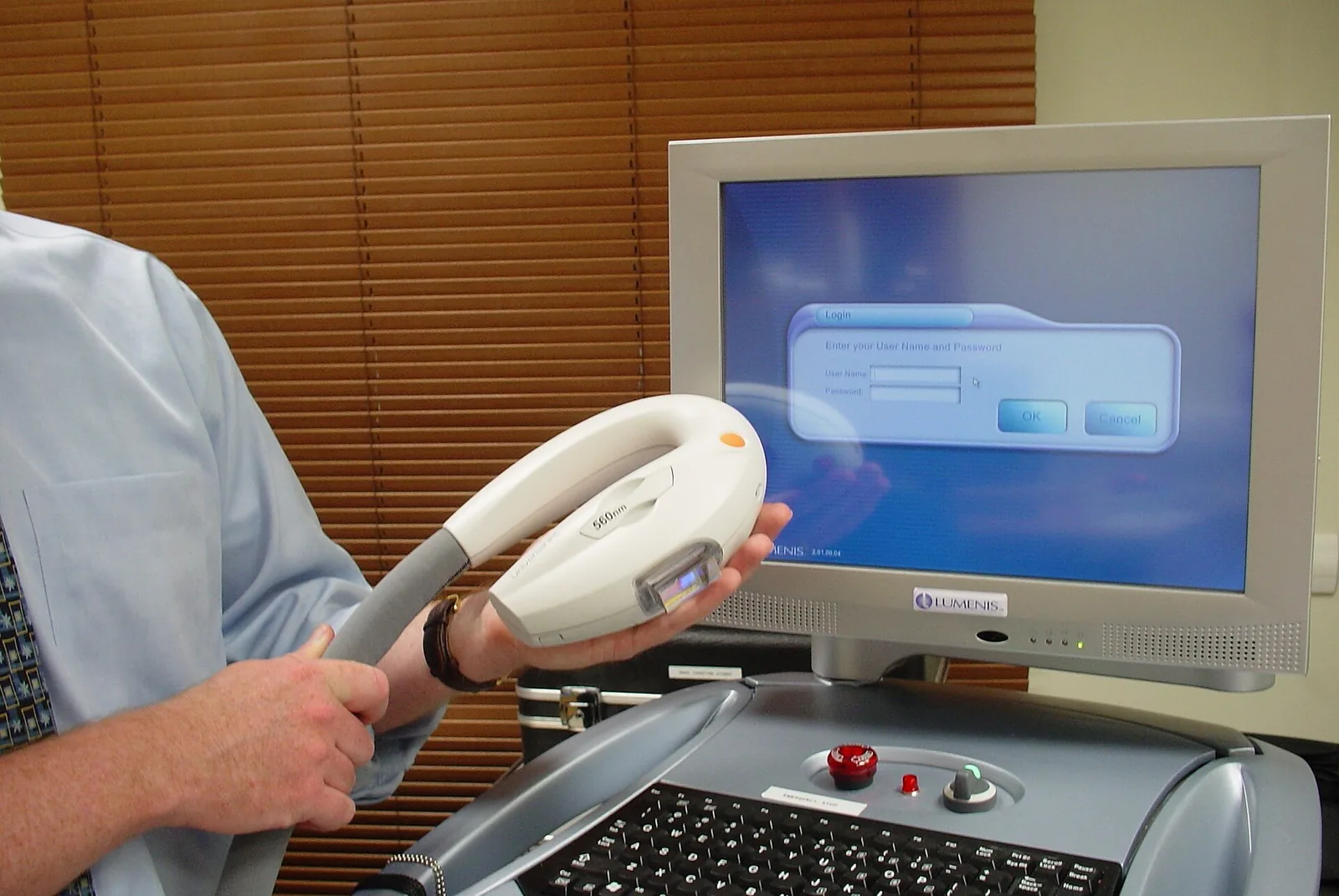
The handpiece of a Lumenis One IPL system; its flat window is placed on the skin to deliver broad pulses of light.
Photo: Dr. Peter Crouch / Public domain via Wikimedia Commons
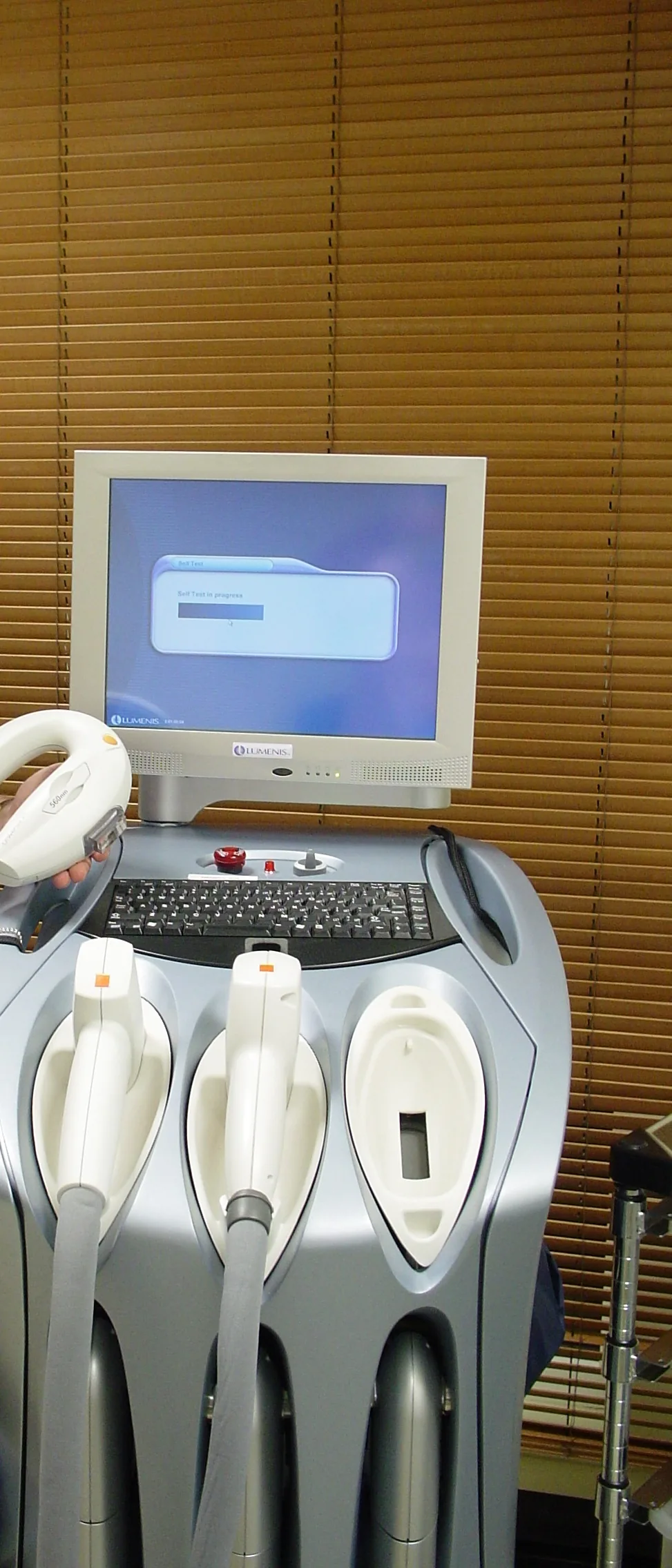
A Lumenis One IPL platform with interchangeable handpieces; settings are chosen on screen, and starting a course with conservative settings is advisable.
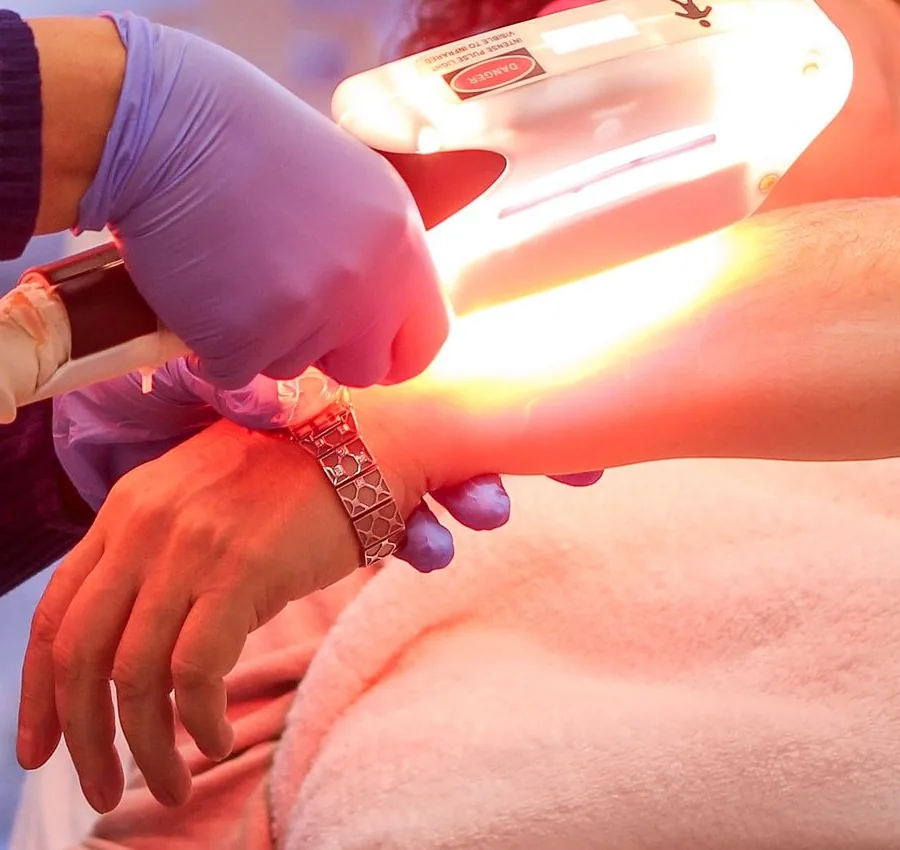
An IPL handpiece releases a bright flash of light over the treatment area; treated brown spots visibly darken, which is the expected end point.
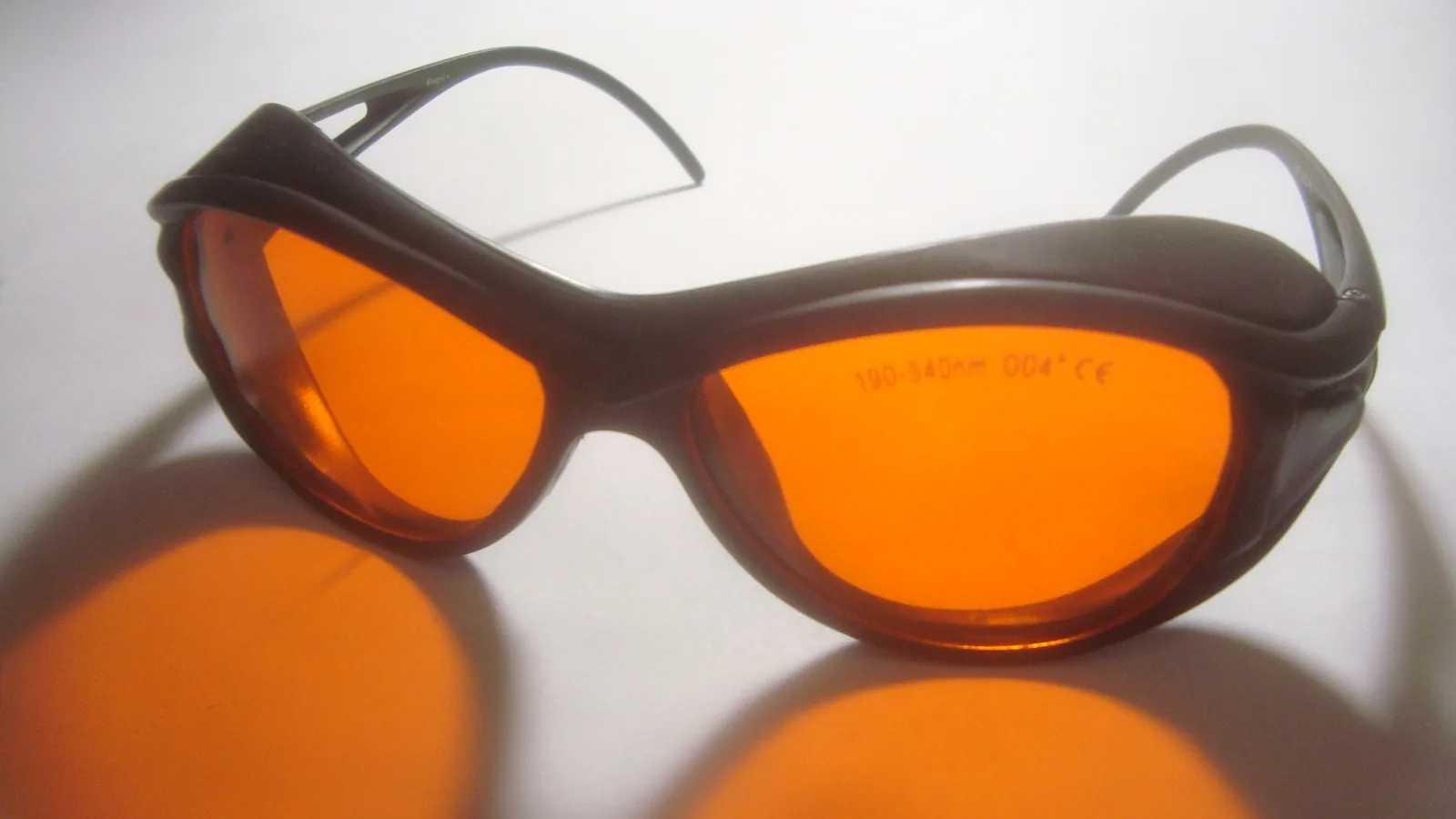
Eye protection is rated by optical density for set wavelengths; because IPL light can harm the eye, shields stay in place throughout the session.
Photo: Карма2 / CC BY-SA 4.0 / CC BY-SA 4.0 via Wikimedia Commons
Device and procedure images are provided by the manufacturers / licensed stock; they do not show COMEDI patients.
At a glance
- How it works
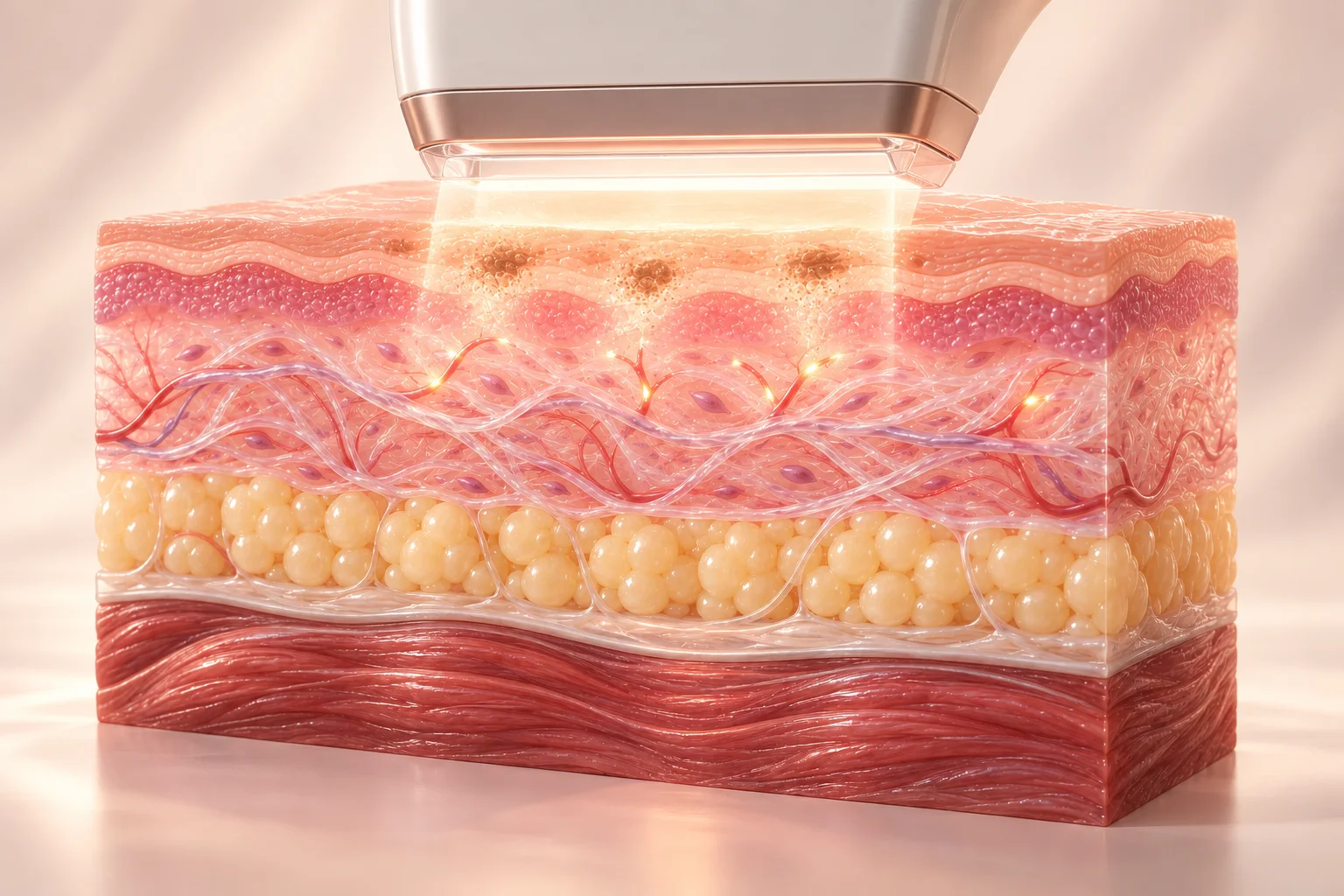
- IPL is not a laser: it emits a broad band of light rather than one wavelength. Filters select the part of the spectrum absorbed by brown pigment or by blood in small vessels.
- Session time
- One manufacturer describes a session as about 15–30 minutes, depending on the concern.
- Anaesthesia
- A chilled gel, cooling, or numbing cream may be used. The pulse is often described as feeling like the snap of a rubber band.
- Sessions & interval
- One manufacturer describes a course of 3–5 sessions at intervals of 2–6 weeks.
- After treatment
- Pink or red skin for a few hours and mild swelling for a few days are described by dermatologic surgeons. Sun protection is needed afterwards.
- Skin tone notes
- Recently tanned or sunburned skin should not be treated. Darker skin is more prone to burns and dark marks from light-based devices, and US clearances for these IPL systems list skin types I–V for some uses.
The type of laser depends on the goal — pigment, redness, texture or hair — and it is often planned as a course rather than one session. Skin tone and the type of pigment change how the skin responds.
It may not suit darker skin tones or deeper pigmentation.
References 7
Real cases
A case only helps when you can see the conditions behind it.
Sign in to see the before & after photos
Free. We use your Google name and email only to answer questions about these cases. Clinic names are shared in your private consultation.
 Before
 After
- Sessions
- 3 sessions (example)
- Combined
- None
- Photo timing
- after 3 sessions (example)
 Before
 After
- Sessions
- 3 sessions (example)
- Combined
- None
- Photo timing
- after 3 sessions (example)
 Before
 After
- Sessions
- 3 sessions (example)
- Combined
- None
- Photo timing
- after 3 sessions (example)
- SessionsOne session, or the result of a course
- CombinedWhether other treatments or surgery were done together
- Photo timingHow long after the procedure the photo was taken
What to ask in a consultation
Questions about whether it suits you and what the alternatives are.
Often considered when
- People with sun-related brown spots or freckles. StatPearls lists lentigines (sun spots), ephelides (freckles), hyperpigmentation and photorejuvenation among the uses the FDA has approved IPL for.
- People with facial redness, small visible blood vessels or rosacea. The AAD describes light therapy as an option for redness and enlarged facial blood vessels, and one review reports IPL as at least as effective as a non-bruising pulsed dye laser for the signs and symptoms of rosacea.
- People with both brown spots and redness who want one treatment that can address each with a different filter. StatPearls explains that cut-off filters adjust the wavelength of light that reaches the skin, so different targets can be chosen.
- People with lighter skin. StatPearls notes that melanin tends to absorb shorter wavelengths, and that shorter wavelengths treat pigmented spots effectively in lighter skin, while longer wavelengths may suit darker skin.
- People who can plan for a series rather than one visit. StatPearls advises telling patients that IPL is planned as a series of at least 2 or more treatments, so more than one session may be needed.
Checks in Korea
- Under Korean law, a clinic that wants to attract foreign patients must register, have at least one specialist for each department in which it plans to treat foreign patients (except departments that are not specialties designated by Presidential Decree), and hold medical malpractice liability insurance or belong to a medical liability mutual aid association. Registration is valid for 3 years from the date of registration.
- Korea's Ministry of Food and Drug Safety runs a medical device information platform (emedi.mfds.go.kr) where information on medical devices, including the device a clinic names, can be looked up.
- Q01Is this laser suitable for my skin tone and type of pigment? How does it compare with other options?
- Q02How many sessions fit into a short stay, and how would I continue afterwards?
- Q03Who will perform the treatment, and what is their specialty?
- Q04Which device or product will be used, and is it the original I asked about?
- Q05How many sessions are usually planned, and can they fit into my stay?
- Q06What should I avoid before and after — sun, alcohol, flights, exercise?
- Q07What is included in the written estimate, and what could change after the consultation?
Check these yourself at the consultation
- Ask which device and which filter will be used for your concern (brown spots, redness, or both).
- Tell the clinic about recent sun exposure or tanning and about any medicines, including acne tablets and retinoid creams.
- Ask whether a test spot is done first, especially if your skin is medium to dark.
Recovery & schedule
Check swelling, daily routine, activity limits and review visits separately.
At a glance
- Eye protection
- StatPearls explains that IPL light can damage pigmented parts of the eye such as the retina, so eye protection of the right optical density is critical, and eye shields should not be moved during the session.
- Course in published reviews
- Because the effect builds up, StatPearls describes 3 to 6 treatments every 2 to 4 weeks for the full effect, and a review describes typically 3 to 6 treatments every 3 to 4 weeks for uneven pigmentation. Darker or deeper lesions may need more. Your own plan is set by the doctor.
- What the doctor looks for
- A review describes the immediate end point for brown spots as visible darkening of the treated spots.
- Starting settings
- StatPearls notes that cautious default settings lower the risk of complications but may be less effective, and that starting a course with conservative settings is advisable.
- When change shows
- The ASDS says patients may not see significant changes until several weeks after the procedure.
- 01Swelling & bruising
Treated brown spots typically crust over within 24 to 48 hours and peel off within seven days, according to one review. StatPearls says skin reactions typically last about 2 to 48 hours, depending on the energy, pulse length and area treated.
- 02Back to routine
The ASDS advises avoiding make-up or lotion on the treated area for 24 hours or until redness and stinging have gone. A slight stinging, like a mild sunburn, usually settles within four to six hours, and cool packs or moist cloths can help.
- 03Activity limits
StatPearls says patients should be counselled on the importance of sun protection after treatment. Before laser treatment, the AAD advises avoiding a tan and using shade, sun-protective clothing and broad-spectrum, water-resistant sunscreen of SPF 30 or higher. The ASDS also advises keeping perfumes, deodorants and other irritants off the area before and after treatment.
- 04Follow-up & flying home
In published reviews, sessions are spaced weeks apart (2 to 4 weeks in StatPearls, 3 to 4 weeks for uneven pigmentation in another review), and one review says crusts on brown spots typically come off within about seven days, though this varies from person to person. Ask how many sessions your travel dates allow, and how photos, check-ups and later sessions will continue after you fly home.
Published guidance; your own clinic sets the actual plan.
Before your visit day
What clinics ask of international patients, in one place.
- Bring your passportClinics register international patients with their passport, and any estimate or prescription is issued in the name on it.
- Patients under 19Adulthood in Korea starts at 19. For a younger patient, clinics generally ask a parent or legal guardian to consent in writing, and many ask them to attend. Tell us the patient's age when you write, and we check what the clinic needs.
- Coming with someoneA family member or friend can usually join you in the consultation room. Treatment and recovery areas follow each clinic's rules, so we check this before your visit. If more than one person is booking, tell us what each person is interested in.
- Language helpCoordinators reply in English, Japanese, Chinese and Korean. Interpretation on the day is arranged for your dates, and we confirm in writing what it covers before you travel.
- Medicines and allergiesWrite down the medicines you take and any allergies. The clinic asks about both before any treatment.
What changes the price
The same treatment can be quoted differently depending on the items below.
What differs from clinic to clinic
- Filters and pulse options
- StatPearls notes that some IPL devices fire only a single pulse while others fire several in sequence, and that choosing the right filter is critical to the result. Clinics differ in which filters and pulse modes they actually use for your concern.
- Cautious or stronger settings
- StatPearls explains that default settings are designed to be safe but may be less effective than stronger energy, while starting conservatively is advisable. How a clinic balances the two, and how fast it steps up over a course, differs.
- Approach for medium or darker skin
- StatPearls describes longer wavelengths and longer delays between pulses (20 to 40 ms rather than the routine 10 to 12 ms) for darker skin, and a 2025 case report stresses settings tailored to skin tone, skin thickness and tanning history plus adequate cooling. Whether a clinic adjusts this way matters most if your skin is not fair.
- Cooling method
- StatPearls lists built-in chilled tips, cryogen spray and cooled glass, as well as ice packs, cold air or cold gel, as ways to protect the skin surface. Clinics and devices differ in which they use.
- Who treats you and who handles problems
- StatPearls says IPL may be given by a physician but is frequently given by a mid-level healthcare provider, and that having a dermatologist or plastic surgeon in the care team means complications can be managed promptly. The 2025 case report cites a study of 43 patients with complications after IPL and laser treatments by medical laypersons without physician oversight, in which excessively high energy settings were found in 62.8% of cases.
- Session spacing
- Published intervals vary: 2 to 4 weeks in StatPearls, 3 to 4 weeks for uneven pigmentation and 3 to 8 weeks for small visible blood vessels and cherry angiomas in another review. The spacing a clinic proposes decides how many sessions fit into your stay.
- Filters per session
- Whether one session covers both brown spots and redness with different filters, or each concern is quoted separately.
- Areas beyond the face
- Whether the neck, chest or hands are included or added at extra cost.
- Course size and spacing
- How many sessions the quote covers and how many weeks apart they are.
- Skin check and test spot
- Whether a skin-type assessment and a test spot before the first full session are included.
- Prescriptions and take-home care
- Whether antiviral medicine (if needed), moisturiser or sunscreen are prescribed or supplied.
- Same-day add-ons
- Whether other treatments are combined in the same visit and priced separately.
- Device & method
- Which laser is used and how it is applied
- Area & size
- Size and number of treated areas
- Sessions
- Recommended sessions, price per session and any package terms
- Numbing & care
- Numbing cream and soothing or recovery care
Prices are set by the clinic after a consultation. Ask for an itemised, written estimate before you book, and check what is included and what could change.
Often charged separately
Ask whether each of these is in your estimate.
| Item | What to ask |
|---|---|
| Consultation fee | Whether the consultation is charged, and whether that amount comes off the treatment price. |
| Check-up and top-up visits | Whether a review visit, or a top-up within a set period, is part of the quoted price. |
Clinics in Korea build a treatment estimate from the area, the amount used or the number of sessions.
The final figure is set after the doctor sees you at the consultation.
Ask for an itemised, written estimate that marks each item above as included or not, so you can compare two quotes on the same basis.
VAT before you compare quotes
The VAT refund for foreign visitors' cosmetic procedures covered only procedures received by 31 December 2025, so procedures received now are not refunded. Plan your budget without it, and ask each clinic whether VAT is included in the written quote so you compare the same total.
Ask COMEDI, for example
Clinics in Seoul differ in equipment, technique, specialist focus and what the price includes. Send us your question and we compare partner clinics for you.
- “I have both brown spots and redness. Which partner clinics treat both in one session, and with which filters?”
- “My skin is medium-toned. Which clinics do a test spot first and adjust settings for skin like mine?”
- “How many sessions could I fit into a two-week stay, and how would each clinic follow up after I fly home?”
- “What does each clinic's quote include: areas, number of sessions, aftercare products and check-ups?”
Precautions & aftercare
General information. Follow the written instructions from your treating doctor for anything specific to you.
Side effects and precautions for IPL photofacial are in one place at the top of this page.
Aftercare for this procedure
- Moisturise the treated area twice a day throughout the course and for at least three months after the final session, as the ASDS advises. One review adds that moisturising twice a day can help crusts on brown spots come off sooner.
- Let the darkened spots and crusts come away on their own over about a week, and ask the clinic before using scrubs or exfoliating products.
- If you have had cold sores, StatPearls says preventive antiviral medicine may be started a day before treatment and continued for up to 2 weeks afterwards. Ask whether this applies to you.
- The ASDS advises avoiding aspirin, anti-inflammatory drugs and herbal supplements before treatment because of bleeding risk. Check with your own doctor before stopping any prescribed medicine.
- Avoid sunbathing, tanning beds, waxing and chemical peels for two weeks before treatment, as the ASDS advises, and keep up sun protection between sessions.
- Tell the clinic about recent tanning, medicines that increase light sensitivity, possible pregnancy, keloid tendency and skin conditions.
- Contact the clinic if pigment darkens or lightens, or if blisters or severe pain appear.
- Keep up sun protection for as long as the clinic advises.
Information only. Suitability, risks, recovery and price are assessed by the treating doctor in a consultation.
Sources for this section 7
- Intense Pulsed Light (IPL) Therapy — StatPearls, NCBI Bookshelf (last update March 1, 2024)
- Current Trends in Intense Pulsed Light (Goldberg DJ, J Clin Aesthet Dermatol 2012) — JCAD
- Laser/light therapy — American Society for Dermatologic Surgery
- Skin conditions that lasers can treat — American Academy of Dermatology
- Second-Degree Burns Following Intense Pulsed Light Therapy in a Patient With Fitzpatrick Skin Type IV: A Case Report (Cureus 2025) — PMC
- 의료 해외진출 및 외국인환자 유치 지원에 관한 법률 제6조 — 국가법령정보센터
- 의료기기안심책방 (의료기기 종합정보 플랫폼) — 식품의약품안전처
Related questions & guides
Worth reading alongside this page.
Notes from people who used COMEDI
Written after a consultation we arranged, and matched to that request.
Common questions
How much does IPL photofacial cost in Korea?+
Prices are set by each clinic after a consultation and depend on the technique, area and your needs. Ask for an itemised, written estimate before you book — it should list what is included and what could change. We help you request and compare estimates.
Can foreigners get IPL photofacial in Korea?+
Yes. Many Seoul clinics see international patients. We help with clinic information, consultations in your language, written estimates and interpretation on the day.