
Tattoo removal
Staged laser sessions that break down tattoo ink so the body can clear it.

- Type
- Non-surgical
- Usually by
- Dermatologist
- Category
- Laser & pigment
- First step
- Consultation
Information only. Suitability, risks, recovery and price are assessed by the treating doctor in a consultation.
Side effects and precautionsWhat to know about Tattoo removal before you book13
Reactions that usually settle, signs to tell the clinic about straight away, and times to wait. Your doctor goes through the risks that apply to you at the consultation.
Usually settles on its own
- Redness, swelling, pinpoint bleeding, tingling or purplish spots after a session
- Blistering and crusting, which a review lists among the acute effects
- Light or dark spots on the skin, which the AAD says tend to disappear within 6 to 12 months
Tell the clinic promptly
- Scarring, changes in skin texture, burns and other wounds. The AAD says these are rare when a dermatologist treats you but more common when the person treating lacks medical training. In a 2026 practitioner survey, raised (hypertrophic) scarring was reported in about 0.2% of sessions.
- Paradoxical darkening of light pink, tan or white tattoos, which a review explains is caused by the laser changing titanium dioxide or iron oxide in the ink.
- Allergic reactions, particularly to red and yellow pigment, which can appear as itchy bumps, nodules or scaly patches.
- Longer-lasting colour changes, especially in darker or tanned skin.
- Keloid formation, ink blow-out and infection, each reported in about 0.1% of sessions in the 2026 survey. Contact the clinic if blisters spread, pain or redness keeps increasing, or the skin changes colour or texture.
Wait or rethink when
- Pregnancy or breastfeeding. The AAD states that women who are pregnant or breastfeeding should not be treated.
- A weakened immune system. The AAD notes that you need a healthy immune system for laser tattoo removal to work.
- A tan on the area. A tattoo-removal clinical study excluded people with excessive tanning, and a review notes that scarring can occur if a high fluence is used, particularly in dark or tanned skin.
- Recent isotretinoin or corticosteroid use, or a history of gold therapy. The same clinical study excluded systemic corticosteroid or isotretinoin use within 6 months and any past use of gold therapy.
- That study also excluded people with a past allergic reaction to tattoo pigments, allergy to local anaesthetics or topical antibiotics, a history of keloid or hypertrophic scarring or abnormal wound healing, immunosuppression, vitiligo, eczema or psoriasis, seizure disorders due to light, recurrent herpes simplex or shingles in the treatment area (unless treated with a preventive regimen), coagulation disorders or prescription blood thinners, and current smoking or smoking within 6 months. Mention any of these at the consultation.
Sources for this section 10
- PicoWay (patient information) — Candela
- Laser tattoo removal (Tattoo removal: Lasers outshine other methods) — American Academy of Dermatology
- Complications of Tattoos and Tattoo Removal: Stop and Think Before you ink (J Cutan Aesthet Surg 2015) — PMC
- Practitioner-Reported Complications in Tattoo Removal (Dermatology 2026) — PMC
- Tattoo Removal: Options and Results — US FDA
- Efficacy of Nd:YAG Lasers for Tattoo Removal: Systematic Review of Clinical Outcomes, Clearance Rates, and Treatment Parameters (J Cosmet Dermatol 2026) — PMC
- A Multi-Center Pilot Study of a Novel Multi-Wavelength Laser for Tattoo Removal (NCT03290547, Cutera) — ClinicalTrials.gov
- 의료법 제27조(무면허 의료행위 등 금지) — 국가법령정보센터
- 의료 해외진출 및 외국인환자 유치 지원에 관한 법률 제6조 — 국가법령정보센터
- 의료기기안심책방 (의료기기 종합정보 플랫폼) — 식품의약품안전처
What is it?
The purpose, the change you can expect and the limits.
Staged laser sessions that break down tattoo ink so the body can clear it.
Pico · Q-switched laser
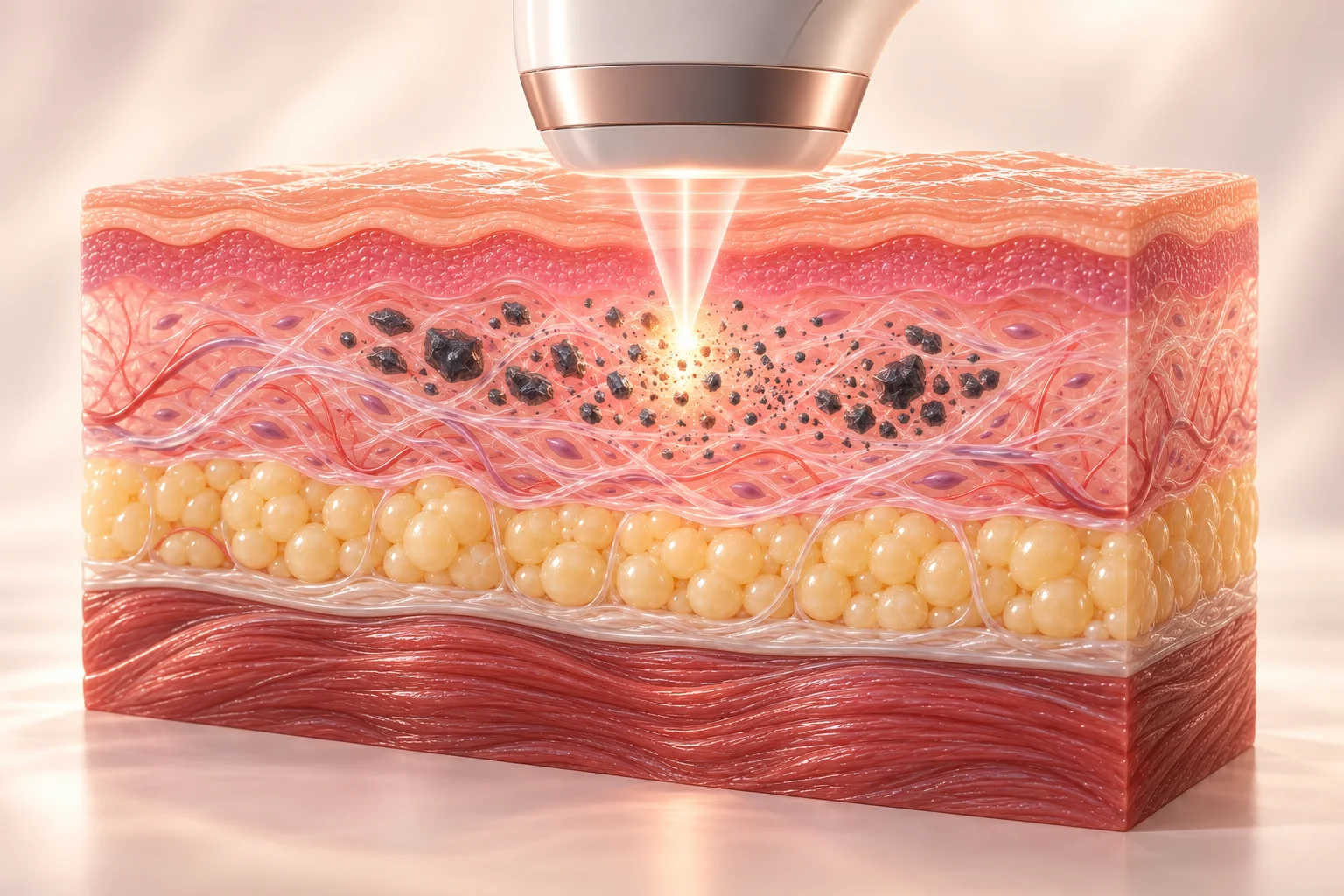
- PicoWay
- PicoSure Pro
- PicoPlus
- Spectra
- Helios III
Devices & products used
- 01PicoWayCandela, USA
A picosecond laser with 532 nm, 730 nm, 785 nm and 1064 nm wavelengths, so different ink colours can be matched to different wavelengths.
- 02PicoSure ProCynosure, USA
A 755 nm picosecond laser; optional 532 nm and 1064 nm add-ons widen the range of ink colours it can address.
- 03PicoPlusLutronic, Korea
Offers 1064 nm (cleared for black, brown, green, blue and purple inks) and 532 nm (red, yellow and orange inks), in picosecond and nanosecond modes.
- 04SpectraLutronic, Korea
A Q-switched (nanosecond) Nd:YAG laser: 1064 nm for dark inks and 532 nm, or 585/650 nm dye handpieces, for lighter colours.
- 05Helios IIILaseroptek, Korea
A Q-switched Nd:YAG laser cleared for blue and black inks at 1064 nm and for red, sky-blue and green inks at 532 nm.
Clinics do not all carry the same devices, products or techniques. Ask which one will be used, by name, before you book.
How it is done, in photos
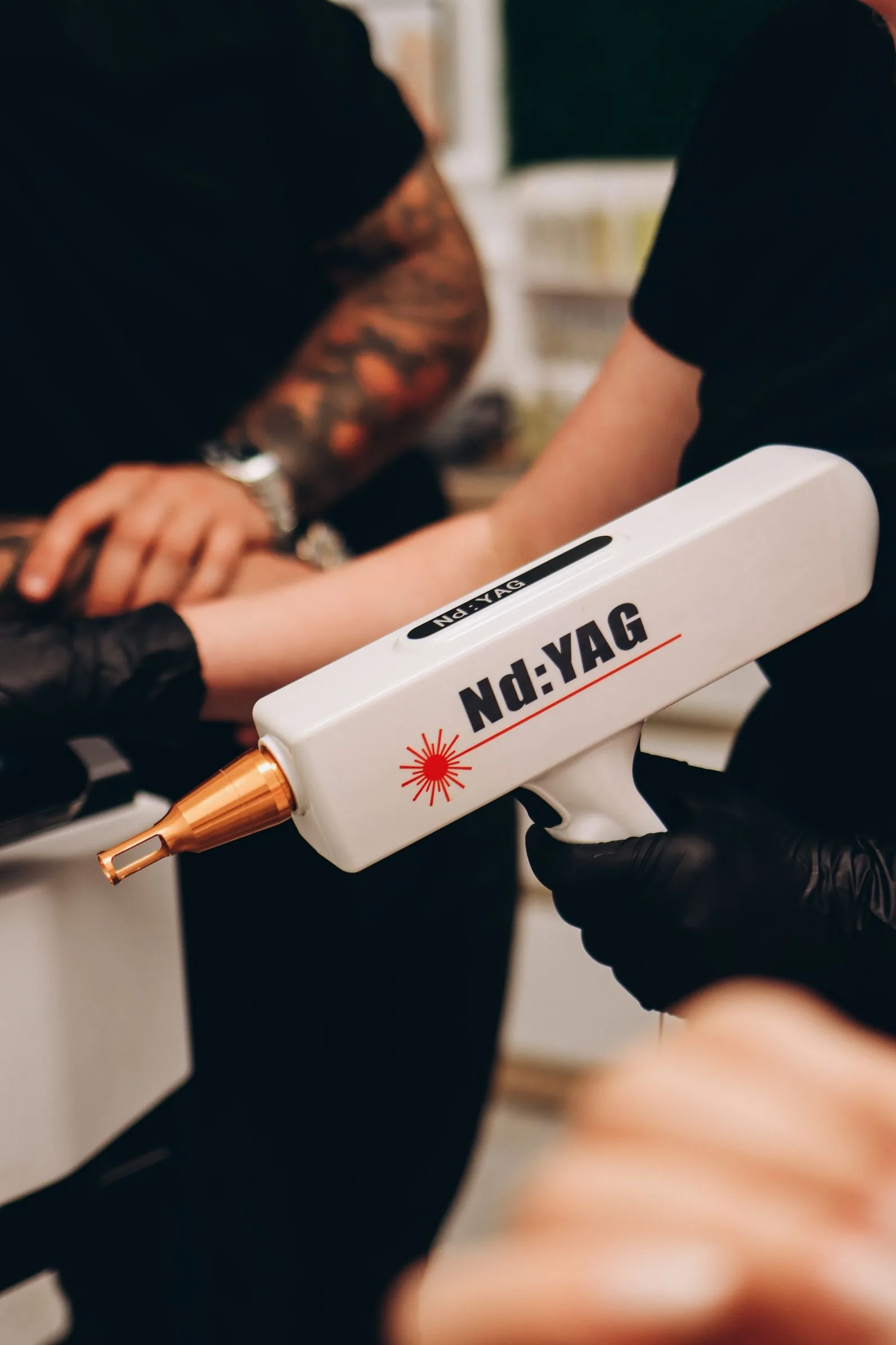
A handheld Nd:YAG laser of the kind used for tattoo removal; removal usually takes a course of several sessions spaced weeks apart.
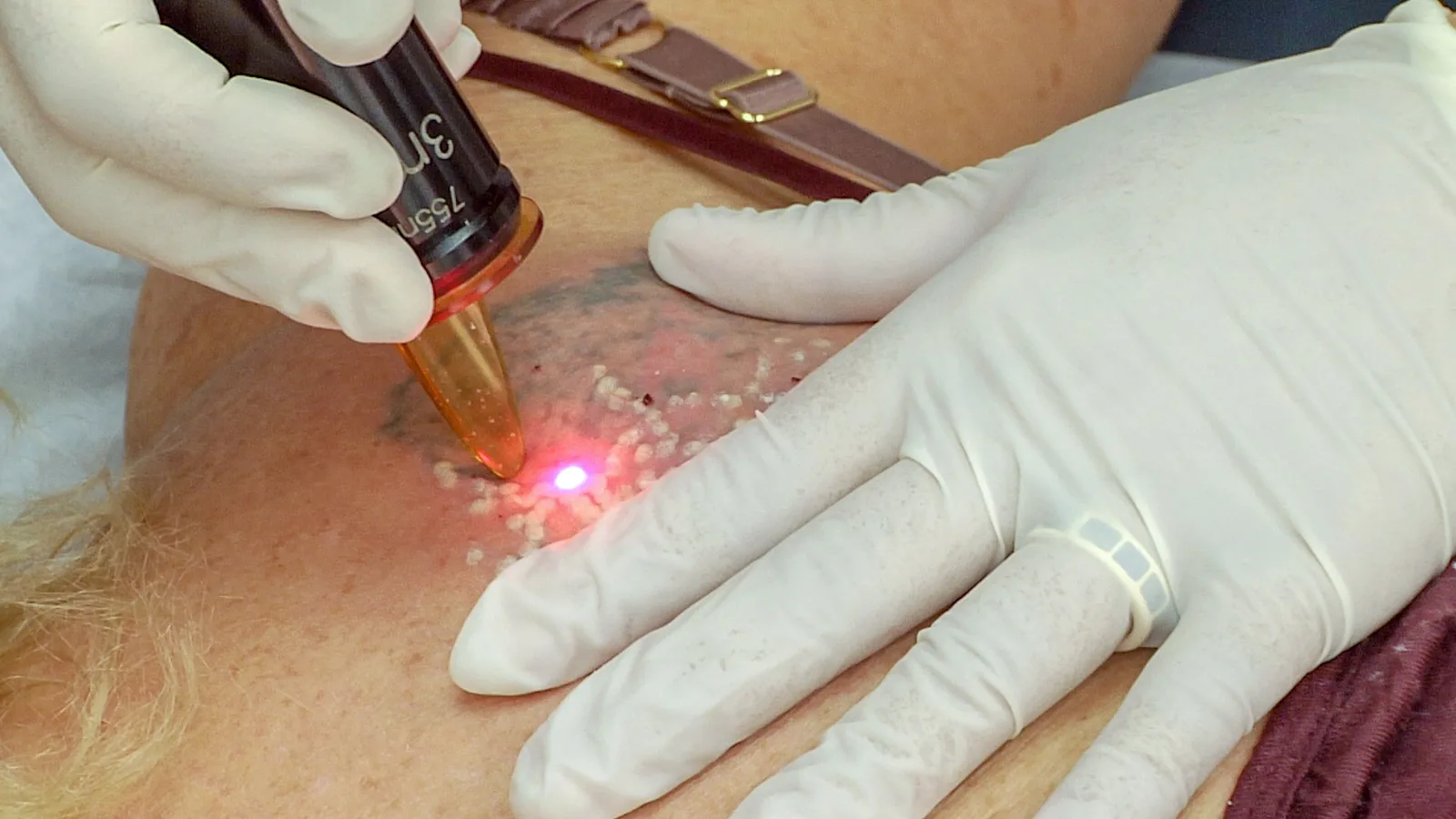
A Q-switched laser handpiece is aimed at the ink, turning the skin briefly white; redness, swelling or a little blistering can follow.
Photo: Amaregenmed (Alice Pien, MD) / CC BY-SA 4.0 / CC BY-SA 4.0 via Wikimedia Commons
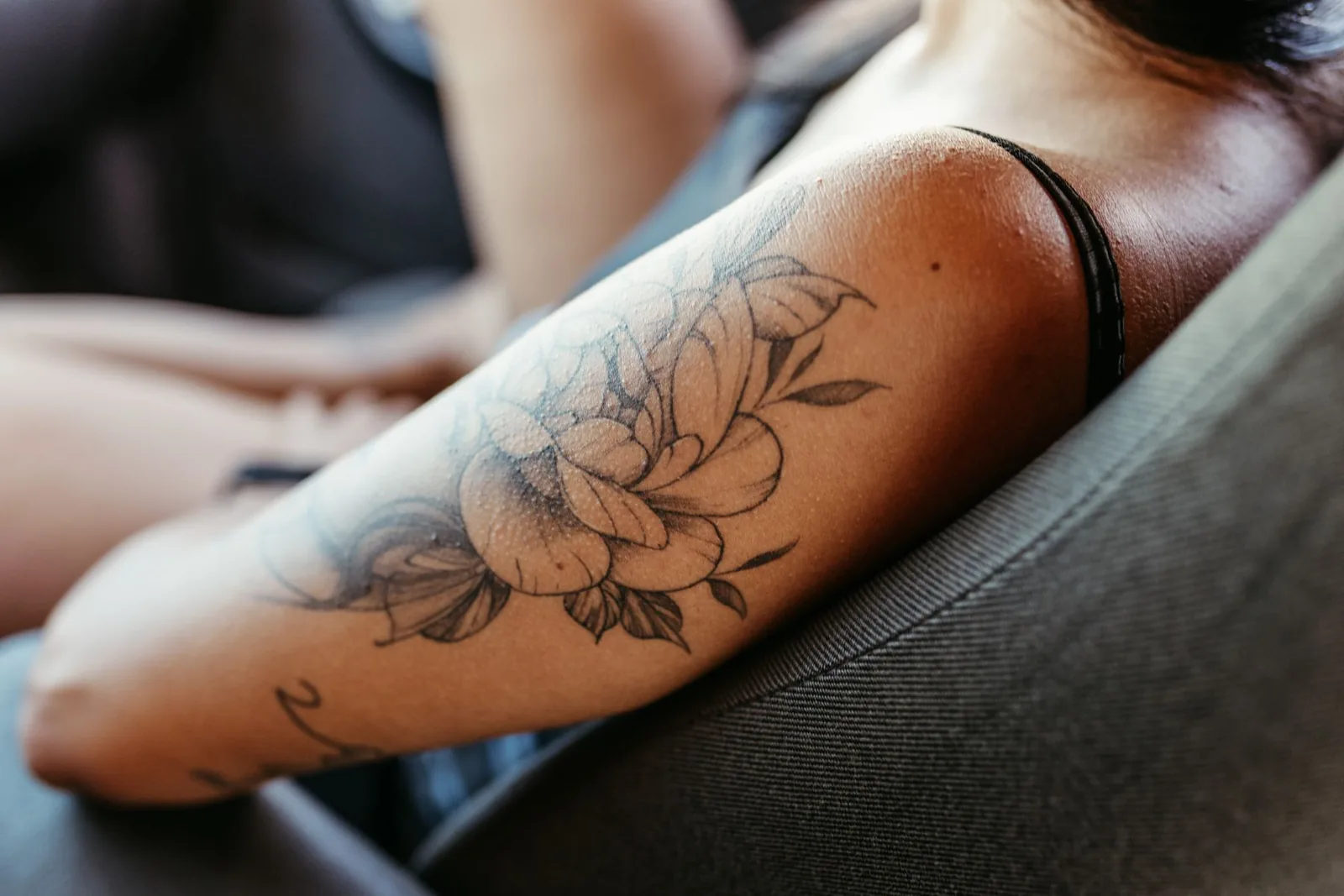
Before removal, the doctor considers the tattoo's age, ink depth and colours, and where it sits on the body.
Device and procedure images are provided by the manufacturers / licensed stock; they do not show COMEDI patients.
At a glance
- How it works
- Very short laser pulses shatter the ink into small particles, which the body's immune system then clears over the following weeks. Q-switched lasers use nanosecond pulses; picosecond lasers use even shorter ones.
- Ink colours
- No single wavelength removes every colour. Black and dark blue respond most readily; green, red and yellow are harder, and skin-coloured, white or permanent make-up inks can turn dark when lasered.
- Anaesthesia
- The sensation is often compared to a thin rubber band snapping against the skin. Numbing cream or a local anaesthetic injection can be given.
- Sessions & interval
- Several sessions are needed, with a few weeks between them so the skin can heal and the body can clear the ink. The number depends on size and colours, and complete removal is not always possible.
- Skin tone notes
- Lighter patches of skin, scarring, redness and soreness are possible. In a US FDA clearance for a picosecond device, 532 nm tattoo removal is listed for skin types I–III and 1064 nm for all skin types.
The type of laser depends on the goal — pigment, redness, texture or hair — and it is often planned as a course rather than one session. Skin tone and the type of pigment change how the skin responds.
Some ink colours and depths do not clear completely, and the long gaps between sessions rarely fit into one trip.
References 7
Real cases
A case only helps when you can see the conditions behind it.
Sign in to see the before & after photos
Free. We use your Google name and email only to answer questions about these cases. Clinic names are shared in your private consultation.
 Before
 After
- Sessions
- 6 sessions (example)
- Combined
- None
- Photo timing
- after 6 sessions (example)
 Before
 After
- Sessions
- 6 sessions (example)
- Combined
- None
- Photo timing
- after 6 sessions (example)
 Before
 After
- Sessions
- 6 sessions (example)
- Combined
- None
- Photo timing
- after 6 sessions (example)
- SessionsOne session, or the result of a course
- CombinedWhether other treatments or surgery were done together
- Photo timingHow long after the procedure the photo was taken
What to ask in a consultation
Questions about whether it suits you and what the alternatives are.
Often considered when
- People with black or blue tattoos. A 2026 systematic review of Nd:YAG lasers found meaningful clearance of black and blue pigment in most studies, generally after 4–8 sessions to reach at least 75% clearance.
- People unhappy with permanent make-up such as lip liner, after a doctor has assessed it. The AAD's guide on laser tattoo removal also speaks to people whose permanent make-up looks less attractive than they imagined, and notes that lasers have largely replaced other tattoo-removal methods.
- People who can plan several visits over a number of months. The AAD advises keeping all appointments, because people too often stop before they see the best result and each treatment removes more ink.
Checks in Korea
- Under Korea's Medical Service Act (Article 27), no one other than a licensed medical professional may perform medical procedures, and no one may have a non-licensed person perform them.
- Under Korean law, a clinic that wants to attract foreign patients must register with the regional government, have at least one specialist for each department it plans to treat foreign patients in (departments that are not among the specialties set by Presidential Decree are excepted), and hold medical malpractice liability insurance or belong to a medical liability mutual aid association. Registration is valid for 3 years from the date of registration.
- Korea's Ministry of Food and Drug Safety runs a medical device information platform (emedi.mfds.go.kr) where information on medical devices, including lasers, can be looked up.
- Q01Is this laser suitable for my skin tone and type of pigment? How does it compare with other options?
- Q02How many sessions fit into a short stay, and how would I continue afterwards?
- Q03Who will perform the treatment, and what is their specialty?
- Q04Which device or product will be used, and is it the original I asked about?
- Q05How many sessions are usually planned, and can they fit into my stay?
- Q06What should I avoid before and after — sun, alcohol, flights, exercise?
- Q07What is included in the written estimate, and what could change after the consultation?
Check these yourself at the consultation
- Ask which lasers and wavelengths the clinic has for the colours in your tattoo, and whether it is a Q-switched or picosecond device.
- Ask how many sessions are expected and how far apart, and plan your travel around the gap of several weeks.
- If the tattoo is cosmetic (eyebrow, lip) or contains white or skin-coloured ink, ask about a test spot because these inks can darken.
Recovery & schedule
Check swelling, daily routine, activity limits and review visits separately.
At a glance
- What the doctor assesses
- The AAD lists what is considered before removal: how long you have had the tattoo, how deep the ink goes, its colours, where it is on the body, your health, the medicines you take and whether you have ever had a raised scar.
- Number of sessions in studies
- In a 2026 systematic review of Nd:YAG lasers, studies generally needed 4–8 sessions to reach at least 75% clearance, ranging from single-session designs to courses of more than 10 sessions. Your own plan depends on your tattoo and is set by the doctor.
- Time between sessions
- In the same review, intervals were most often set at 4–8 weeks, and some studies used longer gaps in the later stages of treatment.
- When change shows
- The AAD says the tattoo should lighten after each treatment. One manufacturer says some people may see initial improvement after the first treatment, but multiple sessions are typically necessary.
- 01Swelling & bruising
The AAD says you may see redness, swelling and a little blistering after a session. One manufacturer also lists pinpoint bleeding, tingling and purplish spots. In a 2026 survey of practitioners, complications reported after removal by trained practitioners included swelling in about 3.0% of treatment sessions, blistering in 1.9% and bruising-type bleeding under the skin (haematoma) in 0.7%.
- 02Back to routine
One manufacturer notes you may need a bandage to keep the area dry for a few days. The AAD says you may need to wash the area and apply an antibiotic ointment for a few days, and to moisturise and cover it until the skin heals.
- 03Activity limits
The AAD advises protecting treated skin from the sun for 3 months, ideally with clothing that blocks light completely. Participants in one clinical study were asked to use SPF 50+ sunscreen on treated areas.
- 04Follow-up & flying home
Studies most often set intervals of 4–8 weeks between sessions, and one clinical study assessed results 6 weeks after the final treatment. Before booking, ask how the remaining sessions could fit your travel plans, for example return visits to Korea or continuing elsewhere, and how progress photos and any reaction will be checked after you fly home.
Published guidance; your own clinic sets the actual plan.
Before your visit day
What clinics ask of international patients, in one place.
- Bring your passportClinics register international patients with their passport, and any estimate or prescription is issued in the name on it.
- Patients under 19Adulthood in Korea starts at 19. For a younger patient, clinics generally ask a parent or legal guardian to consent in writing, and many ask them to attend. Tell us the patient's age when you write, and we check what the clinic needs.
- Coming with someoneA family member or friend can usually join you in the consultation room. Treatment and recovery areas follow each clinic's rules, so we check this before your visit. If more than one person is booking, tell us what each person is interested in.
- Language helpCoordinators reply in English, Japanese, Chinese and Korean. Interpretation on the day is arranged for your dates, and we confirm in writing what it covers before you travel.
- Medicines and allergiesWrite down the medicines you take and any allergies. The clinic asks about both before any treatment.
What changes the price
The same treatment can be quoted differently depending on the items below.
What differs from clinic to clinic
- Picosecond or Q-switched
- Clinics differ in which type they use. A 2026 systematic review found picosecond Nd:YAG systems may achieve similar clearance with fewer sessions or lower energy, but consistent superiority over Q-switched Nd:YAG was not shown, so the device alone does not decide the plan.
- How many wavelengths are on hand
- The AAD notes that a single laser cannot remove all ink colours, and that places using only one laser may leave some ink behind. For a multi-coloured tattoo, which wavelengths a clinic actually has matters.
- Who performs it
- The AAD says results depend almost entirely on the person performing the removal. In a 2026 survey, 87.2% of practitioners had seen clients previously treated by untrained practitioners, and 81.7% of those had observed complications.
- Experience with harder cases
- Practitioners reported complications more often in higher Fitzpatrick skin types, coloured tattoos, permanent make-up and previously treated tattoos. Doctors differ in how much experience they have with cases like these.
- Session spacing and same-day approaches
- Studies most often spaced sessions 4–8 weeks apart, sometimes longer later on. The AAD describes research in which patients safely had 4 laser treatments in 1 day, while noting that more research is needed before such approaches become widely available. How each clinic spaces sessions around your trips is worth comparing.
- Tattoo size and number of colours
- How large the area is and how many ink colours need different wavelengths or handpieces.
- Laser type and wavelengths
- Whether a Q-switched (nanosecond) or picosecond device is used, and which wavelengths are included in the price.
- Pricing basis and sessions
- Whether the quote is per session, per area or a package, and how many sessions it covers.
- Pain control
- Whether numbing cream or a local anaesthetic injection is used, and whether it costs extra.
- Test spot for cosmetic or light inks
- For permanent make-up or white, pink or skin-coloured ink, whether a test spot is done first and charged separately.
- Aftercare supplies and review
- Whether ointment and dressings are supplied, and whether progress photos or a review between trips are included.
- Device & method
- Which laser is used and how it is applied
- Area & size
- Size and number of treated areas
- Sessions
- Recommended sessions, price per session and any package terms
- Numbing & care
- Numbing cream and soothing or recovery care
Prices are set by the clinic after a consultation. Ask for an itemised, written estimate before you book, and check what is included and what could change.
Often charged separately
Ask whether each of these is in your estimate.
| Item | What to ask |
|---|---|
| Consultation fee | Whether the consultation is charged, and whether that amount comes off the treatment price. |
Clinics in Korea build a treatment estimate from the area, the amount used or the number of sessions.
The final figure is set after the doctor sees you at the consultation.
Ask for an itemised, written estimate that marks each item above as included or not, so you can compare two quotes on the same basis.
VAT before you compare quotes
The VAT refund for foreign visitors' cosmetic procedures covered only procedures received by 31 December 2025, so procedures received now are not refunded. Plan your budget without it, and ask each clinic whether VAT is included in the written quote so you compare the same total.
Ask COMEDI, for example
Clinics in Seoul differ in equipment, technique, specialist focus and what the price includes. Send us your question and we compare partner clinics for you.
- “My tattoo has black, red and green ink. Which partner clinics have the wavelengths for these colours, and is it a picosecond or Q-switched device?”
- “I can visit Korea twice a year. How would each clinic space my sessions, and can I continue the rest at home?”
- “I want to remove an eyebrow or lip tattoo. Which clinics do a test spot first?”
- “I have darker skin. Which clinics have doctors experienced in tattoo removal on skin like mine?”
Precautions & aftercare
General information. Follow the written instructions from your treating doctor for anything specific to you.
Side effects and precautions for Tattoo removal are in one place at the top of this page.
Aftercare for this procedure
- If crusts form, do not pick at them. A review advises an emollient or topical antibiotic in that case; use what the clinic prescribes.
- Moisturise and keep the area covered until the skin heals, as the AAD advises.
- When covering treated skin from the sun, choose clothing that blocks light completely. The AAD shows that white and yellow shirts can let light shine through.
- Keep to the planned schedule. The AAD notes that people too often stop before they see the best result.
- Do not use tattoo-removal creams or DIY kits between sessions. The FDA has not approved them and warns they may cause rashes, burns or scars.
- Tell the clinic about recent tanning, medicines that increase light sensitivity, possible pregnancy, keloid tendency and skin conditions.
- Contact the clinic if pigment darkens or lightens, or if blisters or severe pain appear.
- Keep up sun protection for as long as the clinic advises.
Information only. Suitability, risks, recovery and price are assessed by the treating doctor in a consultation.
Sources for this section 10
- Laser tattoo removal (Tattoo removal: Lasers outshine other methods) — American Academy of Dermatology
- Tattoo Removal: Options and Results — US FDA
- Practitioner-Reported Complications in Tattoo Removal (Dermatology 2026) — PMC
- Efficacy of Nd:YAG Lasers for Tattoo Removal: Systematic Review of Clinical Outcomes, Clearance Rates, and Treatment Parameters (J Cosmet Dermatol 2026) — PMC
- Complications of Tattoos and Tattoo Removal: Stop and Think Before you ink (J Cutan Aesthet Surg 2015) — PMC
- A Multi-Center Pilot Study of a Novel Multi-Wavelength Laser for Tattoo Removal (NCT03290547, Cutera) — ClinicalTrials.gov
- PicoWay (patient information) — Candela
- 의료법 제27조(무면허 의료행위 등 금지) — 국가법령정보센터
- 의료 해외진출 및 외국인환자 유치 지원에 관한 법률 제6조 — 국가법령정보센터
- 의료기기안심책방 (의료기기 종합정보 플랫폼) — 식품의약품안전처
Related questions & guides
Worth reading alongside this page.
Notes from people who used COMEDI
Written after a consultation we arranged, and matched to that request.
Common questions
How much does Tattoo removal cost in Korea?+
Prices are set by each clinic after a consultation and depend on the technique, area and your needs. Ask for an itemised, written estimate before you book — it should list what is included and what could change. We help you request and compare estimates.
Can foreigners get Tattoo removal in Korea?+
Yes. Many Seoul clinics see international patients. We help with clinic information, consultations in your language, written estimates and interpretation on the day.