
Thread lift
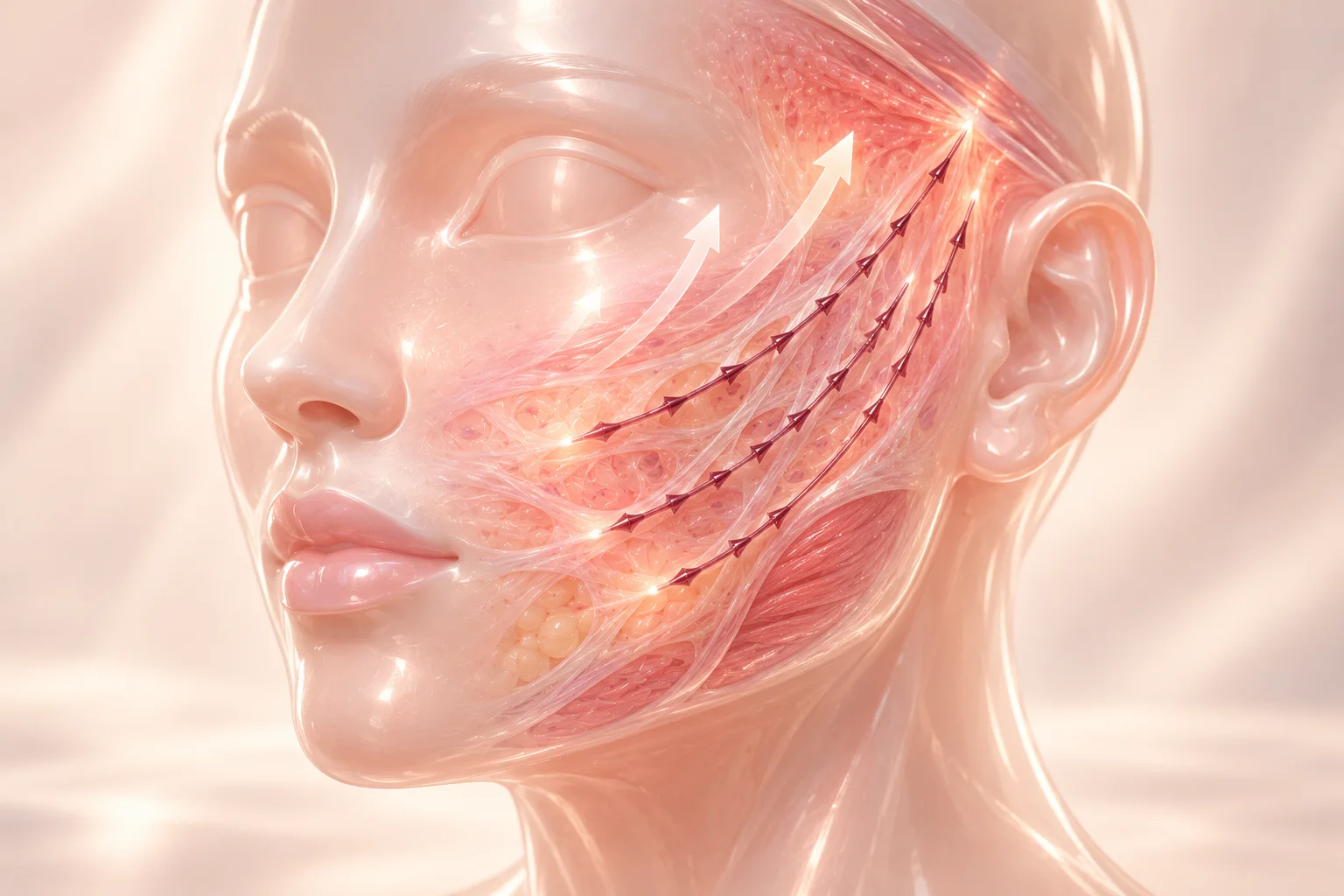
Dissolvable threads are placed under the skin through small entry points to reposition soft tissue on the face.

- Type
- Non-surgical
- Usually by
- Dermatologist
- Category
- Lifting & tightening
- First step
- Consultation
Information only. Suitability, risks, recovery and price are assessed by the treating doctor in a consultation.
Side effects and precautionsWhat to know about Thread lift before you book15
Reactions that usually settle, signs to tell the clinic about straight away, and times to wait. Your doctor goes through the risks that apply to you at the consultation.
Usually settles on its own
- Swelling and bruising — swelling was the most often reported reaction in a pooled analysis of 26 studies (about 35%).
- Irritation and discomfort at the entry points in early healing.
- Difficulty opening the mouth, which ASPS describes as usually temporary.
- Mild skin dimpling — in published reports mild cases settled without treatment or after gentle massage.
Tell the clinic promptly
- Infection, which in published reports was treated with antibiotics and sometimes thread removal — contact the clinic if you suspect it.
- A thread end showing through or coming out of the skin (extrusion).
- A thread that can be seen or felt under the skin, or dimpling that does not settle.
- Pain that persists, numbness or altered sensation.
- Sensitivity to sun or bright light, or an uneven or unfavourable result.
Wait or rethink when
- Known or suspected allergy or foreign-body sensitivity to the thread or instrument materials, in particular plastic biomaterials (this and the items below are from the labelling of one FDA-cleared absorbable thread, Silhouette InstaLift; other threads carry their own labels).
- Very thin facial soft tissue in which the thread may be visible or felt under the skin (same thread's labelling).
- Active sepsis or infection (same thread's labelling).
- Active autoimmune disease, or a history of it (same thread's labelling).
- Pregnancy or breastfeeding, or being under 18 (same thread's labelling).
- Being unable or unwilling to follow the aftercare instructions (same thread's labelling).
Sources for this section 13
- Thread Lift Risks and Safety — American Society of Plastic Surgeons
- Niu Z et al. A Meta-Analysis and Systematic Review of the Incidences of Complications Following Facial Thread-Lifting — Aesthetic Plastic Surgery 2021
- Zhukova O et al. A New Complex Minimally Invasive Thread Lift Method for One-Time Three-Step Fixation of the Face and Neck Soft Tissues — Archives of Plastic Surgery 2022
- Wang CK. Complications of thread lift about skin dimpling and thread extrusion — Dermatologic Therapy 2020
- Li YL et al. Facial Thread Lifting Complications in China: Analysis and Treatment — Plastic and Reconstructive Surgery Global Open 2021
- Thread Lift — American Society of Plastic Surgeons
- Thread Lift Recovery — American Society of Plastic Surgeons
- Thread Lift Results — American Society of Plastic Surgeons
- Thread Lift Preparation — American Society of Plastic Surgeons
- Thread Lift Procedure Steps — American Society of Plastic Surgeons
- Silhouette InstaLift Absorbable Thread, Important Safety Considerations — Tiger Aesthetics (US distributor)
- Hong GW et al. Basic concepts in facial and neck thread lifting procedures — Skin Research and Technology 2024
- Foreign Patient Attraction Information System (MEDICALKOREA) — Korea Health Industry Development Institute
What is it?
The purpose, the change you can expect and the limits.
Dissolvable threads are placed under the skin through small entry points to reposition soft tissue on the face.
PDO · PCL threads
- MINT
- Silhouette Soft / Silhouette InstaLift
Devices & products used
- 01MINTHansBiomed, Korea
A PDO (polydioxanone) thread whose barbs are press-moulded onto the surface in a spiral pattern rather than cut into the thread; it holds US FDA clearances.
- 02Silhouette Soft / Silhouette InstaLiftSinclair Pharma
A suspension suture that grips tissue with small cones instead of barbs; the US-registered version is an absorbable L-lactide/glycolide thread carrying two sets of cones.
- 03PCL threads
Threads made of polycaprolactone, which the body absorbs more slowly than PDO (roughly 1 to 1.5 years in a published study).
Clinics do not all carry the same devices, products or techniques. Ask which one will be used, by name, before you book.
At a glance
- How it works
- Absorbable threads with barbs or cones are passed under the skin to reposition tissue straight away. As they dissolve, they prompt new collagen around them.
- Thread material
- Common materials are PDO, PLLA and PCL. In a published study they were absorbed in about 6–8 months, about 12 months and 1–1.5 years respectively.
- Anaesthesia
- Local anaesthesia. Small entry points are made rather than full incisions.
- Session time
- About one hour (manufacturer's figure for a MINT lift).
- How long it lasts
- Lift is visible straight away and settles as swelling goes down. The MINT manufacturer states results last up to a year; this varies with the thread and the person.
Changes in firmness and contour often appear gradually rather than straight after the session. How much changes, and for how long, depends on skin thickness, the degree of laxity and the device used.
Results are temporary, and surgery may suit better when there is a lot of excess skin.
References 5
Real cases
A case only helps when you can see the conditions behind it.
Sign in to see the before & after photos
Free. We use your Google name and email only to answer questions about these cases. Clinic names are shared in your private consultation.
 Before
 After
- Sessions
- One procedure (example)
- Combined
- None
- Photo timing
- 1 month after (example)
 Before
 After
- Sessions
- One procedure (example)
- Combined
- None
- Photo timing
- 1 month after (example)
 Before
 After
- Sessions
- One procedure (example)
- Combined
- None
- Photo timing
- 1 month after (example)
- SessionsOne session, or the result of a course
- CombinedWhether other treatments or surgery were done together
- Photo timingHow long after the procedure the photo was taken
What to ask in a consultation
Questions about whether it suits you and what the alternatives are.
Often considered when
- Early loosening of the face, such as beginning jowls or a lower jawline that has started to soften.
- Sagging eyebrows or early loosening of the skin of the neck.
- People who want a firmer look without the incisions and longer downtime of a surgical facelift.
- People who want natural-looking results and firmer skin.
Checks in Korea
- Korea's Foreign Patient Attraction Information System (MEDICALKOREA), run by the Korea Health Industry Development Institute, lets the public search registered medical institutions and facilitators by name, region and registration status.
- Q01Is this treatment right for my degree of laxity? If not, what are the alternatives?
- Q02When should I expect to see a change, and how far apart would repeat sessions be?
- Q03Who will perform the treatment, and what is their specialty?
- Q04Which device or product will be used, and is it the original I asked about?
- Q05How many sessions are usually planned, and can they fit into my stay?
- Q06What should I avoid before and after — sun, alcohol, flights, exercise?
- Q07What is included in the written estimate, and what could change after the consultation?
Check these yourself at the consultation
- Ask the brand and material of the thread (PDO, PLLA or PCL) and how many threads will be placed on each side.
- Ask to see the sealed thread packs and their labels before they are opened.
- Ask for the thread brand and number used to be written on your treatment record.
Recovery & schedule
Check swelling, daily routine, activity limits and review visits separately.
At a glance
- Entry points
- There are no real incisions, only small entry points for the threads; according to ASPS these are usually invisible after a few days.
- When the change settles
- ASPS describes the result appearing gradually as swelling and bruising subside, becoming apparent after a few weeks. Timing differs from person to person.
- Repeat treatment
- ASPS notes there is no guarantee, and in some cases one procedure is not enough and another may be needed. Ageing also continues after the lift.
- Satisfaction over time
- A 2021 pooled analysis of 26 studies found satisfaction was lower in the long term than straight after the procedure (88% vs 98%), and advised discussing this fading effect before treatment.
- Age and thread type
- In the same analysis, people older than 50 had higher rates of dimpling and infection, and non-absorbable threads had higher rates of paresthesia (altered skin sensation) and thread extrusion than absorbable ones.
- 01Swelling & bruising
ASPS lists swelling, bruising, irritation and discomfort in early healing, eased with medication, cold compresses and ointment. In one study of 357 patients, bruising lasted up to about 2 weeks and swelling about 5–7 days.
- 02Back to routine
According to ASPS, most people are presentable in public within 3–5 days, though final healing may take a few weeks.
- 03Activity limits
ASPS advises that the treated area should not be subjected to excessive force, rubbing or movement while it heals. Ask your doctor when you can return to exercise and other normal activity.
- 04Follow-up & flying home
Published reports describe dimpling being eased by massage and visible or extruding threads being removed. Ask whether a check-up is possible before your flight and how the clinic follows up once you are home.
Published guidance; your own clinic sets the actual plan.
Before your visit day
What clinics ask of international patients, in one place.
- Bring your passportClinics register international patients with their passport, and any estimate or prescription is issued in the name on it.
- Patients under 19Adulthood in Korea starts at 19. For a younger patient, clinics generally ask a parent or legal guardian to consent in writing, and many ask them to attend. Tell us the patient's age when you write, and we check what the clinic needs.
- Coming with someoneA family member or friend can usually join you in the consultation room. Treatment and recovery areas follow each clinic's rules, so we check this before your visit. If more than one person is booking, tell us what each person is interested in.
- Language helpCoordinators reply in English, Japanese, Chinese and Korean. Interpretation on the day is arranged for your dates, and we confirm in writing what it covers before you travel.
- Medicines and allergiesWrite down the medicines you take and any allergies. The clinic asks about both before any treatment.
What changes the price
The same treatment can be quoted differently depending on the items below.
What differs from clinic to clinic
- Thread design
- Threads grip tissue in different ways, for example with barbs or with small cones made of an absorbable copolymer. Which design a clinic stocks shapes what it can offer.
- Lifting pattern
- Doctors place threads in different configurations (described in the literature as I-, U- and V-type) and choose fixing points according to the tissue, not only the direction of pull.
- Fixation method
- One published technique fixes barbed threads in the main ligaments of the upper, middle and lower face and the neck in three steps during a single procedure.
- Absorbable or not
- Pooled data show non-absorbable threads carried higher rates of paresthesia (altered skin sensation) and extrusion than absorbable ones, so it is worth confirming which kind a clinic uses.
- Plan for corrections
- Dimpling and visible threads are handled by massage, subcision or thread removal in published reports, so how a clinic handles them for a visitor who flies home soon differs.
- Thread type & count
- Which thread (barbed, moulded or cone type; PDO, PCL or other) and how many threads per side.
- Treatment areas
- Mid-face, jawline, brow or neck, and whether both sides are included.
- Medication & aftercare
- Antibiotic ointment, oral medication and cold compresses after the procedure.
- Adjustment & removal
- What happens if dimpling, a visible thread or extrusion needs adjusting or removing, and whether it costs extra.
- Review visits
- How many check-ups are included before you fly and whether remote follow-up is offered.
- Device & tip
- Whether the device is the original, and which tip or cartridge is used
- Shots & energy
- Number of shots or energy delivered, and the areas covered
- Pain control
- Numbing cream, sedation or other options
- Add-ons & care
- Combined treatments, soothing care and review visits
Prices are set by the clinic after a consultation. Ask for an itemised, written estimate before you book, and check what is included and what could change.
Often charged separately
Ask whether each of these is in your estimate.
| Item | What to ask |
|---|---|
| Consultation fee | Whether the consultation is charged, and whether that amount comes off the treatment price. |
Clinics in Korea build a treatment estimate from the area, the amount used or the number of sessions.
The final figure is set after the doctor sees you at the consultation.
Ask for an itemised, written estimate that marks each item above as included or not, so you can compare two quotes on the same basis.
VAT before you compare quotes
The VAT refund for foreign visitors' cosmetic procedures covered only procedures received by 31 December 2025, so procedures received now are not refunded. Plan your budget without it, and ask each clinic whether VAT is included in the written quote so you compare the same total.
Ask COMEDI, for example
Clinics in Seoul differ in equipment, technique, specialist focus and what the price includes. Send us your question and we compare partner clinics for you.
- “Which partner clinics use absorbable threads, and which brand and type would they suggest for my jawline?”
- “How many threads per side would be included in each quote?”
- “Can the clinic check me again before my flight, and what happens if a thread needs adjusting after I am home?”
- “Can I compare a thread lift with a non-surgical device lift for my degree of sagging?”
Precautions & aftercare
General information. Follow the written instructions from your treating doctor for anything specific to you.
Side effects and precautions for Thread lift are in one place at the top of this page.
Aftercare for this procedure
- Before the procedure, you may be asked to stop smoking and to avoid aspirin, anti-inflammatory drugs and herbal supplements, which can increase bleeding and bruising.
- Apply the antibiotic ointment to the entry points if your doctor prescribes it.
- Use cold compresses as your doctor instructs.
- Protect your face from the sun carefully and wear darkly tinted sunglasses until healing is complete.
- Avoid pressing, rubbing or strongly moving the treated area while it heals.
- Tell the clinic about skin conditions, possible pregnancy, keloid tendency, medicines, and any fillers, threads or implants in your face.
- Contact the clinic promptly if pain, blisters or altered sensation continue after the session.
- Follow the clinic's advice on sun protection and moisturising.
Information only. Suitability, risks, recovery and price are assessed by the treating doctor in a consultation.
Sources for this section 13
- Thread Lift — American Society of Plastic Surgeons
- Thread Lift Risks and Safety — American Society of Plastic Surgeons
- Thread Lift Recovery — American Society of Plastic Surgeons
- Thread Lift Results — American Society of Plastic Surgeons
- Thread Lift Preparation — American Society of Plastic Surgeons
- Thread Lift Procedure Steps — American Society of Plastic Surgeons
- Silhouette InstaLift Absorbable Thread, Important Safety Considerations — Tiger Aesthetics (US distributor)
- Niu Z et al. A Meta-Analysis and Systematic Review of the Incidences of Complications Following Facial Thread-Lifting — Aesthetic Plastic Surgery 2021
- Hong GW et al. Basic concepts in facial and neck thread lifting procedures — Skin Research and Technology 2024
- Zhukova O et al. A New Complex Minimally Invasive Thread Lift Method for One-Time Three-Step Fixation of the Face and Neck Soft Tissues — Archives of Plastic Surgery 2022
- Wang CK. Complications of thread lift about skin dimpling and thread extrusion — Dermatologic Therapy 2020
- Li YL et al. Facial Thread Lifting Complications in China: Analysis and Treatment — Plastic and Reconstructive Surgery Global Open 2021
- Foreign Patient Attraction Information System (MEDICALKOREA) — Korea Health Industry Development Institute
Related questions & guides
Worth reading alongside this page.
Notes from people who used COMEDI
Written after a consultation we arranged, and matched to that request.
Common questions
How much does Thread lift cost in Korea?+
Prices are set by each clinic after a consultation and depend on the technique, area and your needs. Ask for an itemised, written estimate before you book — it should list what is included and what could change. We help you request and compare estimates.
Can foreigners get Thread lift in Korea?+
Yes. Many Seoul clinics see international patients. We help with clinic information, consultations in your language, written estimates and interpretation on the day.