
Mole& lesion removal
Removal of benign moles, warts, skin tags and seborrhoeic keratoses after a doctor has examined them.

- Type
- Non-surgical
- Usually by
- Dermatologist
- Category
- Laser & pigment
- First step
- Consultation
Information only. Suitability, risks, recovery and price are assessed by the treating doctor in a consultation.
Side effects and precautionsWhat to know about Mole & lesion removal before you book12
Reactions that usually settle, signs to tell the clinic about straight away, and times to wait. Your doctor goes through the risks that apply to you at the consultation.
Usually settles on its own
- Redness and swelling, which one department found settled within hours or days with newer lower-power CO2 systems
- Darker or red skin over the treated area in coloured skin; a CO2 laser guideline describes this as temporary, lasting about six weeks and gradually improving
- Temporary scarring or darkening after skin tag removal, which the NHS says is usually temporary, particularly on black or brown skin
Tell the clinic promptly
- Infection (viral, bacterial or yeast), delayed lightening of the skin, redness that does not fade, and slow healing, which a CO2 laser guideline lists as more serious complications
- Keloids or raised scars, reported in about 1% of treatments in one department's 30-year experience, with the low rate seen above all at lower settings
- Scarring or darkening after skin tag removal that becomes permanent, which the NHS says can sometimes happen
- Regrowth with atypical-looking cells: a 2014 review notes reports of atypical cells under the microscope, called 'pseudomelanoma', in moles treated with CO2 lasers, and says benign-looking moles that come back after laser treatment may show new atypical features. Show any regrowth to a dermatologist.
Wait or rethink when
- Isotretinoin (an acne medicine) taken within the previous six months. A CO2 laser guideline lists this as a contraindication.
- An active bacterial or viral skin infection in the area to be treated, which the same guideline lists as a contraindication.
- A history of keloids or raised (hypertrophic) scars, also listed as a contraindication in the guideline.
- Ongoing sun (ultraviolet) exposure, previous radiation therapy to the area, or a collagen vascular disease, all listed as contraindications in the guideline.
- A mole that has changed size, shape or colour, or that is painful, itchy, inflamed, bleeding or crusty. The NHS advises seeing a doctor about a mole like this.
Sources for this section 11
- Carbon dioxide laser guidelines (J Cutan Aesthet Surg 2009) — PMC
- Highlights of thirty-year experience of CO2 laser use at the Florence (Italy) Department of Dermatology (Sci World J 2012) — PMC
- Skin tags — NHS
- Optimal management of common acquired melanocytic nevi (moles): current perspectives (Clin Cosmet Investig Dermatol 2014) — PMC
- Moles: Diagnosis and treatment — American Academy of Dermatology
- Aesthetic techniques for melanocytic nevus management: systematic review and meta-analysis (Front Med 2026) — PMC
- Carbon dioxide laser versus erbium:YAG laser in treatment of epidermal verrucous nevus: a comparative randomized clinical study (J Dermatolog Treat 2017) — PubMed
- Moles — NHS
- 의료 해외진출 및 외국인환자 유치 지원에 관한 법률 제6조 — 국가법령정보센터
- 의료법 제27조(무면허 의료행위 등 금지) — 국가법령정보센터
- 의료기기안심책방 (의료기기 종합정보 플랫폼) — 식품의약품안전처
What is it?
The purpose, the change you can expect and the limits.
Removal of benign moles, warts, skin tags and seborrhoeic keratoses after a doctor has examined them.
CO2 laser removal · skin tags
- UltraPulse
- eCO2
- Sciton Er:YAG (ZoomScan)
Devices & products used
- 01UltraPulseLumenis, Israel
A CO2 laser with fine handpieces (down to 0.2 mm) for controlled removal of small areas of tissue.
- 02eCO2Lutronic, Korea
A 10.6 µm CO2 laser cleared in the US for ablation, resurfacing and coagulation of soft tissue in dermatology.
- 03Sciton Er:YAG (ZoomScan)Sciton, USA
A 2940 nm erbium:YAG laser that removes tissue in thin, adjustable layers with little heat spread.
Clinics do not all carry the same devices, products or techniques. Ask which one will be used, by name, before you book.
How it is done, in photos
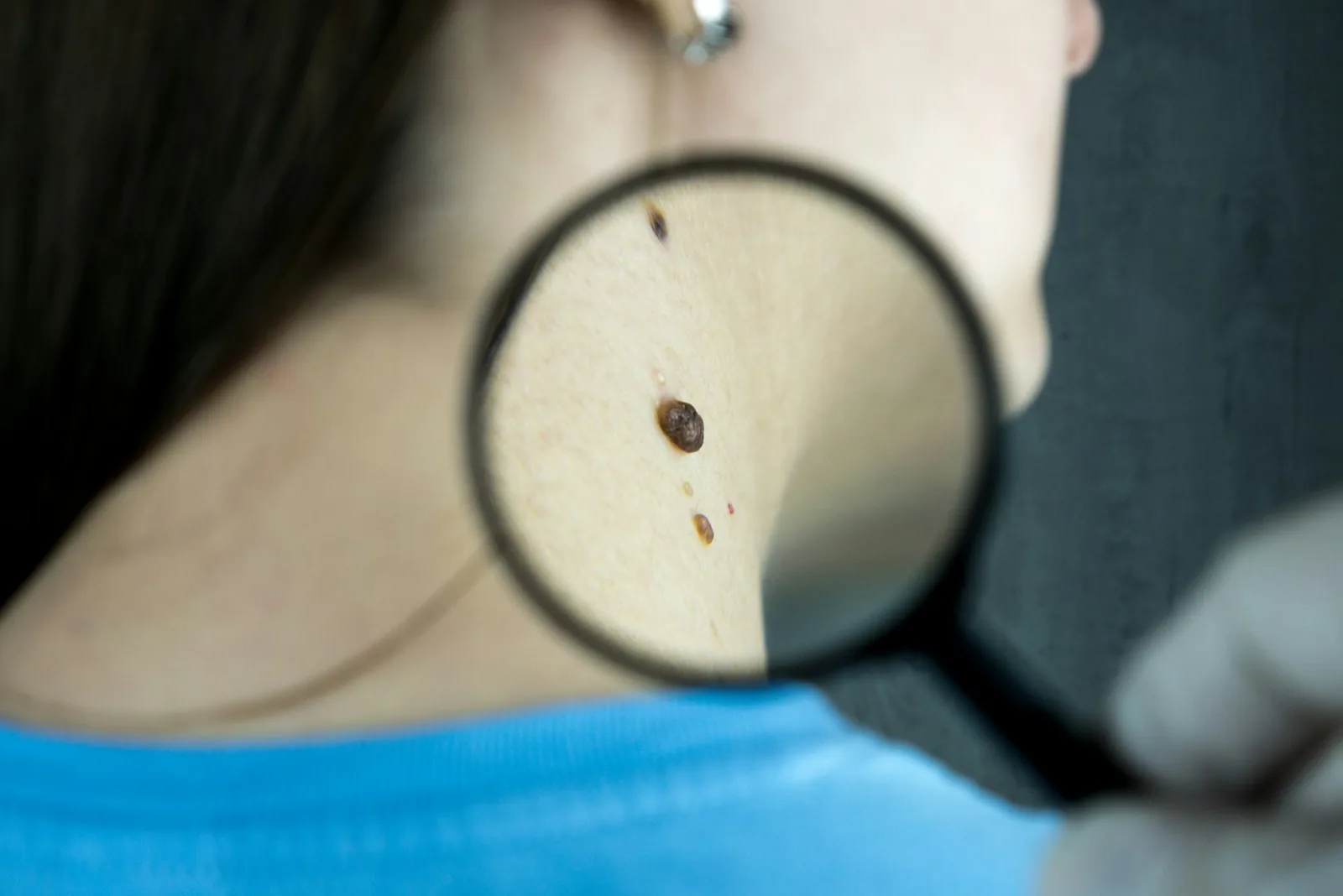
Before any removal is planned, a mole on the neck is examined closely under a magnifying glass to check its size and colour.
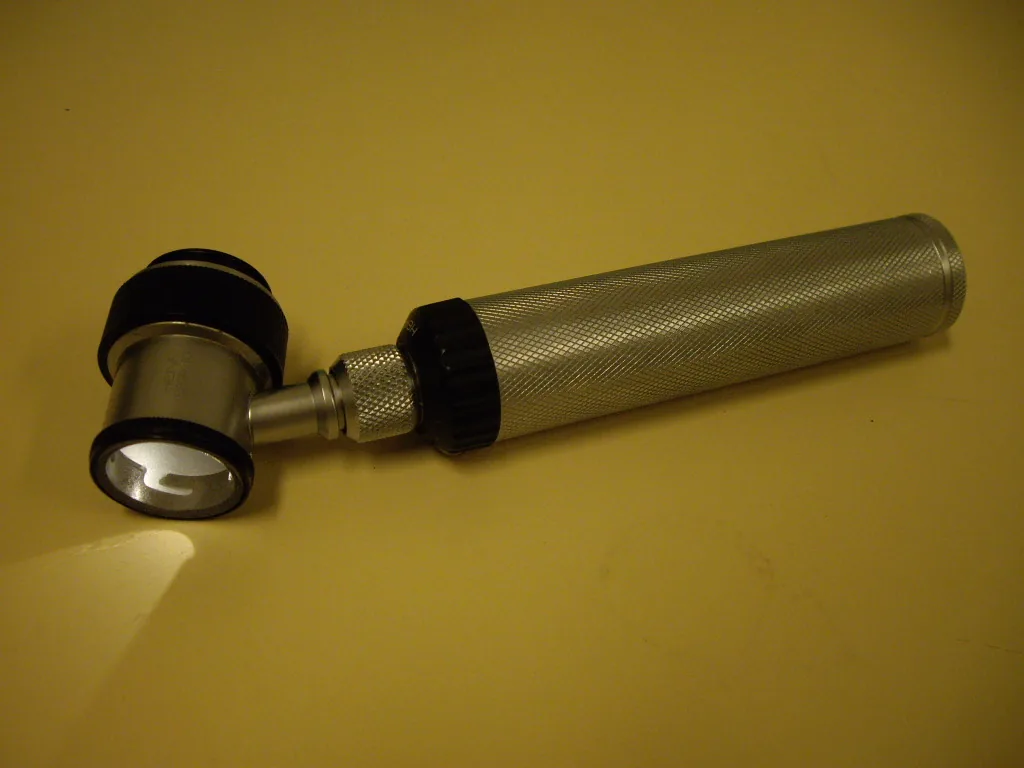
A handheld dermatoscope, a lighted magnifier that doctors use to look closely at a mole on the skin surface before treatment.
Photo: Frank33 / CC BY-SA 3.0 (Wikimedia Commons) / CC BY-SA 3.0 via Wikimedia Commons
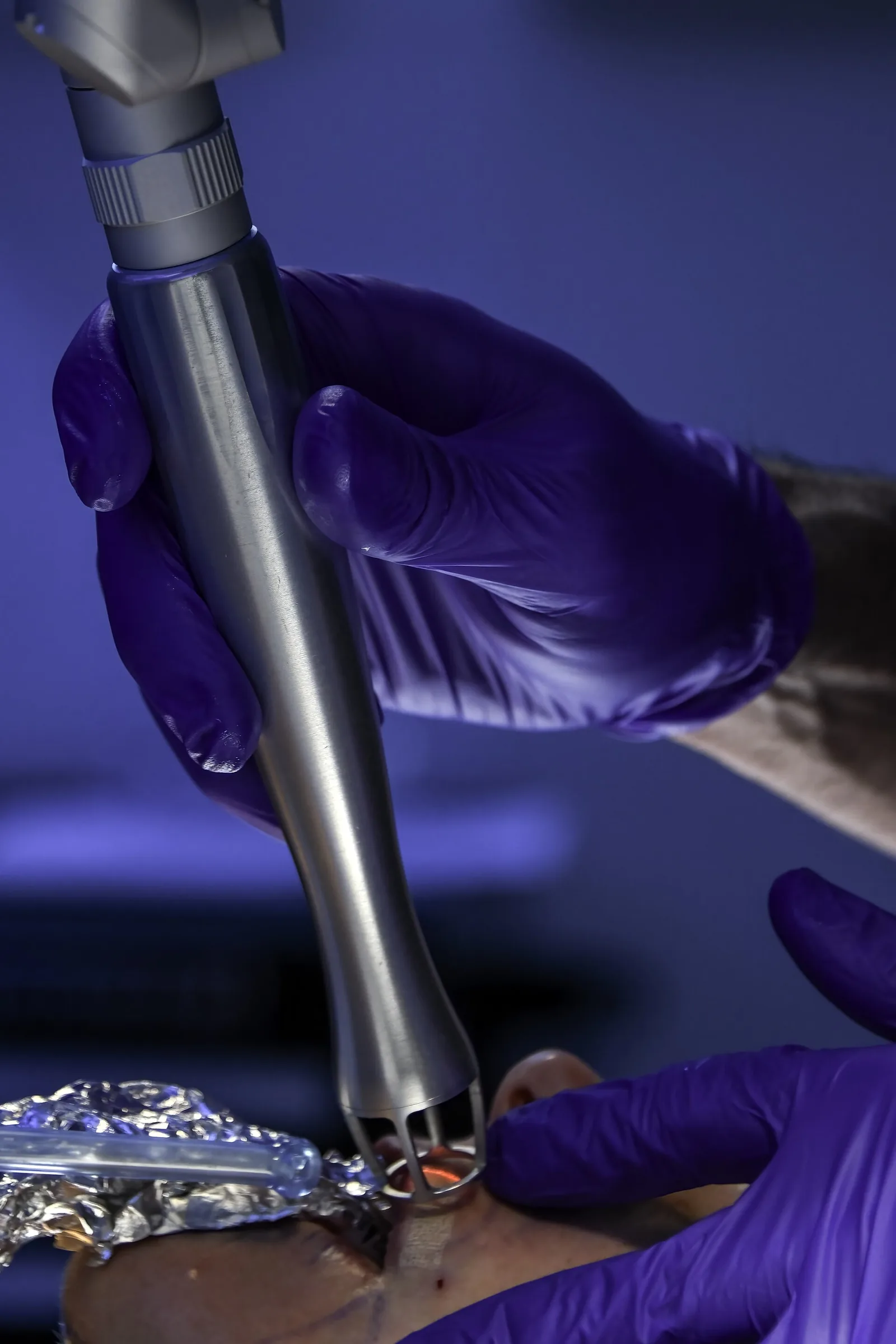
A laser handpiece is held just above the skin while foil shields the surrounding area; most mole removals need only one office visit.
Device and procedure images are provided by the manufacturers / licensed stock; they do not show COMEDI patients.
At a glance
- How it works
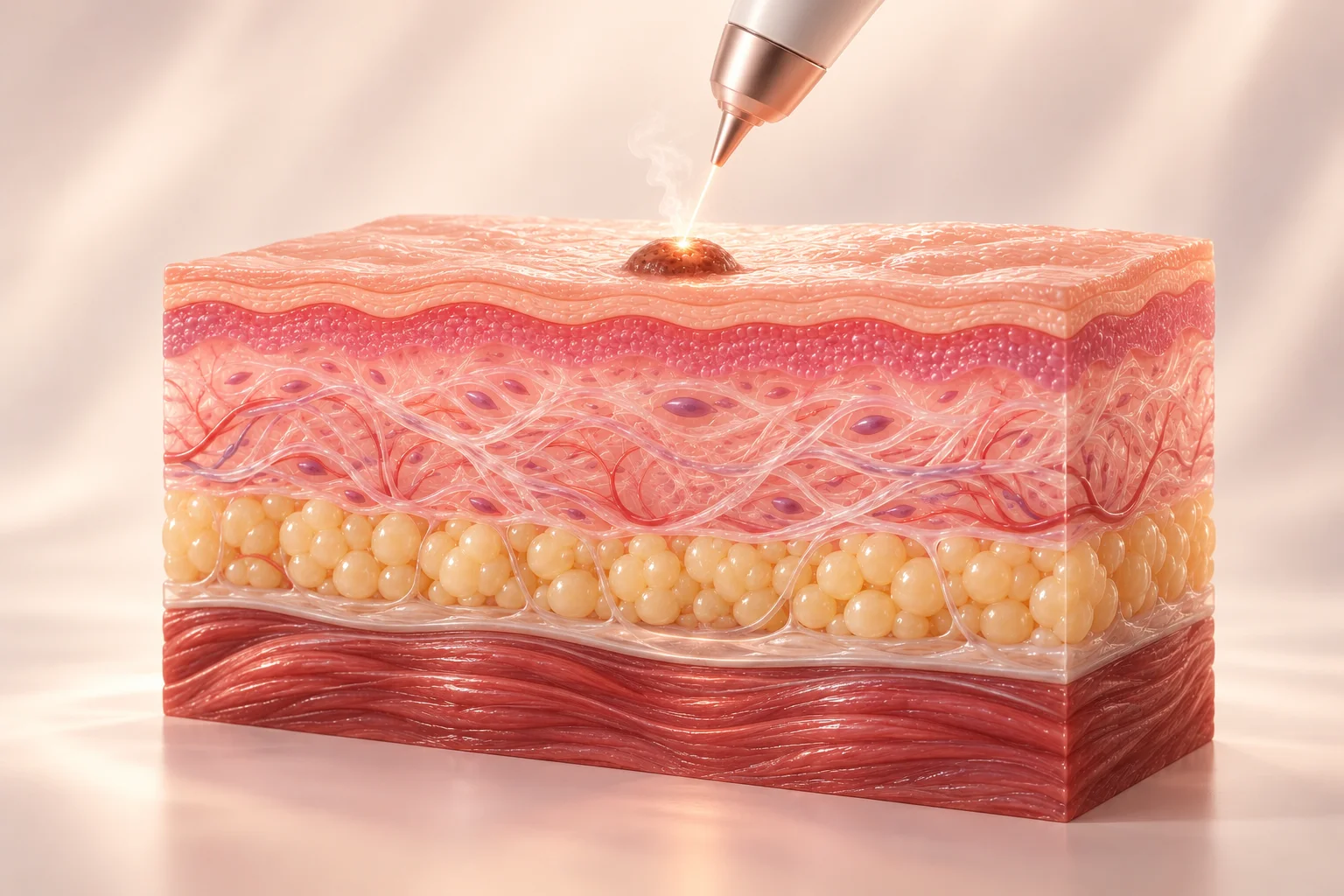
- CO2 (10,600 nm) and erbium:YAG (2940 nm) light is absorbed by water in the skin, so the mole tissue is vaporised layer by layer. Erbium lasers spread less heat into nearby skin than CO2 lasers.
- Which moles
- A published review suggests pigment lasers for flat (junctional) moles and pulsed ablative CO2 or erbium lasers for raised (compound or dermal) moles. A mole that has changed in size, shape or colour, or that itches or bleeds, needs a medical check first.
- Tissue testing
- Laser removal destroys the tissue, so nothing is left to examine under a microscope. Surgical removal (cutting out or shaving) is the method that allows the mole to be checked for cancer cells.
- Regrowth
- In a 2026 pooled analysis, moles came back more often after CO2 or erbium laser than after surgical excision, particularly deeper (intradermal) moles. Dermatologists advise having any mole that regrows looked at promptly.
- Skin tone notes
- Darkening or lightening of the treated spot and scarring have been reported after both CO2 and erbium laser removal. Darker skin is more prone to dark marks after laser treatment in general.
The type of laser depends on the goal — pigment, redness, texture or hair — and it is often planned as a course rather than one session. Skin tone and the type of pigment change how the skin responds.
A doctor's examination comes first, and a mark may remain or the lesion may return.
References 7
- American Academy of Dermatology – Moles: diagnosis and treatment
- NHS – Moles
- Frontiers in Medicine (2026) – Aesthetic techniques for melanocytic nevus management: systematic review and meta-analysis
- Clinical, Cosmetic and Investigational Dermatology (2014) – Optimal management of common acquired melanocytic nevi
- Lumenis – UltraPulse
- US FDA 510(k) K091115 – Lutronic eCO2 Laser System
- Sciton – ZoomScan Er:YAG
Real cases
A case only helps when you can see the conditions behind it.
Sign in to see the before & after photos
Free. We use your Google name and email only to answer questions about these cases. Clinic names are shared in your private consultation.
 Before
 After
- Sessions
- One session (example)
- Combined
- None
- Photo timing
- 4 weeks after (example)
 Before
 After
- Sessions
- One session (example)
- Combined
- None
- Photo timing
- 4 weeks after (example)
 Before
 After
- Sessions
- One session (example)
- Combined
- None
- Photo timing
- 4 weeks after (example)
- SessionsOne session, or the result of a course
- CombinedWhether other treatments or surgery were done together
- Photo timingHow long after the procedure the photo was taken
What to ask in a consultation
Questions about whether it suits you and what the alternatives are.
Often considered when
- People with a mole that has been checked and is bothersome, for example because it rubs against clothing, or that they find unattractive. The AAD lists these, along with suspicious moles, as reasons a dermatologist removes a mole.
- People for whom how the area looks afterwards matters most. In a 2026 systematic review and meta-analysis of mole-removal techniques, satisfaction with appearance averaged 8.8/10 after erbium:YAG laser and 8.4/10 after CO2 laser, compared with 7.6/10 after shave excision and 6.2/10 after surgical excision.
- People with skin tags they want removed. A CO2 laser guideline covers skin tags, which are removed by cutting through the base with the laser.
- People with several lesions, or lesions in places that are awkward for surgery. A 30-year report from a dermatology department in Florence, Italy, describes CO2 laser as preferred for patients with several or wide lesions, and notes that surgery has limited use around the inner corner of the eye, the ears and the sides of the nose.
Checks in Korea
- Under Korea's Medical Service Act (Article 27), no one other than a licensed medical professional may perform medical procedures, and no one may have a non-licensed person perform them.
- Under Korean law, a clinic that wants to attract foreign patients must register with the city or provincial government, have at least one specialist for each department it plans to treat foreign patients in (except departments that are not specialties set by Presidential Decree), and hold medical malpractice liability insurance or belong to a medical liability mutual aid association. Registration is valid for 3 years.
- Korea's Ministry of Food and Drug Safety runs a medical device information platform (emedi.mfds.go.kr) where information on medical devices can be looked up.
- Q01Is this laser suitable for my skin tone and type of pigment? How does it compare with other options?
- Q02How many sessions fit into a short stay, and how would I continue afterwards?
- Q03Who will perform the treatment, and what is their specialty?
- Q04Which device or product will be used, and is it the original I asked about?
- Q05How many sessions are usually planned, and can they fit into my stay?
- Q06What should I avoid before and after — sun, alcohol, flights, exercise?
- Q07What is included in the written estimate, and what could change after the consultation?
Check these yourself at the consultation
- Ask whether the doctor examines each mole (for example with a dermatoscope) before deciding between laser and surgical removal with tissue testing.
- Ask which laser (CO2 or erbium) is used, what numbing is given, and how the wound should be cared for.
- Ask what the clinic does if a mole comes back and whether a second session is likely for deeper moles.
Recovery & schedule
Check swelling, daily routine, activity limits and review visits separately.
At a glance
- Anaesthesia
- A CO2 laser guideline describes numbing cream applied under a covering for 60 minutes, or a local anaesthetic injection, for small lesions. One dermatology department reports that it typically uses no anaesthetic at low power settings and uses local anaesthetic for sensitive areas such as around the eyes.
- Number of visits
- The AAD says most mole removals need only one office visit, and occasionally a patient may need to return for a second visit. A 2014 review's table of laser studies lists one study in which pulsed erbium:YAG and ultrapulse CO2 lasers each showed 100% improvement in 20 moles after one session.
- Healing time
- One department advises against removing the scab because this delays healing, and reports that redness disappears within a few weeks. In a small randomised trial of 20 patients with a different benign growth (verrucous epidermal naevus), new skin covered the wound after 13.5 days on average with CO2 laser and 7.9 days with erbium:YAG laser.
- Skin tags
- The NHS says a removed skin tag does not usually come back.
- 01Swelling & bruising
Pain, redness and swelling are the immediate reactions described by one department; with newer pulsed CO2 systems at lower settings, swelling and redness were limited to hours or days, and redness faded within a few weeks.
- 02Back to routine
Facial wounds are often covered. A CO2 laser guideline advises hydrocolloid dressings after facial procedures, and one department describes a clear dressing that patients remove daily, wash the wound with a cleansing foam, and reapply for one to two weeks. Ask how visible the dressing will be and when make-up is allowed.
- 03Activity limits
Sun matters. One department found colour changes (lighter or darker spots) happened more often when treatment was done in summer than in winter, and it advises protecting the wound with sunscreen. Ask the clinic about swimming, saunas and exercise while the wound is open.
- 04Follow-up & flying home
The AAD says a patient occasionally needs a second visit, and that a mole which grows back should be seen again straight away. If tissue is sent for testing, ask when and how you will receive the result after you fly home, and how a regrowth would be checked from abroad.
Published guidance; your own clinic sets the actual plan.
Before your visit day
What clinics ask of international patients, in one place.
- Bring your passportClinics register international patients with their passport, and any estimate or prescription is issued in the name on it.
- Patients under 19Adulthood in Korea starts at 19. For a younger patient, clinics generally ask a parent or legal guardian to consent in writing, and many ask them to attend. Tell us the patient's age when you write, and we check what the clinic needs.
- Coming with someoneA family member or friend can usually join you in the consultation room. Treatment and recovery areas follow each clinic's rules, so we check this before your visit. If more than one person is booking, tell us what each person is interested in.
- Language helpCoordinators reply in English, Japanese, Chinese and Korean. Interpretation on the day is arranged for your dates, and we confirm in writing what it covers before you travel.
- Medicines and allergiesWrite down the medicines you take and any allergies. The clinic asks about both before any treatment.
What changes the price
The same treatment can be quoted differently depending on the items below.
What differs from clinic to clinic
- CO2 or erbium laser
- Clinics differ in which ablative laser they use. In a small randomised trial on verrucous epidermal naevi, new skin covered the wound after 13.5 days on average with CO2 and 7.9 days with erbium:YAG, and apart from this the two lasers showed equivalent results. In the 2026 meta-analysis, satisfaction was 8.4/10 with CO2 and 8.8/10 with erbium.
- Vaporise or cut out and test
- A laser can vaporise the lesion or cut it out. A CO2 laser guideline describes cutting skin tags at the base in focused cutting mode and says excised mole specimens should always be sent for testing. In the 2026 meta-analysis, surgical excision cleared 96.4% of moles with 2.1% recurrence, against 12.9% recurrence for CO2 and 14.3% for erbium laser.
- How each mole is assessed
- A 2014 review says dermoscopy in trained hands is a good non-invasive check, but in doubtful cases a biopsy is probably the only certain way to confirm abnormal cells. How carefully a clinic examines each mole before choosing a method is worth comparing.
- Settings and depth
- One department reports keloids and raised scars in about 1% of treatments, low above all when lower settings were used, and a CO2 laser guideline warns not to go too deep on moles to avoid scarring. Doctors balance depth against the chance of regrowth differently.
- Wound care routine
- Some clinics cover facial wounds with hydrocolloid or clear dressings changed daily for one to two weeks and add antibiotic ointment, while others use other routines. This affects how the spot looks during a short stay.
- Number and size of lesions
- How many moles or skin tags are included, and whether larger or raised ones are priced differently.
- Method for each lesion
- Whether each lesion is vaporised with CO2 or erbium laser, cut out with the laser, or removed surgically by shave or excision.
- Tissue testing
- Whether removed tissue is sent to a laboratory, and whether that fee is included.
- Numbing method
- Whether numbing cream, a local anaesthetic injection, or no anaesthetic is planned.
- Dressings and ointment
- Whether hydrocolloid dressings, ointment and sunscreen for the healing period are supplied.
- Second visit or regrowth
- Whether a second session or treatment of a regrowth is included or charged separately.
- Device & method
- Which laser is used and how it is applied
- Area & size
- Size and number of treated areas
- Sessions
- Recommended sessions, price per session and any package terms
- Numbing & care
- Numbing cream and soothing or recovery care
Prices are set by the clinic after a consultation. Ask for an itemised, written estimate before you book, and check what is included and what could change.
Often charged separately
Ask whether each of these is in your estimate.
| Item | What to ask |
|---|---|
| Consultation fee | Whether the consultation is charged, and whether that amount comes off the treatment price. |
| Check-up and top-up visits | Whether a review visit, or a top-up within a set period, is part of the quoted price. |
Clinics in Korea build a treatment estimate from the area, the amount used or the number of sessions.
The final figure is set after the doctor sees you at the consultation.
Ask for an itemised, written estimate that marks each item above as included or not, so you can compare two quotes on the same basis.
VAT before you compare quotes
The VAT refund for foreign visitors' cosmetic procedures covered only procedures received by 31 December 2025, so procedures received now are not refunded. Plan your budget without it, and ask each clinic whether VAT is included in the written quote so you compare the same total.
Ask COMEDI, for example
Clinics in Seoul differ in equipment, technique, specialist focus and what the price includes. Send us your question and we compare partner clinics for you.
- “I have several moles and a few skin tags. Which partner clinics use CO2 and which use erbium laser, and how many lesions does the quote cover?”
- “Which clinics send removed tissue for testing, and how would I get the result after I fly home?”
- “How visible will the dressings be during my stay, and when can I wear make-up?”
- “If a mole grows back after I return home, how does each clinic handle a check or touch-up?”
Precautions & aftercare
General information. Follow the written instructions from your treating doctor for anything specific to you.
Side effects and precautions for Mole & lesion removal are in one place at the top of this page.
Aftercare for this procedure
- Let scabs fall off on their own. A CO2 laser guideline says to avoid picking, and one department notes that removing the scab delays healing.
- If a dressing is applied, follow the clinic's routine; one department has patients wash the wound with a cleansing foam and reapply a clear dressing daily for one to two weeks.
- Apply the topical antibiotic the clinic gives you, if one is prescribed; one department routinely uses it under a patch on the face and other sun-exposed areas.
- Protect the healing spot with sunscreen, since one department saw more colour changes after summer treatments.
- Tell the clinic about recent tanning, medicines that increase light sensitivity, possible pregnancy, keloid tendency and skin conditions.
- Contact the clinic if pigment darkens or lightens, or if blisters or severe pain appear.
- Keep up sun protection for as long as the clinic advises.
Information only. Suitability, risks, recovery and price are assessed by the treating doctor in a consultation.
Sources for this section 11
- Moles: Diagnosis and treatment — American Academy of Dermatology
- Carbon dioxide laser guidelines (J Cutan Aesthet Surg 2009) — PMC
- Aesthetic techniques for melanocytic nevus management: systematic review and meta-analysis (Front Med 2026) — PMC
- Optimal management of common acquired melanocytic nevi (moles): current perspectives (Clin Cosmet Investig Dermatol 2014) — PMC
- Highlights of thirty-year experience of CO2 laser use at the Florence (Italy) Department of Dermatology (Sci World J 2012) — PMC
- Carbon dioxide laser versus erbium:YAG laser in treatment of epidermal verrucous nevus: a comparative randomized clinical study (J Dermatolog Treat 2017) — PubMed
- Skin tags — NHS
- Moles — NHS
- 의료 해외진출 및 외국인환자 유치 지원에 관한 법률 제6조 — 국가법령정보센터
- 의료법 제27조(무면허 의료행위 등 금지) — 국가법령정보센터
- 의료기기안심책방 (의료기기 종합정보 플랫폼) — 식품의약품안전처
Related questions & guides
Worth reading alongside this page.
Notes from people who used COMEDI
Written after a consultation we arranged, and matched to that request.
Common questions
How much does Mole & lesion removal cost in Korea?+
Prices are set by each clinic after a consultation and depend on the technique, area and your needs. Ask for an itemised, written estimate before you book — it should list what is included and what could change. We help you request and compare estimates.
Can foreigners get Mole & lesion removal in Korea?+
Yes. Many Seoul clinics see international patients. We help with clinic information, consultations in your language, written estimates and interpretation on the day.