
Vbeam& rosacea laser
A laser that targets visible blood vessels, used for redness, broken capillaries and flushing.
- Type
- Non-surgical
- Usually by
- Dermatologist
- Category
- Laser & pigment
- First step
- Consultation
Information only. Suitability, risks, recovery and price are assessed by the treating doctor in a consultation.
Side effects and precautionsWhat to know about Vbeam & rosacea laser before you book16
Reactions that usually settle, signs to tell the clinic about straight away, and times to wait. Your doctor goes through the risks that apply to you at the consultation.
Usually settles on its own
- Bruising straight after treatment, which one NHS leaflet calls entirely normal with this treatment
- Skin that feels warm and looks bruised like mild sunburn, as another NHS leaflet describes
- Redness, which the AAD says usually fades within 2 weeks
- Swelling or an inflamed look that settles over a few days
- Skin tightening, itch or pain during treatment, which the AAD notes some patients feel
- Scabbing or blistering; both NHS leaflets say scabs should be left to fall off naturally
Tell the clinic promptly
- Infection, for which one NHS leaflet says antibiotics may be needed and patients should contact the department.
- Lighter or darker skin in the treated area. The same leaflet says lighter patches can be permanent; an NHS laser centre says such marks usually return to normal but can take a long time.
- Scarring, which that leaflet describes as rare but possible and the AAD as rare in skilled hands.
- Eye damage from the laser light, which is why protective glasses are worn throughout.
- Contact the clinic if the area becomes infected, or if you have any concerns or problems after treatment, as both NHS leaflets advise.
Wait or rethink when
- Taking or having recently taken Accutane, being on blood thinners, or being pregnant. The ASDS lists these among the conditions that make a patient not a good candidate for laser/light therapy.
- Being subject to keloid scarring, showing severe or unusual scar formations, or having skin resurfacing disorders. The ASDS lists these as well.
- Having recently tanned or suffered severe sunburn. The ASDS lists this, and an NHS laser centre says side effects are more likely if the skin is tanned when treated.
- Very dark skin. An NHS laser centre says laser treatment may not be suitable for people with very dark skin because of the increased risk of side effects, and the ASDS lists being dark skinned among its non-candidate conditions.
- If your main concern is spots or pustules rather than redness, an NHS laser centre says a vascular laser may not have much effect on them, and that they are usually best treated with antibiotics or topical creams.
Sources for this section 9
- Lasers and lights: How well do they treat rosacea? — American Academy of Dermatology
- Pulsed dye laser — patient information leaflet, The Rotherham NHS Foundation Trust
- Rosacea (laser treatments) — Bristol Laser Centre, North Bristol NHS Trust (2025)
- Pulsed dye laser treatment (PDL) — Chelsea and Westminster Hospital NHS Foundation Trust
- Laser/light therapy — American Society for Dermatologic Surgery
- Rosacea — StatPearls, NCBI Bookshelf (updated 2023)
- US FDA 510(k) K230990 — Candela Vbeam Family of Pulsed Dye Lasers (Vbeam Prima, Vbeam Perfecta)
- 의료 해외진출 및 외국인환자 유치 지원에 관한 법률 제6조 — 국가법령정보센터
- 의료기기안심책방 (의료기기 종합정보 플랫폼) — 식품의약품안전처
What is it?
The purpose, the change you can expect and the limits.
A laser that targets visible blood vessels, used for redness, broken capillaries and flushing.
Pulsed dye laser · Excel V
- Vbeam Perfecta / Vbeam Pro
- excel V+
- GentleMax Pro Plus
- Clarity II
- Stellar M22 (Multi-Spot Nd:YAG)
Devices & products used
- 01Vbeam Perfecta / Vbeam ProCandela, USA
A 595 nm pulsed dye laser with adjustable pulse durations of up to 40 milliseconds and a cryogen spray that cools the skin with each pulse; the Pro model adds 1064 nm.
- 02excel V+Cutera, USA
Combines 532 nm and 1064 nm wavelengths in one system, with spot sizes up to 16 mm, for surface redness and deeper vessels.
- 03GentleMax Pro PlusCandela, USA
A 755 nm alexandrite and 1064 nm long-pulsed Nd:YAG platform; besides hair removal it is cleared for facial vessels and spider and leg veins.
- 04Clarity IILutronic, Korea
A 755 nm and 1064 nm long-pulsed laser; its US FDA clearance lists the 1064 nm wavelength for vascular lesions such as telangiectasia, rosacea and leg veins.
- 05Stellar M22 (Multi-Spot Nd:YAG)Lumenis, Israel
A 1064 nm Nd:YAG handpiece cleared for superficial and deep leg telangiectasias and reticular veins of 0.1–4.0 mm diameter.
Clinics do not all carry the same devices, products or techniques. Ask which one will be used, by name, before you book.
How it is done, in photos
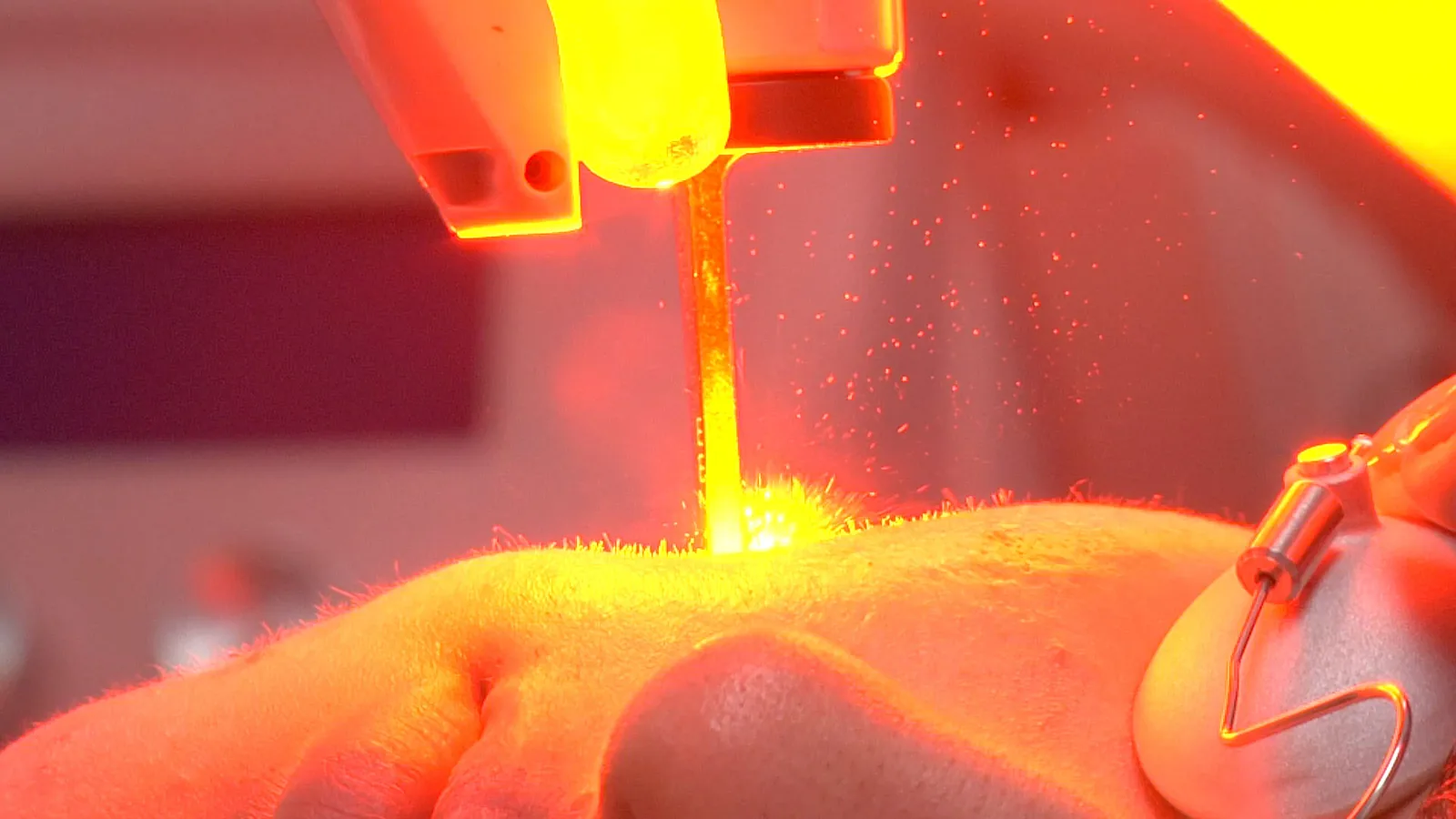
A Vbeam pulsed dye laser is aimed beside the nose to treat visible vessels; each pulse may sting like a rubber band snapped against skin.
Photo: James Mutter / CC BY-SA 4.0 / CC BY-SA 4.0 via Wikimedia Commons
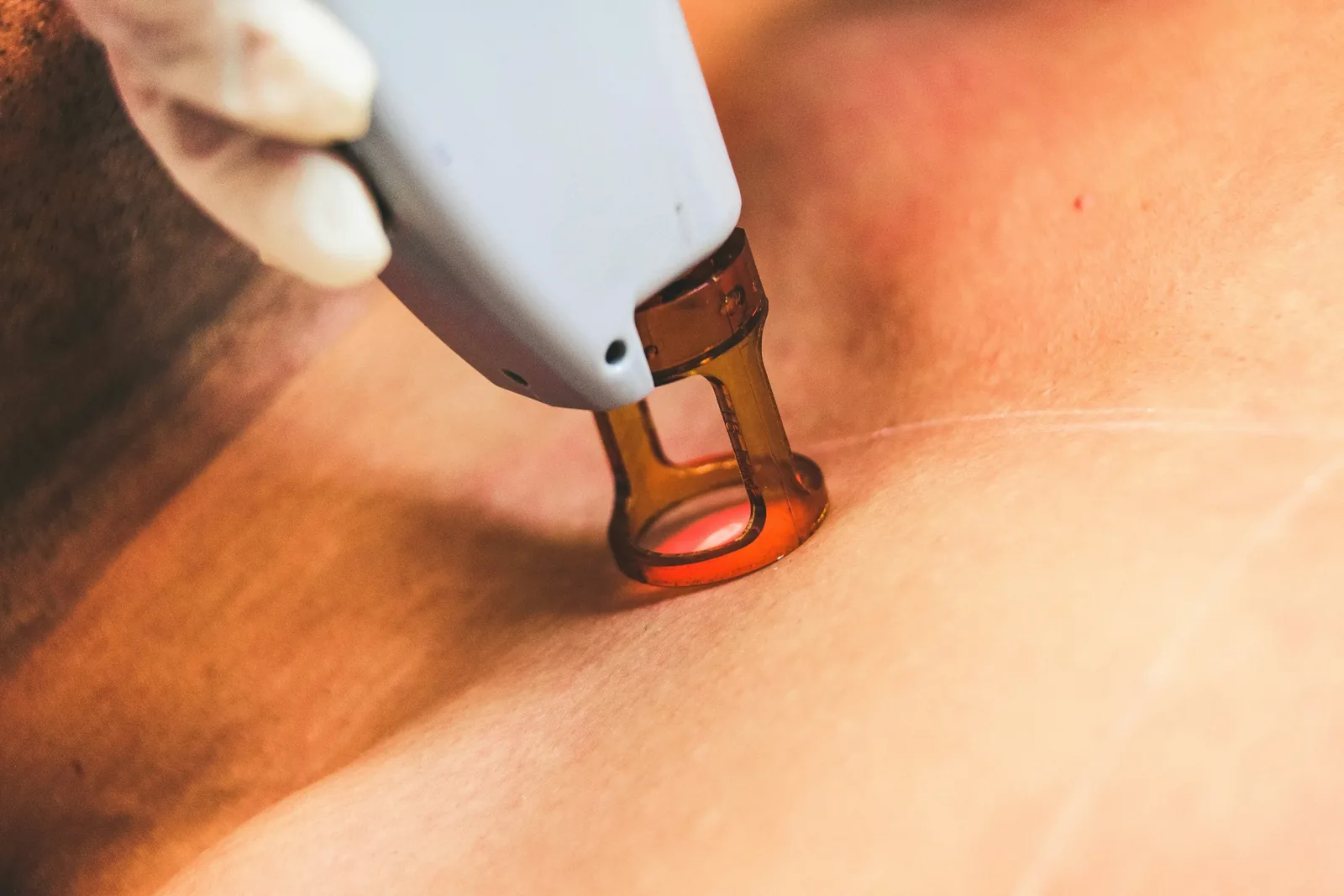
A laser handpiece with a spacer tip is held against the skin, so each pulse lands at the same distance across the treated area.
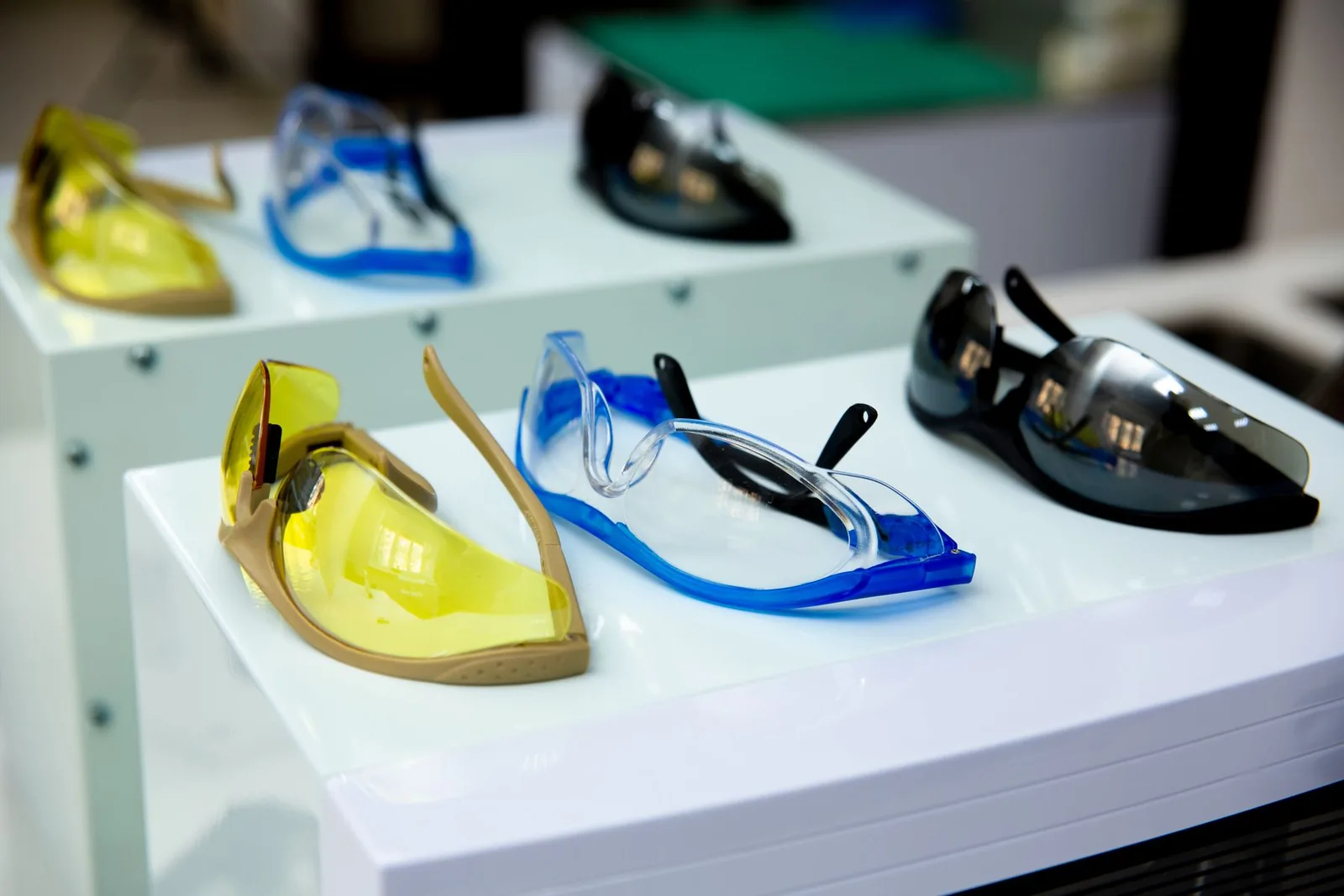
Protective glasses or goggles like these are worn throughout vascular laser treatment to shield the eyes from the laser light.
Device and procedure images are provided by the manufacturers / licensed stock; they do not show COMEDI patients.
At a glance
- How it works
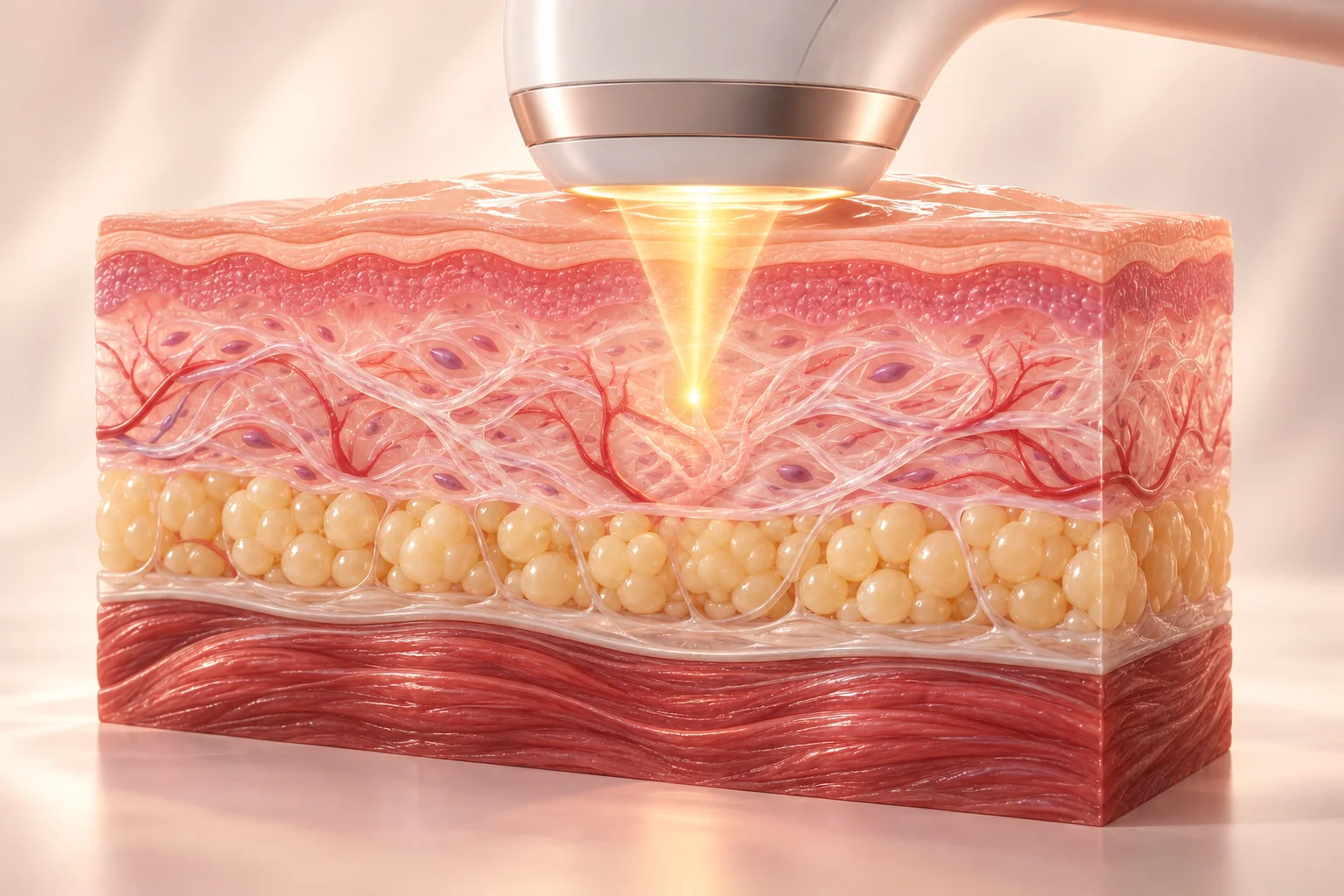
- The light passes through the top layer of skin and is absorbed by blood in the vessels underneath. The heat damages the vessel so that redness fades over time.
- Anaesthesia
- No general anaesthetic is used. Numbing cream may be applied to sensitive areas, and many devices cool the skin as they fire.
- Sessions & interval
- For visible facial vessels in rosacea, US dermatology guidance describes 1–3 treatments, usually 3–4 weeks apart. Some hospital pulsed dye laser services leave a longer gap between sessions.
- After treatment
- The area can feel warm and look sunburned. Bruising or purple spots may appear and usually clear within one to two weeks.
- Skin tone notes
- Treatment is not carried out on suntanned skin, and fake tan should be avoided beforehand. Darker skin is more prone to burns and dark marks, so settings and wavelength are chosen with care; a test patch is often done first.
The type of laser depends on the goal — pigment, redness, texture or hair — and it is often planned as a course rather than one session. Skin tone and the type of pigment change how the skin responds.
Redness can return depending on its cause, and several sessions may be needed.
References 7
- Candela – Vbeam
- Cutera – excel V+
- Candela – Gentle Pro Series
- US FDA 510(k) K183566 – Lutronic CLARITY II Laser System
- US FDA 510(k) K193500 – Lumenis Stellar M22 IPL and Laser System
- Chelsea and Westminster Hospital NHS Foundation Trust – Pulsed dye laser treatment
- American Academy of Dermatology – Lasers and lights for rosacea
Real cases
A case only helps when you can see the conditions behind it.
Sign in to see the before & after photos
Free. We use your Google name and email only to answer questions about these cases. Clinic names are shared in your private consultation.
 Before
 After
- Sessions
- 3 sessions (example)
- Combined
- None
- Photo timing
- after 3 sessions (example)
 Before
 After
- Sessions
- 3 sessions (example)
- Combined
- None
- Photo timing
- after 3 sessions (example)
 Before
 After
- Sessions
- 3 sessions (example)
- Combined
- None
- Photo timing
- after 3 sessions (example)
- SessionsOne session, or the result of a course
- CombinedWhether other treatments or surgery were done together
- Photo timingHow long after the procedure the photo was taken
What to ask in a consultation
Questions about whether it suits you and what the alternatives are.
Often considered when
- People whose rosacea shows as visible blood vessels. The AAD says a laser or light treatment can reduce (or get rid of) the blood vessels, and that laser treatment can also reduce redness.
- People bothered mainly by the redness and thread veins of rosacea. An NHS laser centre says a vascular laser is usually helpful for these, but may not have much effect on spots or pustules.
- People with facial thread veins, spider naevi or port wine stains, which an NHS pulsed dye laser leaflet lists among the conditions its service treats.
- People with red scars. Another NHS pulsed dye laser leaflet says the treatment is used to lighten redness and improve the texture of skin and scar tissue.
- People who see laser as one part of a wider rosacea plan. The AAD says laser or light therapy is unlikely to be the only treatment, and plans often also include medication and rosacea-friendly skin care.
Checks in Korea
- Under Korean law, a clinic that wants to attract foreign patients must register, have at least one specialist for each department in which it plans to treat foreign patients (except departments that are not specialties designated by Presidential Decree), and hold medical malpractice liability insurance or belong to a medical liability mutual aid association. Registration is valid for 3 years from the date of registration.
- Korea's Ministry of Food and Drug Safety runs a medical device information platform (emedi.mfds.go.kr) where information on medical devices, including the laser a clinic names, can be looked up.
- For comparison abroad, the US FDA clearance for the Vbeam Prima and Vbeam Perfecta (K230990) lists, at 595 nm, benign cutaneous vascular lesions such as facial and leg telangiectasia, rosacea, port wine stains, hemangiomas and Poikiloderma of Civatte. Ask the clinic which model it uses.
- Q01Is this laser suitable for my skin tone and type of pigment? How does it compare with other options?
- Q02How many sessions fit into a short stay, and how would I continue afterwards?
- Q03Who will perform the treatment, and what is their specialty?
- Q04Which device or product will be used, and is it the original I asked about?
- Q05How many sessions are usually planned, and can they fit into my stay?
- Q06What should I avoid before and after — sun, alcohol, flights, exercise?
- Q07What is included in the written estimate, and what could change after the consultation?
Check these yourself at the consultation
- Ask which laser and wavelength will be used (for example 595 nm pulsed dye, 532 nm, or 1064 nm Nd:YAG) and why it suits your type of redness or veins.
- Ask whether bruising is expected with the planned settings and how long it usually lasts.
- Check sun and tanning limits before treatment and whether a test patch is done.
Recovery & schedule
Check swelling, daily routine, activity limits and review visits separately.
At a glance
- What it feels like
- One NHS pulsed dye laser leaflet describes a cool spray followed by a pulse of light that may sting like a rubber band snapped against the skin. Another notes that if numbing cream is used, it must go on at least one hour before treatment.
- Eye protection
- Both NHS leaflets say protective glasses or goggles are worn during treatment to protect the eyes from the laser light.
- Test patch timing
- In one NHS service, a small test patch is normally done first, and the larger treatment follows at an appointment 8 to 12 weeks later if there have been no problems. Another NHS service also starts with a test patch visit.
- Course in NHS services
- An NHS laser centre says most people have 2 to 4 treatments, with session length and number depending on severity. Two other NHS services space repeat sessions about 8 to 12 weeks apart, or at least 12 weeks apart. Your own plan is set by the doctor.
- How long results last
- For visible blood vessels, the AAD says results tend to last 3 to 5 years. Treated vessels do not reappear, but new ones can form.
- 01Swelling & bruising
One NHS pulsed dye laser leaflet says bruising appears straight away, often darkens for up to 3 days, and lasts about 14 days or longer; it is obvious and cannot be covered adequately with make-up. Swelling settles over a few days. An NHS laser centre describes bruising for a few days, so ask the clinic how long bruising is likely to last with your plan.
- 02Back to routine
The same leaflet notes that, when the face is treated, some patients find it hard to carry on with their normal job until the bruising fades. It allows make-up 2 to 3 days after treatment if the skin is not broken; another NHS hospital asks patients to wait at least 5 days before using make-up on treated scars.
- 03Activity limits
One NHS hospital advises avoiding hot water, saunas and swimming until swelling has gone, and sports or high-risk physical activity until bruising has gone. An NHS laser centre advises avoiding strenuous exercise for a couple of days.
- 04Follow-up & flying home
Published intervals range from 3 to 4 weeks (AAD) to 8 to 12 weeks or at least 12 weeks (two NHS services), so later sessions may fall after you fly home. Bruising can last about two weeks, and both NHS services ask for sun block on the treated area for at least 6 months. Ask how photos, check-ups and later sessions will continue from home.
Published guidance; your own clinic sets the actual plan.
Before your visit day
What clinics ask of international patients, in one place.
- Bring your passportClinics register international patients with their passport, and any estimate or prescription is issued in the name on it.
- Patients under 19Adulthood in Korea starts at 19. For a younger patient, clinics generally ask a parent or legal guardian to consent in writing, and many ask them to attend. Tell us the patient's age when you write, and we check what the clinic needs.
- Coming with someoneA family member or friend can usually join you in the consultation room. Treatment and recovery areas follow each clinic's rules, so we check this before your visit. If more than one person is booking, tell us what each person is interested in.
- Language helpCoordinators reply in English, Japanese, Chinese and Korean. Interpretation on the day is arranged for your dates, and we confirm in writing what it covers before you travel.
- Medicines and allergiesWrite down the medicines you take and any allergies. The clinic asks about both before any treatment.
What changes the price
The same treatment can be quoted differently depending on the items below.
What differs from clinic to clinic
- Which lasers the clinic has
- An NHS laser centre, for example, has both a pulsed dye laser and an Nd:YAG laser and decides which suits you at the consultation. StatPearls lists pulsed dye laser (585 to 595 nm), Nd:YAG and IPL as options for rosacea redness and visible vessels. A clinic can only offer what it owns, so the same concern may be treated differently.
- How much bruising to expect
- Published guidance describes very different bruising: about 14 days in one NHS leaflet, a few days at an NHS laser centre, and purple or red spots clearing in 1 to 2 weeks according to the AAD. Ask each clinic what it expects for your plan, especially if you have meetings or flights soon after.
- Test patch and spacing policy
- One NHS service waits 8 to 12 weeks after a test patch, another spaces sessions at least 12 weeks apart, and the AAD describes 3 to 4 weeks. The policy a clinic follows decides how much fits into one trip.
- Who treats you
- The AAD says results depend largely on the person performing the treatment, and that a dermatologist considers your medical history and can tell you whether a laser or light device can effectively treat your rosacea.
- Laser alone or a full rosacea plan
- The AAD says laser is unlikely to be the only rosacea treatment, and StatPearls notes that persistent redness and visible vessels often need vessel-targeting treatment such as creams or vascular laser. Some clinics treat the vessels only; others also prescribe and plan ongoing care.
- Consultation and test patch
- Whether the first consultation and the test patch are included or charged as separate visits.
- Second wavelength
- The US FDA clearance lists a 1064 nm Nd:YAG wavelength for the Vbeam Prima only, so ask whether it is used in your plan and whether it is included or charged extra.
- Number of sessions quoted
- Whether the quote is for one session or a course, and how the cost changes if more sessions are needed.
- Rosacea consultation and prescriptions
- Whether a doctor's review of your rosacea and any creams or tablets are part of the plan or quoted separately.
- Take-home supplies
- Whether soothing gel, moisturiser and sun block for the following months are supplied.
- Remote follow-up
- Whether photo reviews after you fly home, and guidance for later sessions, are included.
- Device & method
- Which laser is used and how it is applied
- Area & size
- Size and number of treated areas
- Sessions
- Recommended sessions, price per session and any package terms
- Numbing & care
- Numbing cream and soothing or recovery care
Prices are set by the clinic after a consultation. Ask for an itemised, written estimate before you book, and check what is included and what could change.
Often charged separately
Ask whether each of these is in your estimate.
| Item | What to ask |
|---|---|
| Consultation fee | Whether the consultation is charged, and whether that amount comes off the treatment price. |
Clinics in Korea build a treatment estimate from the area, the amount used or the number of sessions.
The final figure is set after the doctor sees you at the consultation.
Ask for an itemised, written estimate that marks each item above as included or not, so you can compare two quotes on the same basis.
VAT before you compare quotes
The VAT refund for foreign visitors' cosmetic procedures covered only procedures received by 31 December 2025, so procedures received now are not refunded. Plan your budget without it, and ask each clinic whether VAT is included in the written quote so you compare the same total.
Ask COMEDI, for example
Clinics in Seoul differ in equipment, technique, specialist focus and what the price includes. Send us your question and we compare partner clinics for you.
- “I have rosacea redness and visible veins. Which partner clinics have both a 595 nm pulsed dye laser and a 1064 nm option?”
- “I fly home 10 days after treatment. Which clinics can plan settings that keep bruising short?”
- “Do your partner clinics need a test patch first, and how many weeks apart would sessions be?”
- “What does each clinic's quote include: consultation, test patch, aftercare products and photo follow-up?”
Precautions & aftercare
General information. Follow the written instructions from your treating doctor for anything specific to you.
Side effects and precautions for Vbeam & rosacea laser are in one place at the top of this page.
Aftercare for this procedure
- Use aloe vera gel or ice packs straight after treatment to ease discomfort; one NHS hospital gives aloe vera gel to use for the first 24 hours.
- For discomfort, both NHS leaflets suggest simple painkillers such as paracetamol for the first few days and ask patients to avoid aspirin. Check with the doctor before changing any prescribed medicine.
- Wash the area gently, apply a simple moisturiser 3 to 4 times a day as one NHS hospital advises, and leave scabs to fall off on their own.
- On the treatment day, one NHS service asks patients not to wear perfume, aftershave or hair products, and to bring unperfumed soap to wash off make-up on the area.
- For rosacea, StatPearls advises keeping a diary of triggers such as UV light, spices, weather changes and alcohol, using pH-balanced cleansers rather than soap, and daily broad-spectrum sunscreen of SPF 30 or higher.
- Tell the clinic about recent tanning, medicines that increase light sensitivity, possible pregnancy, keloid tendency and skin conditions.
- Contact the clinic if pigment darkens or lightens, or if blisters or severe pain appear.
- Keep up sun protection for as long as the clinic advises.
Information only. Suitability, risks, recovery and price are assessed by the treating doctor in a consultation.
Sources for this section 9
- Lasers and lights: How well do they treat rosacea? — American Academy of Dermatology
- Pulsed dye laser — patient information leaflet, The Rotherham NHS Foundation Trust
- Rosacea (laser treatments) — Bristol Laser Centre, North Bristol NHS Trust (2025)
- Pulsed dye laser treatment (PDL) — Chelsea and Westminster Hospital NHS Foundation Trust
- Laser/light therapy — American Society for Dermatologic Surgery
- Rosacea — StatPearls, NCBI Bookshelf (updated 2023)
- US FDA 510(k) K230990 — Candela Vbeam Family of Pulsed Dye Lasers (Vbeam Prima, Vbeam Perfecta)
- 의료 해외진출 및 외국인환자 유치 지원에 관한 법률 제6조 — 국가법령정보센터
- 의료기기안심책방 (의료기기 종합정보 플랫폼) — 식품의약품안전처
Related questions & guides
Worth reading alongside this page.
Notes from people who used COMEDI
Written after a consultation we arranged, and matched to that request.
Common questions
How much does Vbeam & rosacea laser cost in Korea?+
Prices are set by each clinic after a consultation and depend on the technique, area and your needs. Ask for an itemised, written estimate before you book — it should list what is included and what could change. We help you request and compare estimates.
Can foreigners get Vbeam & rosacea laser in Korea?+
Yes. Many Seoul clinics see international patients. We help with clinic information, consultations in your language, written estimates and interpretation on the day.