
Pico laser
Ultra-short laser pulses used for freckles, sun spots, pigmentation and tattoo ink.

- Type
- Non-surgical
- Usually by
- Dermatologist
- Category
- Laser & pigment
- First step
- Consultation
Information only. Suitability, risks, recovery and price are assessed by the treating doctor in a consultation.
Side effects and precautionsWhat to know about Pico laser before you book13
Reactions that usually settle, signs to tell the clinic about straight away, and times to wait. Your doctor goes through the risks that apply to you at the consultation.
Usually settles on its own
- Redness, swelling, tingling, pinpoint bleeding or purplish spots after a session
- Pain and crusting, which cleared within two weeks in a study on deep pigment
- Temporary darkening of treated skin; in one study after 755 nm treatment it resolved by the 3-month check
- Light or dark spots after tattoo removal, which the AAD says tend to disappear within 6 to 12 months
Tell the clinic promptly
- Scarring, changes in skin texture, burns and other wounds. The AAD lists these as rare when a dermatologist treats you, but more common when the person treating lacks medical training.
- Burns and dark marks in darker skin. The AAD notes that lasers can be used on all skin types, but darker skin is more prone to these after laser treatment.
- Colour change in some tattoos, such as skin-coloured cosmetic tattoos. One review reports cases where colour changes happened whichever type of laser was used.
- Rebound darkening or white spots when melasma is treated with repeated low-energy laser. One review warns that this risk may increase with picosecond lasers depending on how they are used. Contact the clinic if new white or dark patches, blisters or wounds appear.
Wait or rethink when
- A tan or sunburn on the area to be treated. AAD laser guidance says that if you show up with a tan or sunburn, your dermatologist cannot treat you.
- Pregnancy or breastfeeding, if the plan is tattoo removal. The AAD states that women who are pregnant or breastfeeding should not be treated.
- A weakened immune system, if the plan is tattoo removal. The AAD notes that you need a healthy immune system for laser tattoo removal to work.
- A tendency to get cold sores. The AAD advises taking medicine to prevent cold sores before laser treatment if you are prone to them, so tell the doctor in advance.
- A study of picosecond treatment for deep (dermal) pigment excluded people with light hypersensitivity, an active or systemic infection, medicines for which sunlight is a contraindication, a history of skin cancer, keloid scarring or immunosuppression, pregnant or breastfeeding women, and anyone who had another laser on the same spot within the previous 12 months. Mention any of these at the consultation.
Sources for this section 14
- PicoWay (patient information) — Candela
- Picosecond pulse duration laser treatment for dermal melanocytosis in Asians: A retrospective review (Laser Therapy 2016) — J-STAGE
- Laser tattoo removal — American Academy of Dermatology
- Skin conditions that lasers can treat — American Academy of Dermatology
- Picosecond Laser Treatment for Tattoos and Benign Cutaneous Pigmented Lesions (Laser Therapy 2017) — J-STAGE
- An update on fractional picosecond laser treatment: histology and clinical applications (Lasers Med Sci 2023) — Springer
- Safety and efficacy of picosecond laser therapy in skin of color: A systematic review (JAAD Reviews 2026) — full text shared by the authors on ResearchGate
- A Systematic Review of Picosecond Laser in Dermatology: Evidence and Recommendations (Lasers Surg Med 2020) — Wiley
- 10 things to know before having laser treatment for your scar — American Academy of Dermatology
- PicoSure Pro — Cynosure
- US FDA 510(k) K173700 – Lutronic PICOPLUS Laser System
- 의료 해외진출 및 외국인환자 유치 지원에 관한 법률 제6조 — 국가법령정보센터
- 의료법 제27조(무면허 의료행위 등 금지) — 국가법령정보센터
- 의료기기안심책방 (의료기기 종합정보 플랫폼) — 식품의약품안전처
What is it?
The purpose, the change you can expect and the limits.
Ultra-short laser pulses used for freckles, sun spots, pigmentation and tattoo ink.
PicoSure · PicoPlus · Discovery Pico
- PicoSure Pro
- PicoWay
- PicoPlus
- Discovery Pico
Devices & products used
- 01PicoSure ProCynosure, USA
A 755 nm picosecond laser with optional 532 nm and 1064 nm add-ons; the Platinum Focus lens spreads the beam into many small points for skin revitalisation.
- 02PicoWayCandela, USA
A picosecond laser offering 532 nm, 730 nm, 785 nm and 1064 nm; the Resolve handpieces split the 532 nm or 1064 nm beam into micro-beams.
- 03PicoPlusLutronic, Korea
Emits 1064 nm and 532 nm light, each at either 450 picoseconds or 2 nanoseconds, so one device can work in both picosecond and nanosecond modes.
- 04Discovery PicoQuanta System, Italy
A picosecond Nd:YAG laser family; the US FDA record lists a 1064 nm, 450-picosecond handpiece for tattoos and benign pigmented lesions.
Clinics do not all carry the same devices, products or techniques. Ask which one will be used, by name, before you book.
How it is done, in photos
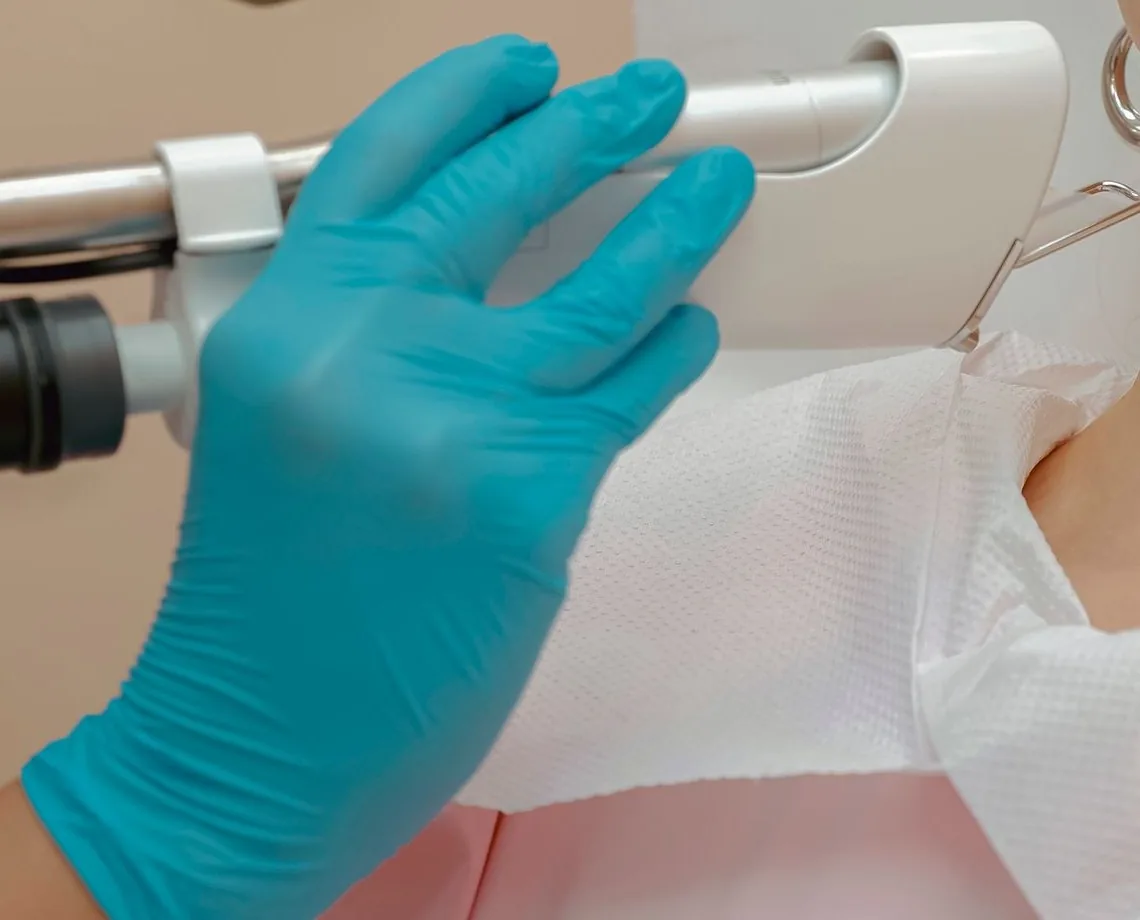
A gloved hand guides a laser handpiece along the jaw and neck; low-energy passes over a wide area usually cause only minimal crusting.
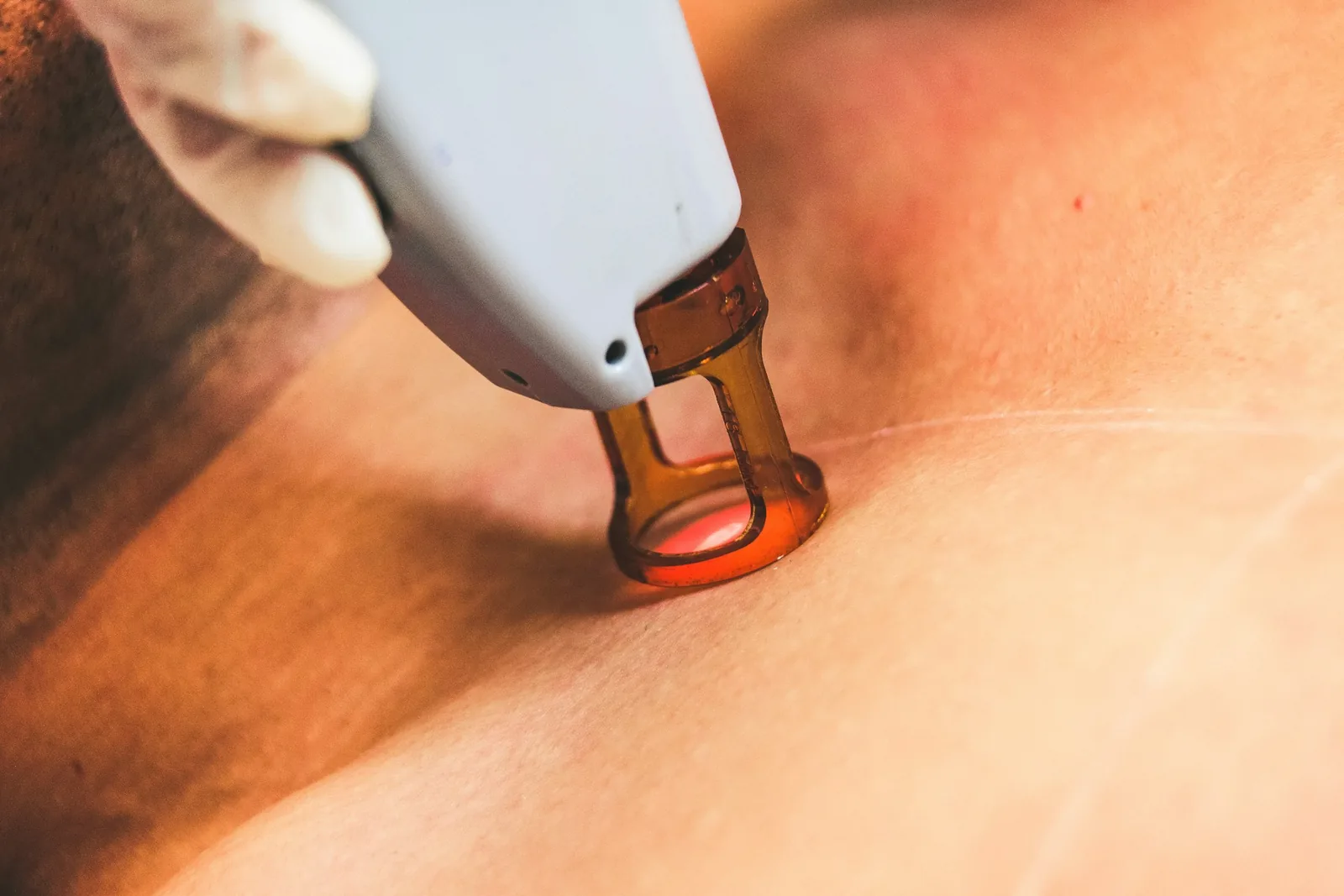
A laser handpiece with a spacer tip rests on the skin, keeping the tip at a set distance while the pulses are delivered.
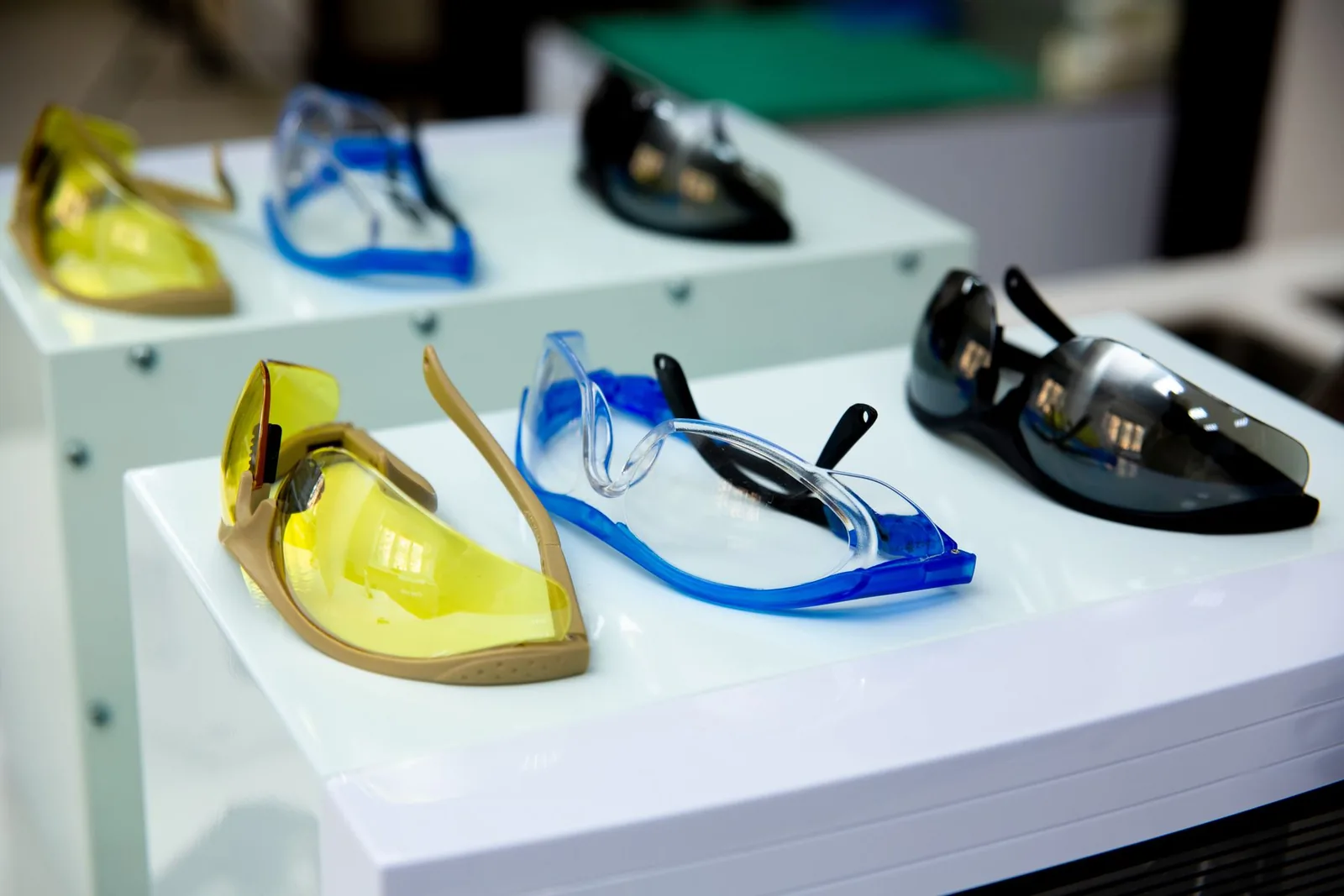
Protective eyewear in several tints sits ready in the treatment room; each tint is made to block a particular range of laser wavelengths.
Device and procedure images are provided by the manufacturers / licensed stock; they do not show COMEDI patients.
At a glance
- How it works
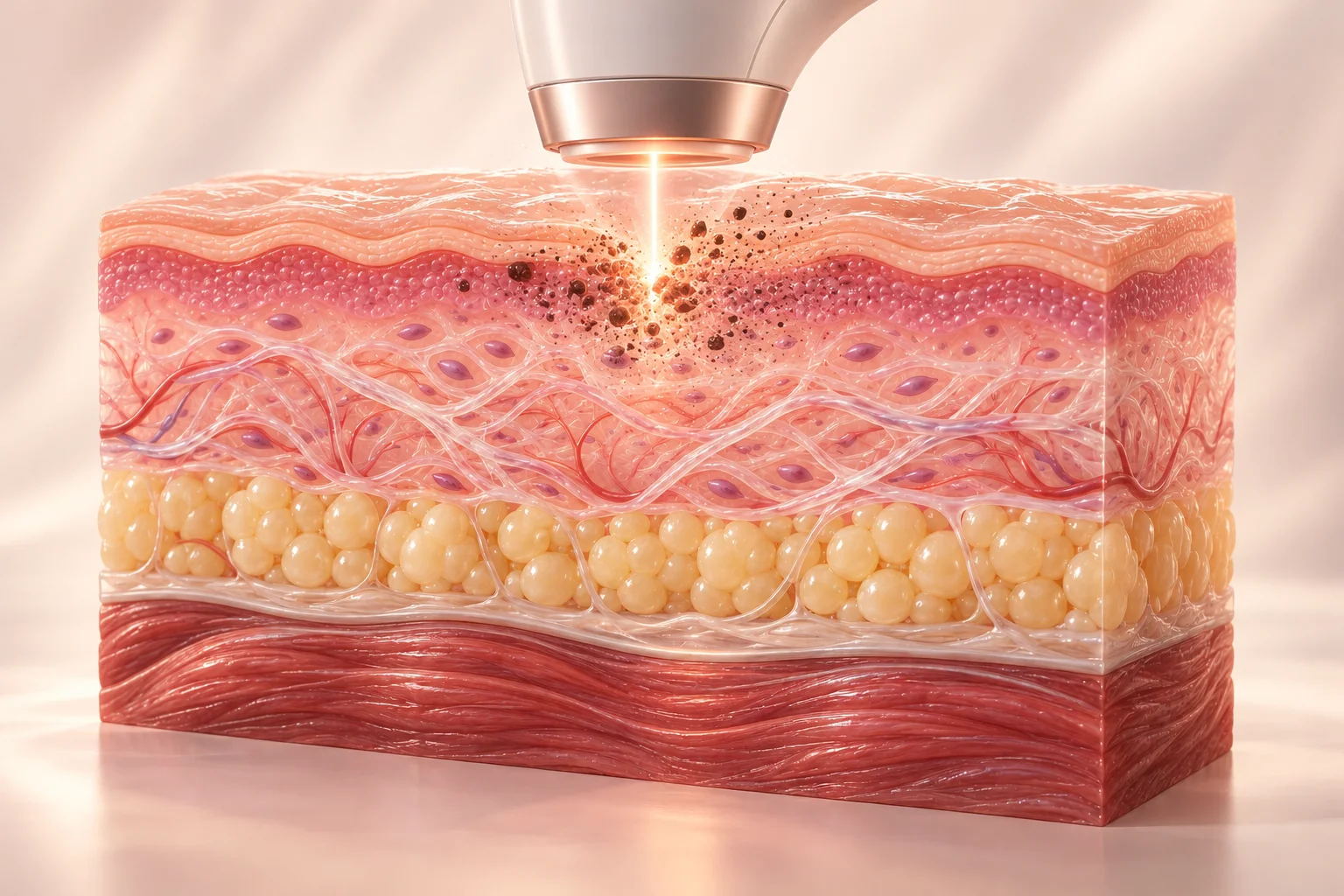
- Pulses last trillionths of a second (picoseconds). Energy delivered this fast breaks pigment or ink mainly by a pressure (photoacoustic) effect, with less heating of the surrounding skin.
- Session time
- The manufacturer of one widely used device describes a typical session as about 15–20 minutes, depending on the area.
- Anaesthesia
- Numbing cream can be applied on request. Tattoo removal is usually more uncomfortable than treatment for pigment spots or acne scars.
- Sessions & interval
- Several sessions spaced weeks apart are usual. The number depends on what is being treated and how the skin responds.
- Downtime
- Manufacturer information describes little or no downtime for skin treatments, with most people back to normal activities within a day.
- Skin tone notes
- The wavelength is chosen to suit skin tone. In US FDA clearances, 532 nm picosecond tattoo removal is listed for lighter skin (types I–III), while 1064 nm is listed for all skin types.
The type of laser depends on the goal — pigment, redness, texture or hair — and it is often planned as a course rather than one session. Skin tone and the type of pigment change how the skin responds.
Response depends on the type and depth of pigment, and several sessions may be needed.
Real cases
A case only helps when you can see the conditions behind it.
Sign in to see the before & after photos
Free. We use your Google name and email only to answer questions about these cases. Clinic names are shared in your private consultation.
 Before
 After
- Sessions
- 3 sessions (example)
- Combined
- None
- Photo timing
- after 3 sessions (example)
 Before
 After
- Sessions
- 3 sessions (example)
- Combined
- None
- Photo timing
- after 3 sessions (example)
 Before
 After
- Sessions
- 3 sessions (example)
- Combined
- None
- Photo timing
- after 3 sessions (example)
- SessionsOne session, or the result of a course
- CombinedWhether other treatments or surgery were done together
- Photo timingHow long after the procedure the photo was taken
What to ask in a consultation
Questions about whether it suits you and what the alternatives are.
Often considered when
- People with defined, benign pigment spots such as sun spots (solar lentigines) or birthmark-type pigment like nevus of Ota. A 2020 systematic review of 77 studies rated the evidence for benign pigmented lesions at levels I to IV.
- People removing a tattoo, including one that did not clear with older nanosecond lasers. The same systematic review rated tattoo removal at the highest evidence level (level I), and another review reports that tattoos resistant to nanosecond treatment have responded well to picosecond lasers.
- People looking at texture concerns such as atrophic acne scars, enlarged pores or sun-related ageing, using a picosecond laser fitted with a fractional (lens-array) handpiece. A 2023 review describes positive results for these uses while noting that more research is still needed.
- People with darker skin (Fitzpatrick types IV to VI) who want a pigment laser. A 2026 systematic review of 21 studies and 257 patients found side effects were generally mild and short-lived, with low rates of colour change and no permanent scarring, although most of the studies were small.
Checks in Korea
- Under Korea's Medical Service Act (Article 27), no one other than a licensed medical professional may perform medical procedures, and no one may have a non-licensed person perform them.
- Under Korean law, a clinic that wants to attract foreign patients must register with the city or provincial government, have at least one specialist for each department it plans to treat foreign patients in (except departments that are not specialties set by Presidential Decree), and hold medical malpractice liability insurance or belong to a medical liability mutual aid association. Registration is valid for 3 years.
- Korea's Ministry of Food and Drug Safety runs a medical device information platform (emedi.mfds.go.kr) where information on medical devices can be looked up.
- Q01Is this laser suitable for my skin tone and type of pigment? How does it compare with other options?
- Q02How many sessions fit into a short stay, and how would I continue afterwards?
- Q03Who will perform the treatment, and what is their specialty?
- Q04Which device or product will be used, and is it the original I asked about?
- Q05How many sessions are usually planned, and can they fit into my stay?
- Q06What should I avoid before and after — sun, alcohol, flights, exercise?
- Q07What is included in the written estimate, and what could change after the consultation?
Check these yourself at the consultation
- Ask which picosecond device and which wavelength will be used for your skin tone and concern.
- Ask whether a test spot is done first and how many sessions the clinic expects.
- Check sun exposure limits before and after treatment and tell the clinic about any medicines you take.
Recovery & schedule
Check swelling, daily routine, activity limits and review visits separately.
At a glance
- Before scar treatment
- If the laser is for scars, AAD guidance on laser treatment for scars asks you to give the dermatologist a list of the medicines and supplements you take, and to quit smoking for at least 2 weeks before laser treatment.
- Spot or whole-face approach
- In one review, a sun spot treated at higher energy turned white straight away and formed a dark crust that came off after about 10 days. Low-energy passes over the whole face caused minimal crusting and did not interfere with daily activities. Which approach is used is decided by the doctor.
- Number of sessions in studies
- In a 2026 systematic review of picosecond lasers in darker skin, patients had on average about 4 sessions, with a range of 1 to 10. Studies of fractional picosecond lasers described in a 2023 review spaced sessions anywhere from 2 weeks to 4–8 weeks apart.
- When change shows
- One manufacturer says some people may see initial improvement after the first session, depending on the condition treated. Studies on deep pigment judged results 3 months after the final session.
- How long it lasts
- In one study reviewed in 2023, improvement in pores seen at 12 and 20 weeks had faded by 1 year, while pigmentation was still 38% improved. Another review notes that melasma treated with repeated low-energy laser often returns after treatment stops, and calls for careful trials before using picosecond lasers for melasma in Asian skin.
- 01Swelling & bruising
One manufacturer lists redness, swelling, pinpoint bleeding, tingling and purplish spots among the more common reactions. In a study on deep pigment, redness, swelling, pain and crusting all cleared within two weeks; the 1064 nm laser caused stronger short-term redness and swelling than the 755 nm laser.
- 02Back to routine
How soon you look normal depends on the approach. A higher-energy spot treatment can leave a dark crust for about 10 days, while low-energy whole-face passes caused minimal crusting and no need for a dressing in one review. After tattoo removal, one manufacturer notes you may need a bandage to keep the area dry for a few days.
- 03Activity limits
The AAD says you will need to protect treated skin from the sun until it heals, and advises protecting skin treated for tattoo removal from the sun for 3 months.
- 04Follow-up & flying home
In studies described in a 2023 review, fractional picosecond sessions were spaced anywhere from 2 weeks to 4–8 weeks apart, and one study on deep pigment judged results 3 months after the final session. Ask how follow-up photos, remaining sessions and any reaction will be handled after you fly home.
Published guidance; your own clinic sets the actual plan.
Before your visit day
What clinics ask of international patients, in one place.
- Bring your passportClinics register international patients with their passport, and any estimate or prescription is issued in the name on it.
- Patients under 19Adulthood in Korea starts at 19. For a younger patient, clinics generally ask a parent or legal guardian to consent in writing, and many ask them to attend. Tell us the patient's age when you write, and we check what the clinic needs.
- Coming with someoneA family member or friend can usually join you in the consultation room. Treatment and recovery areas follow each clinic's rules, so we check this before your visit. If more than one person is booking, tell us what each person is interested in.
- Language helpCoordinators reply in English, Japanese, Chinese and Korean. Interpretation on the day is arranged for your dates, and we confirm in writing what it covers before you travel.
- Medicines and allergiesWrite down the medicines you take and any allergies. The clinic asks about both before any treatment.
What changes the price
The same treatment can be quoted differently depending on the items below.
What differs from clinic to clinic
- Mode and cleared skin types
- The same machine can be cleared differently by mode. In one US FDA clearance, the 1064 nm picosecond mode is listed for benign pigmented lesions on skin types I to IV, while the 1064 nm nanosecond mode is listed for skin types I to VI. Another maker lists its lens-array handpiece for acne scars and wrinkles in skin types I to IV.
- Flat beam or fractional lens
- A 2023 review describes a study in which fractional 532 nm and 1064 nm picosecond beams caused small bleeds by heating surface blood vessels, while the 755 nm lens array avoided vessel damage. In a melasma study, the full beam gave similar clearance to the fractional lens with less darkening, downtime and pain.
- Strong spot treatment or repeated low energy
- Some clinics treat spots once at higher energy, which leaves a crust, while others use repeated low-energy passes. One review says repeated low-energy picosecond treatment should be studied with caution and may carry risks similar to laser toning, so the approach a clinic proposes is worth comparing.
- Combination plans
- Reviewed studies paired picosecond lasers with IPL, fillers, botulinum toxin or lightening cream. In one split-face trial in darker skin, adding precision cryotherapy gave more improvement than the laser alone without more side effects. Clinics differ in which combinations they offer.
- Who treats you
- The AAD warns that limited training and supervision in non-medical settings may put your health at risk, and that darker skin is more prone to burns and dark marks after laser. Doctors differ in how much experience they have with your skin type and concern.
- Wavelength and handpiece
- Which wavelength (for example 532, 755, 785 or 1064 nm) is used, and whether a flat beam or a fractional lens-array handpiece is planned.
- Spot treatment or full face
- Whether the quote covers individual spots, a low-energy pass over the whole face, or both in one visit.
- Tattoo size and colours
- For tattoos, the size of the area and how many ink colours need different wavelengths.
- Number of sessions and spacing
- How many sessions are included and how far apart, since studies used anywhere from 1 to 10 sessions.
- Combined treatments
- Whether other treatments such as cryotherapy, IPL or creams are added and whether they cost extra.
- Aftercare supplies and review
- Whether ointment, dressings and sunscreen are supplied, and whether a review visit or progress photos are included.
- Device & method
- Which laser is used and how it is applied
- Area & size
- Size and number of treated areas
- Sessions
- Recommended sessions, price per session and any package terms
- Numbing & care
- Numbing cream and soothing or recovery care
Prices are set by the clinic after a consultation. Ask for an itemised, written estimate before you book, and check what is included and what could change.
Often charged separately
Ask whether each of these is in your estimate.
| Item | What to ask |
|---|---|
| Consultation fee | Whether the consultation is charged, and whether that amount comes off the treatment price. |
Clinics in Korea build a treatment estimate from the area, the amount used or the number of sessions.
The final figure is set after the doctor sees you at the consultation.
Ask for an itemised, written estimate that marks each item above as included or not, so you can compare two quotes on the same basis.
VAT before you compare quotes
The VAT refund for foreign visitors' cosmetic procedures covered only procedures received by 31 December 2025, so procedures received now are not refunded. Plan your budget without it, and ask each clinic whether VAT is included in the written quote so you compare the same total.
Ask COMEDI, for example
Clinics in Seoul differ in equipment, technique, specialist focus and what the price includes. Send us your question and we compare partner clinics for you.
- “Which partner clinics use which picosecond device and wavelength for my spots, and is it a flat beam or a lens-array handpiece?”
- “Would each clinic treat my spots once at higher energy or with repeated low-energy sessions, and how long would any crusts last?”
- “I have a multi-coloured tattoo. Which clinics have the wavelengths for my ink colours, and how many sessions can fit into my stay?”
- “I have darker skin. Which clinics have doctors experienced with picosecond lasers on skin like mine?”
Precautions & aftercare
General information. Follow the written instructions from your treating doctor for anything specific to you.
Side effects and precautions for Pico laser are in one place at the top of this page.
Aftercare for this procedure
- After tattoo removal, the AAD says you may need to wash the area and apply an antibiotic ointment for a few days. Follow the clinic's instructions for your area.
- If a bandage is applied after tattoo removal, keep the area dry for as long as the clinic advises.
- Spots treated at higher energy can form a dark crust that, in one review, came off by itself after about 10 days. Ask the clinic how to look after it until then.
- Leave enough time between tattoo sessions. The AAD explains that a laser cannot safely break down all ink layers in one session and that your skin needs time to heal in between.
- If you were treated for tattoo removal, keep the area out of the sun for 3 months, as the AAD advises.
- Tell the clinic about recent tanning, medicines that increase light sensitivity, possible pregnancy, keloid tendency and skin conditions.
- Contact the clinic if pigment darkens or lightens, or if blisters or severe pain appear.
- Keep up sun protection for as long as the clinic advises.
Information only. Suitability, risks, recovery and price are assessed by the treating doctor in a consultation.
Sources for this section 14
- An update on fractional picosecond laser treatment: histology and clinical applications (Lasers Med Sci 2023) — Springer
- Picosecond Laser Treatment for Tattoos and Benign Cutaneous Pigmented Lesions (Laser Therapy 2017) — J-STAGE
- Safety and efficacy of picosecond laser therapy in skin of color: A systematic review (JAAD Reviews 2026) — full text shared by the authors on ResearchGate
- A Systematic Review of Picosecond Laser in Dermatology: Evidence and Recommendations (Lasers Surg Med 2020) — Wiley
- Picosecond pulse duration laser treatment for dermal melanocytosis in Asians: A retrospective review (Laser Therapy 2016) — J-STAGE
- 10 things to know before having laser treatment for your scar — American Academy of Dermatology
- Laser tattoo removal — American Academy of Dermatology
- Skin conditions that lasers can treat — American Academy of Dermatology
- PicoWay (patient information) — Candela
- PicoSure Pro — Cynosure
- US FDA 510(k) K173700 – Lutronic PICOPLUS Laser System
- 의료 해외진출 및 외국인환자 유치 지원에 관한 법률 제6조 — 국가법령정보센터
- 의료법 제27조(무면허 의료행위 등 금지) — 국가법령정보센터
- 의료기기안심책방 (의료기기 종합정보 플랫폼) — 식품의약품안전처
Related questions & guides
Worth reading alongside this page.
Notes from people who used COMEDI
Written after a consultation we arranged, and matched to that request.
Common questions
How much does Pico laser cost in Korea?+
Prices are set by each clinic after a consultation and depend on the technique, area and your needs. Ask for an itemised, written estimate before you book — it should list what is included and what could change. We help you request and compare estimates.
Can foreigners get Pico laser in Korea?+
Yes. Many Seoul clinics see international patients. We help with clinic information, consultations in your language, written estimates and interpretation on the day.