
Laserhair removal
A laser that targets hair follicles, usually planned as a course of several sessions.

- Type
- Non-surgical
- Usually by
- Dermatologist
- Category
- Laser & pigment
- First step
- Consultation
Information only. Suitability, risks, recovery and price are assessed by the treating doctor in a consultation.
Side effects and precautionsWhat to know about Laser hair removal before you book13
Reactions that usually settle, signs to tell the clinic about straight away, and times to wait. Your doctor goes through the risks that apply to you at the consultation.
Usually settles on its own
- Redness and swelling right after treatment, like a mild sunburn
- Discomfort, which a cool compress can ease
Tell the clinic promptly
- Blistering
- Skin lightening or darkening — skin colour tends to return to normal in time, but some changes are permanent
- Scarring
- Cold sore (herpes simplex) outbreaks or infection
- Hair growth in other areas (localised or compensatory hypertrichosis): the Indian guideline calls it rare, but says it may occur
Wait or rethink when
- An active skin infection in the area to be treated
- A skin disease made worse by light, such as systemic lupus erythematosus
- Under 15 years of age (listed as a contraindication in Indian dermatology guidelines)
- Long-term use of medicines that make the skin more sensitive to light, such as minocycline or isotretinoin. The guideline lists this as a relative contraindication, and people who took these medicines in the past are treated only after proper counselling
- A keloid in the area to be treated — the guideline says laser hair removal should not be performed there. A keloid tendency, psoriasis or vitiligo calls for caution, and a keloid tendency for counselling first
- A previous history of herpes simplex (cold sores) — the guideline lists it as a relative contraindication because of the risk of bringing on active lesions. Treatment goes ahead only after proper informed consent and only after a course of acyclovir
Sources for this section 4
- Laser hair removal: FAQs — American Academy of Dermatology
- Standard guidelines of care: Laser and IPL hair reduction (IADVL Dermatosurgery Task Force, 2008) — Indian Journal of Dermatology, Venereology and Leprology
- Laser Hair Removal — American Society of Plastic Surgeons
- 의료용 레이저(피부치료용) 안전사용 정보 (2016-08-25) — 식품의약품안전처
What is it?
The purpose, the change you can expect and the limits.
A laser that targets hair follicles, usually planned as a course of several sessions.
Diode · Alexandrite · Nd:YAG
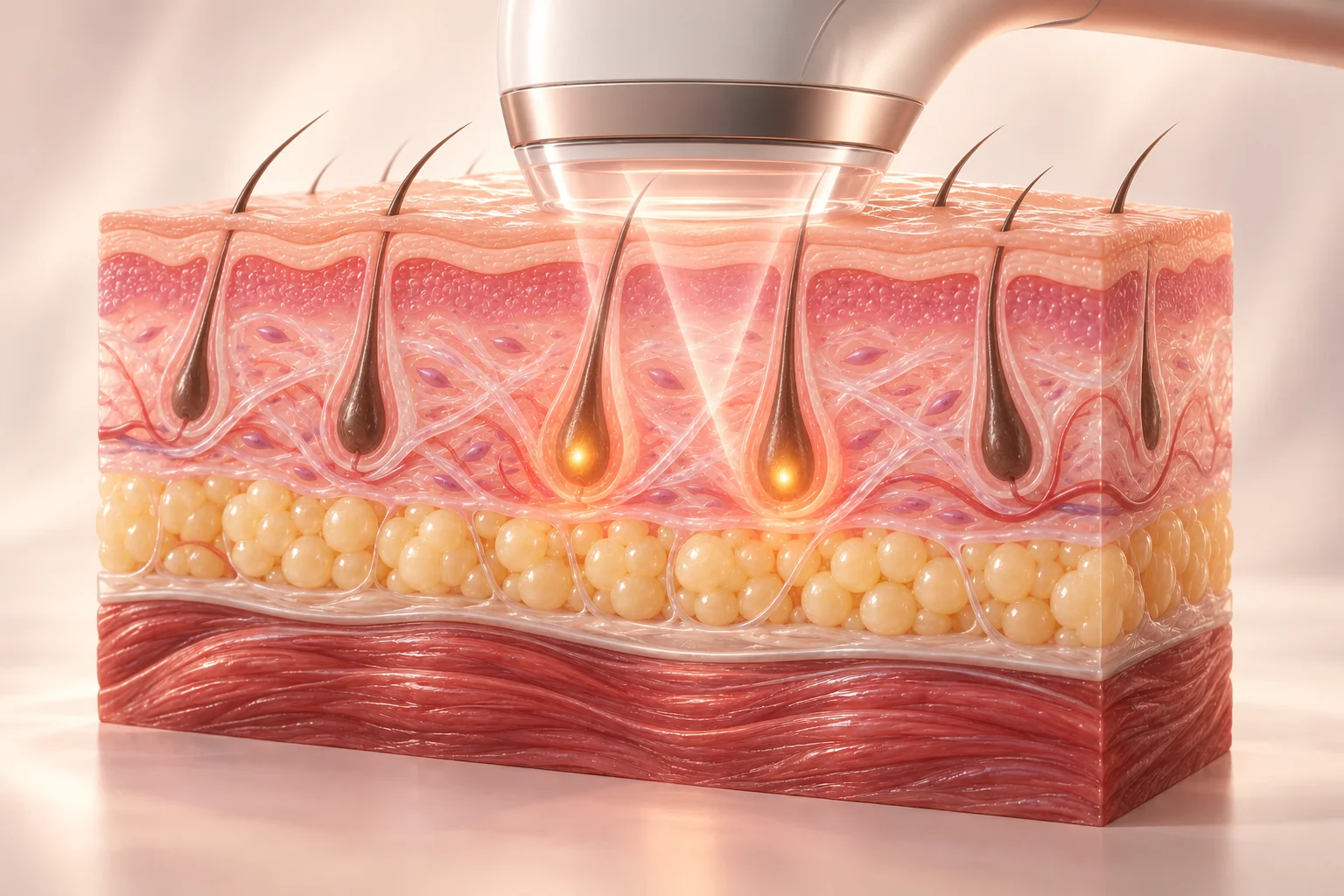
- GentleMax Pro Plus
- Elite iQ
- Clarity II
- Soprano Titanium
Devices & products used
- 01GentleMax Pro PlusCandela, USA
Combines a 755 nm alexandrite laser and a 1064 nm Nd:YAG laser, and sprays a burst of cryogen onto the skin with each pulse.
- 02Elite iQCynosure, USA
A 755 nm and 1064 nm dual-wavelength laser with a melanin reader (Skintel) that measures skin pigment to guide test-spot settings.
- 03Clarity IILutronic, Korea
Houses separate 755 nm alexandrite and 1064 nm Nd:YAG lasers; its US FDA clearance covers hair reduction on skin types I–VI, including tanned skin.
- 04Soprano TitaniumAlma Lasers
A diode laser that fires 755 nm, 810 nm and 1064 nm together, heating follicles gradually while the cooled handpiece is kept moving over the skin.
Clinics do not all carry the same devices, products or techniques. Ask which one will be used, by name, before you book.
How it is done, in photos
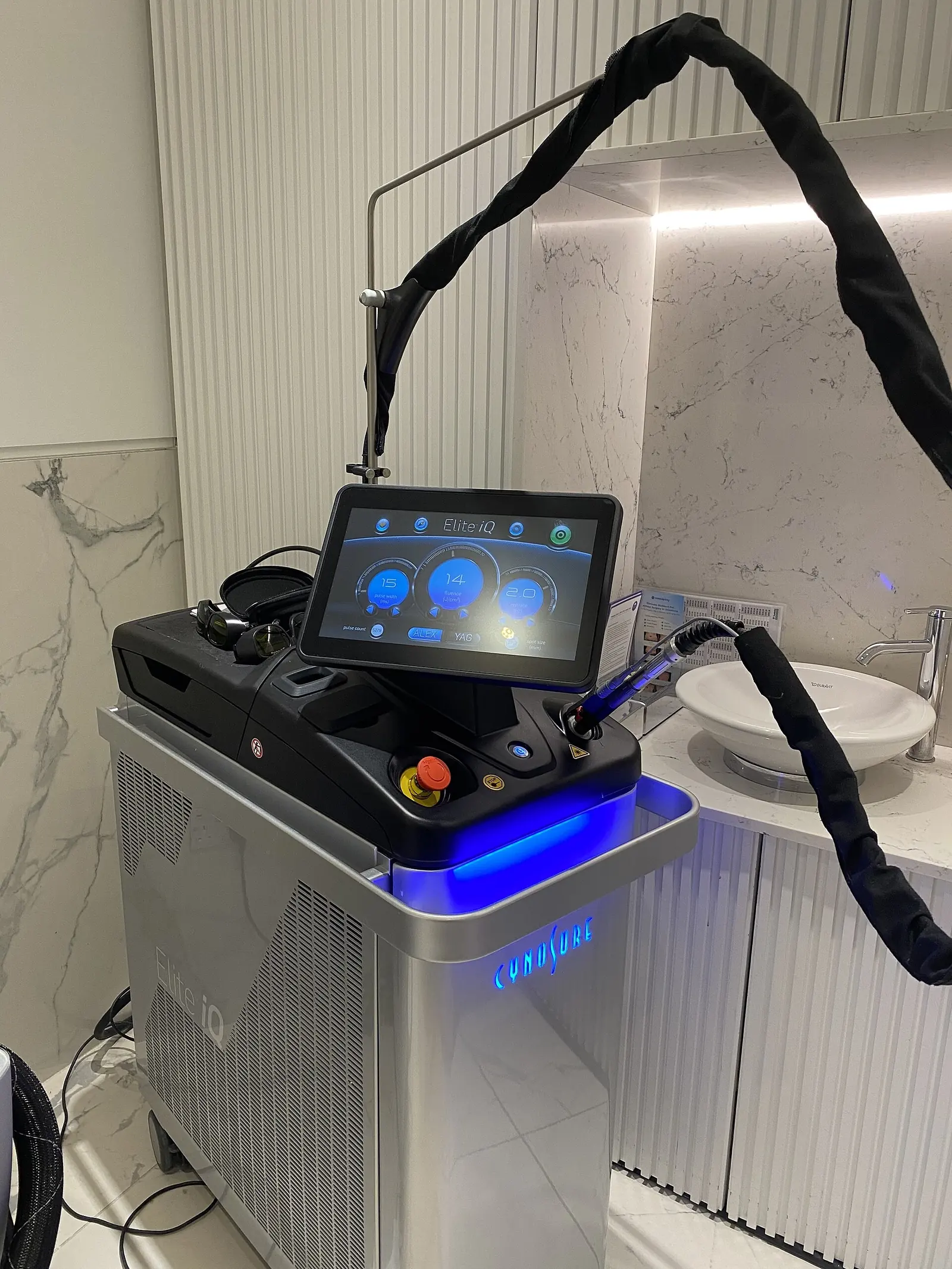
A Cynosure Elite iQ hair removal laser; it affects only actively growing follicles, which is why several sessions are usually needed.
Photo: Secretlondon / CC BY-SA 4.0 / CC BY-SA 4.0 via Wikimedia Commons
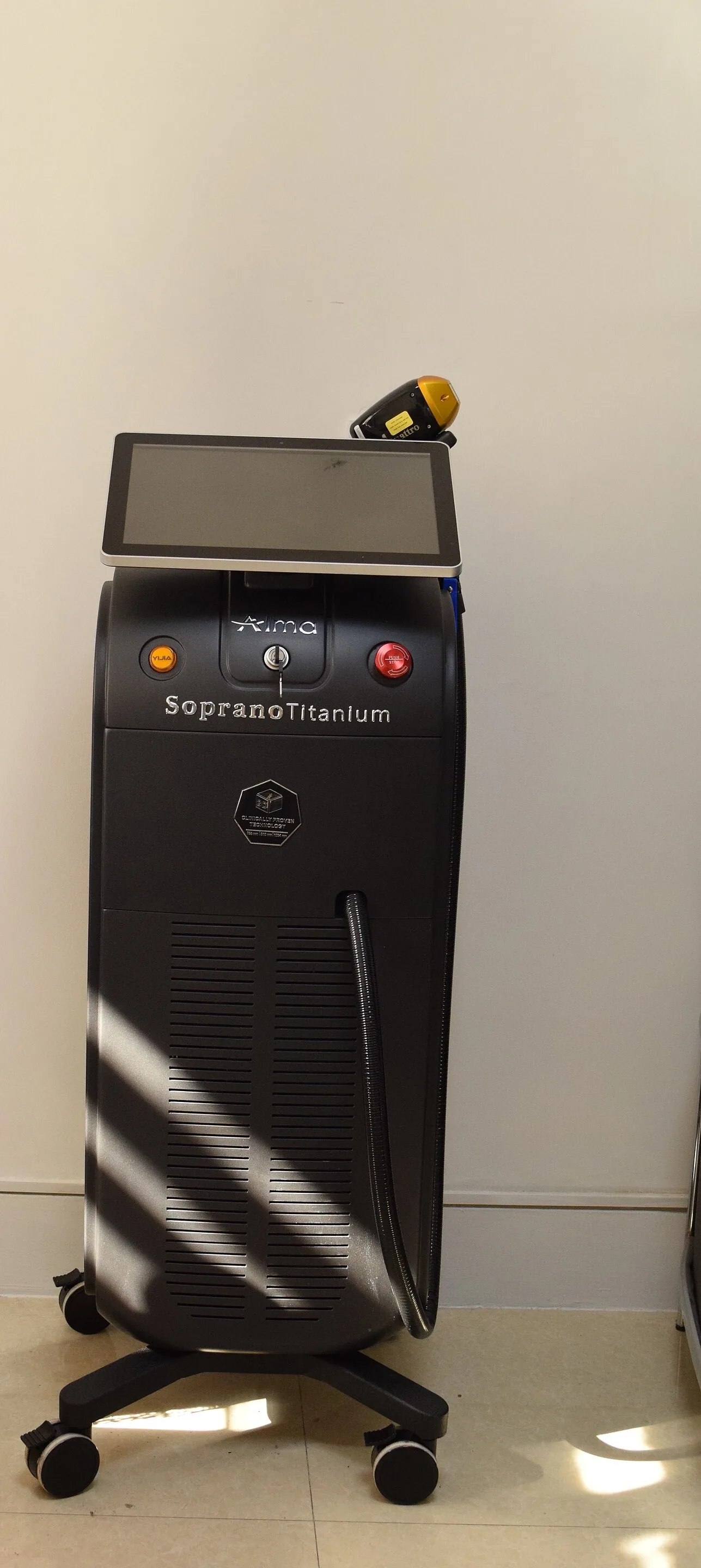
A Soprano Titanium diode laser by Alma Lasers; results depend on hair colour and thickness, the area, the laser used and skin colour.
Photo: Ft10$roma / CC BY-SA 4.0 / CC BY-SA 4.0 via Wikimedia Commons
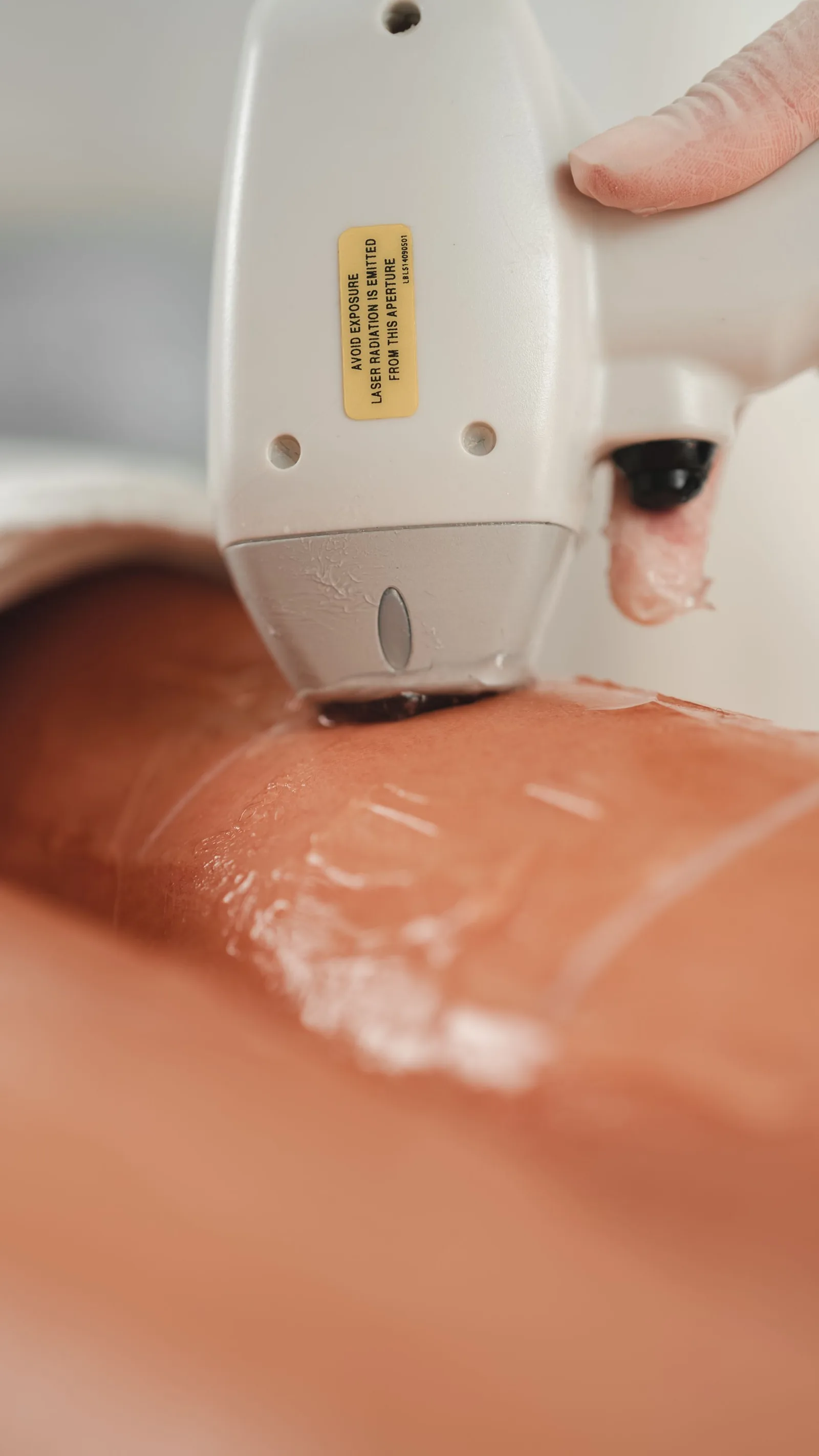
A laser handpiece glides over cooling gel on trimmed skin; hair should be about 1–5 mm long, and plucking beforehand reduces the effect.
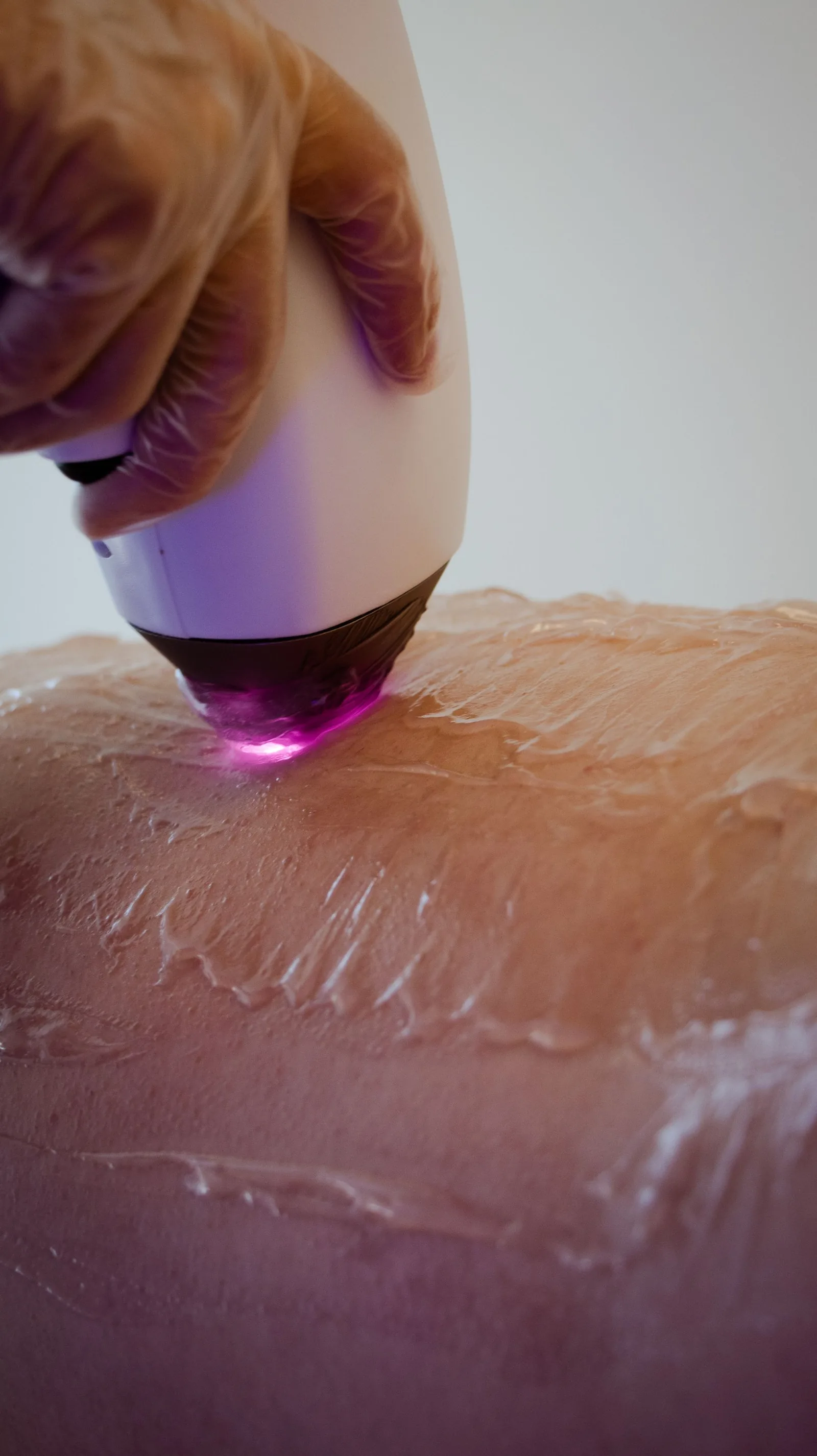
The handpiece window sits flat on gel-covered skin; right afterwards the treated skin often looks red and swollen, like a mild sunburn.
Device and procedure images are provided by the manufacturers / licensed stock; they do not show COMEDI patients.
At a glance
- How it works
- Laser light is absorbed by melanin in the hair follicle, and the resulting heat damages the follicle. Regulators describe the outcome as permanent hair reduction, meaning a long-term, stable drop in the number of regrowing hairs, not removal of every hair.
- Session time
- A small area such as the upper lip takes minutes. A large area such as the back or legs can take more than an hour.
- Anaesthesia
- Most areas need none; the pulses feel like warm pinpricks or a rubber band snap. A numbing gel is sometimes applied 30–60 minutes beforehand for small, sensitive areas.
- Sessions & interval
- Most people need 2–6 treatments, typically every 4–6 weeks. Occasional maintenance sessions may be needed later.
- Skin tone notes
- The 755 nm alexandrite wavelength is strongly absorbed by melanin and suits lighter skin, while the longer 1064 nm Nd:YAG wavelength is used for darker skin. Tanning should be avoided before and after treatment.
- After treatment
- Redness, swelling and mild discomfort for one to three days are common. Blistering, scarring and lasting colour change are rare but possible.
The type of laser depends on the goal — pigment, redness, texture or hair — and it is often planned as a course rather than one session. Skin tone and the type of pigment change how the skin responds.
Response depends on hair colour and thickness, and it does not remove every hair permanently.
Real cases
A case only helps when you can see the conditions behind it.
Sign in to see the before & after photos
Free. We use your Google name and email only to answer questions about these cases. Clinic names are shared in your private consultation.
 Before
 After
- Sessions
- 5 sessions (example)
- Combined
- None
- Photo timing
- after 5 sessions (example)
 Before
 After
- Sessions
- 5 sessions (example)
- Combined
- None
- Photo timing
- after 5 sessions (example)
 Before
 After
- Sessions
- 5 sessions (example)
- Combined
- None
- Photo timing
- after 5 sessions (example)
- SessionsOne session, or the result of a course
- CombinedWhether other treatments or surgery were done together
- Photo timingHow long after the procedure the photo was taken
What to ask in a consultation
Questions about whether it suits you and what the alternatives are.
Often considered when
- People who want long-term hair reduction and accept that it slows hair growth rather than guaranteeing permanent removal
- Excess hair growth (hirsutism), after the underlying cause has been checked
- Hair-related skin problems such as razor bumps (pseudofolliculitis), where hair is removed for therapeutic reasons
- Dark hair on lighter skin, the combination the AAD says laser hair removal works best for
Checks in Korea
- Korea's Ministry of Food and Drug Safety (MFDS) advises getting an accurate diagnosis from a dermatology specialist on whether the condition can be treated by laser, and being treated by a specialist with plenty of laser experience.
- Saunas and jjimjilbang are a common part of a Korea trip, but MFDS advises avoiding strong heat like these after a medical laser treatment, and not having another skin procedure before the skin has recovered.
- Q01Is this laser suitable for my skin tone and type of pigment? How does it compare with other options?
- Q02How many sessions fit into a short stay, and how would I continue afterwards?
- Q03Who will perform the treatment, and what is their specialty?
- Q04Which device or product will be used, and is it the original I asked about?
- Q05How many sessions are usually planned, and can they fit into my stay?
- Q06What should I avoid before and after — sun, alcohol, flights, exercise?
- Q07What is included in the written estimate, and what could change after the consultation?
Check these yourself at the consultation
- Ask which laser type and wavelength (alexandrite 755 nm, diode, or Nd:YAG 1064 nm) will be used for your skin tone and hair colour.
- Tell the clinic about recent sun exposure or tanning, and ask whether a test spot is done first.
- Ask how many sessions are planned and how they fit with the length of your stay, since sessions are normally weeks apart.
Recovery & schedule
Check swelling, daily routine, activity limits and review visits separately.
At a glance
- Before the first session
- An Indian dermatology guideline advises trimming the hair or shaving the area a day earlier, so that hair is no more than about 1–5 mm long at treatment. ASPS notes that plucking beforehand reduces the effect, because the laser's target is gone.
- During the session
- Everyone in the room must wear protective eyewear. The AAD notes that treatment causes small plumes of smoke with a sulphur-like smell.
- Why several sessions
- Laser hair removal only affects actively growing hair follicles, so ASPS explains that several treatments may be needed for significant hair reduction.
- When change shows
- The AAD describes a reduction of roughly 10–25% after the first treatment. Results depend on hair colour and thickness, the area, the laser used and skin colour.
- How long it lasts
- According to the AAD, most patients see no hair on the treated skin for several months or even years, and when hair regrows there tends to be less of it. ASPS adds that regrown hair is finer, lighter and fewer, and that it does not guarantee permanent removal.
- 01Swelling & bruising
Swelling & bruising: the treated skin is red and swollen right afterwards, looking like a mild sunburn. A cool compress can ease the discomfort.
- 02Back to routine
Back to routine: the AAD says there is generally no real downtime, and most people return to everyday activities straight away despite the redness.
- 03Activity limits
Activity limits: keep direct sun off the treated skin and avoid tanning beds and sun lamps. Korea's drug and device regulator (MFDS) also advises avoiding strong heat such as saunas and jjimjilbang, and irritating cosmetics or massage on the area.
- 04Follow-up & flying home
Follow-up & flying home: each session is a separate visit weeks apart and a course usually takes several sessions, so one trip usually covers only part of it. Plan how the remaining sessions or maintenance treatments will be done after you fly home.
Published guidance; your own clinic sets the actual plan.
Before your visit day
What clinics ask of international patients, in one place.
- Bring your passportClinics register international patients with their passport, and any estimate or prescription is issued in the name on it.
- Patients under 19Adulthood in Korea starts at 19. For a younger patient, clinics generally ask a parent or legal guardian to consent in writing, and many ask them to attend. Tell us the patient's age when you write, and we check what the clinic needs.
- Coming with someoneA family member or friend can usually join you in the consultation room. Treatment and recovery areas follow each clinic's rules, so we check this before your visit. If more than one person is booking, tell us what each person is interested in.
- Language helpCoordinators reply in English, Japanese, Chinese and Korean. Interpretation on the day is arranged for your dates, and we confirm in writing what it covers before you travel.
- Medicines and allergiesWrite down the medicines you take and any allergies. The clinic asks about both before any treatment.
What changes the price
The same treatment can be quoted differently depending on the items below.
What differs from clinic to clinic
- Laser type for your skin
- The Indian guideline lists several lasers for hair reduction, including alexandrite (755 nm), diode (800 nm) and Nd:YAG (1064 nm). The AAD says it is now an option for darker skin too, but must be performed very carefully. Clinics own different machines, so the laser offered to you depends on where you go.
- Cooling
- The Indian guideline calls cooling after treatment essential, while noting that how it is done depends on the system used. Which cooling a clinic's machine and routine provide varies.
- Who operates the laser
- An Indian dermatology guideline prefers the physician to perform the entire procedure, and accepts a properly trained nurse assistant or junior doctor only after the patient has been informed, under the senior physician's direct supervision and after the parameters have been determined. This is Indian guidance, not a rule for Korea; the AAD recommends choosing a board-certified dermatologist. Ask the clinic who will actually operate the laser.
- Test spot policy
- Dermatology guidelines describe a test patch as useful for setting precise parameters but not mandatory, so some clinics do one and others do not.
- Checking the cause of excess hair
- For hirsutism, the Indian guideline says female patients must be evaluated to rule out the underlying cause, with tests in consultation with a gynaecologist or endocrinologist in selected patients. Whether this check is offered, or the clinic treats the hair alone, differs.
- Plan across trips
- Because a course takes several sessions weeks apart and maintenance treatments may follow, clinics differ in how they schedule sessions for visitors and handle the rest of the course.
- Combined areas
- Whether adjoining areas (for example full legs plus bikini) are quoted together or one by one.
- Test spot
- Whether a test spot is done and whether it needs a separate visit before the first full session.
- Doctor's skin assessment
- Whether the doctor's consultation and skin and hair assessment are included or charged separately.
- After-care products
- Whether prescribed creams or sunscreen given after treatment are included.
- Unused sessions
- How long a package stays valid and what happens to sessions you cannot attend before flying home.
- Touch-up sessions
- Whether later maintenance sessions are priced separately from the initial course.
- Device & method
- Which laser is used and how it is applied
- Area & size
- Size and number of treated areas
- Sessions
- Recommended sessions, price per session and any package terms
- Numbing & care
- Numbing cream and soothing or recovery care
Prices are set by the clinic after a consultation. Ask for an itemised, written estimate before you book, and check what is included and what could change.
Often charged separately
Ask whether each of these is in your estimate.
| Item | What to ask |
|---|---|
| Consultation fee | Whether the consultation is charged, and whether that amount comes off the treatment price. |
Clinics in Korea build a treatment estimate from the area, the amount used or the number of sessions.
The final figure is set after the doctor sees you at the consultation.
Ask for an itemised, written estimate that marks each item above as included or not, so you can compare two quotes on the same basis.
VAT before you compare quotes
The VAT refund for foreign visitors' cosmetic procedures covered only procedures received by 31 December 2025, so procedures received now are not refunded. Plan your budget without it, and ask each clinic whether VAT is included in the written quote so you compare the same total.
Ask COMEDI, for example
Clinics in Seoul differ in equipment, technique, specialist focus and what the price includes. Send us your question and we compare partner clinics for you.
- “Which partner clinics have a laser suited to my skin type, and which one is it?”
- “I am in Korea for 10 days. How many sessions can I fit in, and what happens to the rest of the package?”
- “Does a doctor do the treatment, and is a test spot included?”
- “Can you compare quotes for underarms and full legs, including touch-up sessions?”
Precautions & aftercare
General information. Follow the written instructions from your treating doctor for anything specific to you.
Side effects and precautions for Laser hair removal are in one place at the top of this page.
Aftercare for this procedure
- Use a cool compress if the skin feels hot or tender.
- Between sessions, shave or trim only; avoid plucking, waxing or electrolysis, which remove the hair the laser needs to target. The guideline also says not to bleach the hair in the treatment area.
- Avoid continuous sun exposure, and long hours under halogen lights, while the skin settles.
- Do not use irritating cosmetics, scrubs or massage on the treated area until it has recovered.
- Do not rush into another skin procedure before the skin has recovered.
- Tell the clinic about recent tanning, medicines that increase light sensitivity, possible pregnancy, keloid tendency and skin conditions.
- Contact the clinic if pigment darkens or lightens, or if blisters or severe pain appear.
- Keep up sun protection for as long as the clinic advises.
Information only. Suitability, risks, recovery and price are assessed by the treating doctor in a consultation.
Sources for this section 4
- Laser hair removal: FAQs — American Academy of Dermatology
- Laser Hair Removal — American Society of Plastic Surgeons
- Standard guidelines of care: Laser and IPL hair reduction (IADVL Dermatosurgery Task Force, 2008) — Indian Journal of Dermatology, Venereology and Leprology
- 의료용 레이저(피부치료용) 안전사용 정보 (2016-08-25) — 식품의약품안전처
Related questions & guides
Worth reading alongside this page.
Notes from people who used COMEDI
Written after a consultation we arranged, and matched to that request.
Common questions
How much does Laser hair removal cost in Korea?+
Prices are set by each clinic after a consultation and depend on the technique, area and your needs. Ask for an itemised, written estimate before you book — it should list what is included and what could change. We help you request and compare estimates.
Can foreigners get Laser hair removal in Korea?+
Yes. Many Seoul clinics see international patients. We help with clinic information, consultations in your language, written estimates and interpretation on the day.