
CO2& Fraxel laser
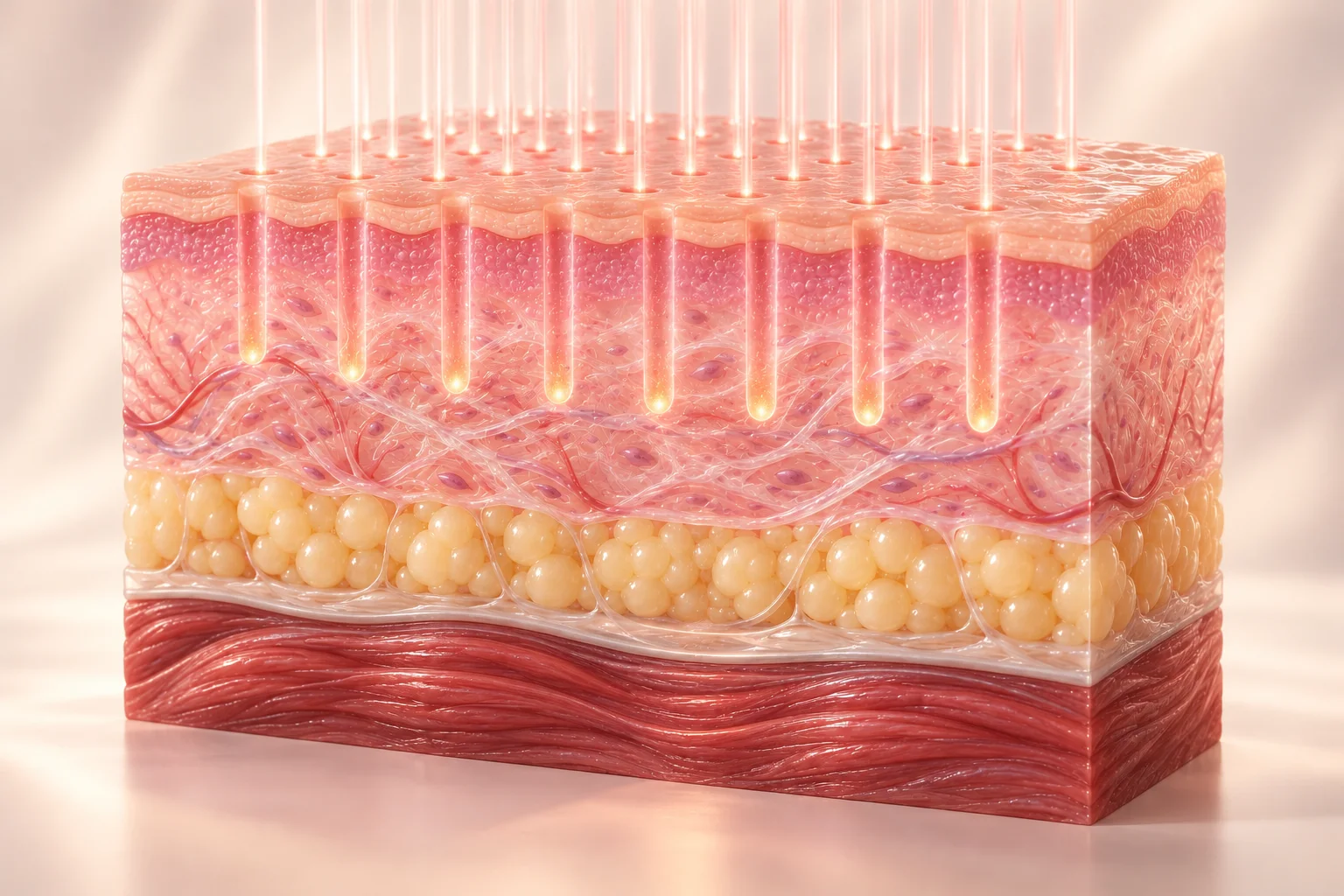
Microscopic treatment zones are created in the skin. It is used for scars, texture and fine lines.

- Type
- Non-surgical
- Usually by
- Dermatologist
- Category
- Laser & pigment
- First step
- Consultation
Information only. Suitability, risks, recovery and price are assessed by the treating doctor in a consultation.
Side effects and precautionsWhat to know about CO2 & Fraxel laser before you book13
Reactions that usually settle, signs to tell the clinic about straight away, and times to wait. Your doctor goes through the risks that apply to you at the consultation.
Usually settles on its own
- Redness and inflammation, and a clear or straw-coloured fluid at first. An NHS leaflet describes these as common or normal and says the redness improves within a few days.
- Darkening of the skin (hyperpigmentation). An NHS leaflet says it can occur in up to 37 out of 100 people and usually fades naturally within 6 months, and is more likely in people with darker skin or who tan easily.
- Pinkness of the new skin, which ASPS says gradually lightens over two to three months but may take up to a year to go away.
Tell the clinic promptly
- Infection. NHS leaflets ask you to contact the clinic if the area becomes increasingly red, swollen, painful or hot, or leaks pus or fluid that is not clear.
- Lightening of the skin (hypopigmentation). An NHS leaflet says it occurs in up to 16 out of 100 patients and can be permanent.
- Cold sore (herpes simplex) flare-ups, especially when the area around the mouth is treated. Tell the clinic if you get cold sores.
- Acne developing in the treated area in people who have had acne. One NHS centre may prescribe low-dose antibiotics for 2 or 3 months afterwards to help prevent this.
- Scarring. The ASDS and AAD list scarring among the possible side effects of resurfacing.
Wait or rethink when
- Active acne, very dark skin, deep wrinkles, or excessive or sagging skin. ASPS says you may not be a good candidate for laser skin resurfacing if you have any of these.
- A wound that has broken down or an infection in the area. An NHS hospital leaflet says treatment must be delayed until the area is healed.
- Oral retinoids such as isotretinoin taken within the last 6 months. The same leaflet says they should be stopped for 6 months before laser treatment, and retinoid creams for 2 weeks, because they may lead to delayed healing and scarring.
- Pregnancy. The leaflet asks you to tell the clinic, as there is an increased risk of permanent pigment changes or a longer healing time.
- A tan or sunburn. The AAD states that if you arrive for laser treatment with a tan or sunburn, your dermatologist cannot treat you.
Sources for this section 13
- Carbon Dioxide (CO2) Laser: Information for Patients (2025) — Queen Victoria Hospital NHS Foundation Trust
- Laser Resurfacing: Information and advice for patients (2013) — Sandwell and West Birmingham Hospitals NHS Trust
- Laser resurfacing — American Society for Dermatologic Surgery
- Laser Skin Resurfacing Recovery — American Society of Plastic Surgeons
- Many ways to firm sagging skin — American Academy of Dermatology
- Nonablative Fractional Laser Resurfacing in Skin of Color: Evidence-based Review (J Clin Aesthet Dermatol 2017), abstract — PubMed
- 10 things to know before having laser treatment for your scar — American Academy of Dermatology
- Skin conditions that lasers can treat — American Academy of Dermatology
- Laser Skin Resurfacing Candidates — American Society of Plastic Surgeons
- Acne scars: Consultation and treatment — American Academy of Dermatology
- 의료 해외진출 및 외국인환자 유치 지원에 관한 법률 제6조 — 국가법령정보센터
- 의료법 제27조(무면허 의료행위 등 금지) — 국가법령정보센터
- 의료기기안심책방 (의료기기 종합정보 플랫폼) — 식품의약품안전처
What is it?
The purpose, the change you can expect and the limits.
Microscopic treatment zones are created in the skin. It is used for scars, texture and fine lines.
Fractional laser resurfacing
- Fraxel (1550 nm / 1927 nm)
- UltraPulse
- eCO2
- Sciton Er:YAG (ZoomScan)
- ResurFX (Stellar M22 module)
Devices & products used
- 01Fraxel (1550 nm / 1927 nm)Solta Medical, USA
A non-ablative fractional laser with two wavelengths, 1550 nm and 1927 nm, that heats columns of skin without removing the surface.
- 02UltraPulseLumenis, Israel
An ablative CO2 laser with fractional modes: ActiveFX uses a 1.3 mm spot for the surface and DeepFX a 0.12 mm spot for deeper columns.
- 03eCO2Lutronic, Korea
A CO2 laser (10.6 µm, strongly absorbed by water in tissue) with a scanner handpiece that lays down a pattern of small spots.
- 04Sciton Er:YAG (ZoomScan)Sciton, USA
A 2940 nm erbium:YAG laser that lets the operator set ablation depth and added heat (coagulation) separately.
- 05ResurFX (Stellar M22 module)Lumenis, Israel
A 1565 nm non-ablative fractional laser module cleared for fractional skin resurfacing.
Clinics do not all carry the same devices, products or techniques. Ask which one will be used, by name, before you book.
How it is done, in photos
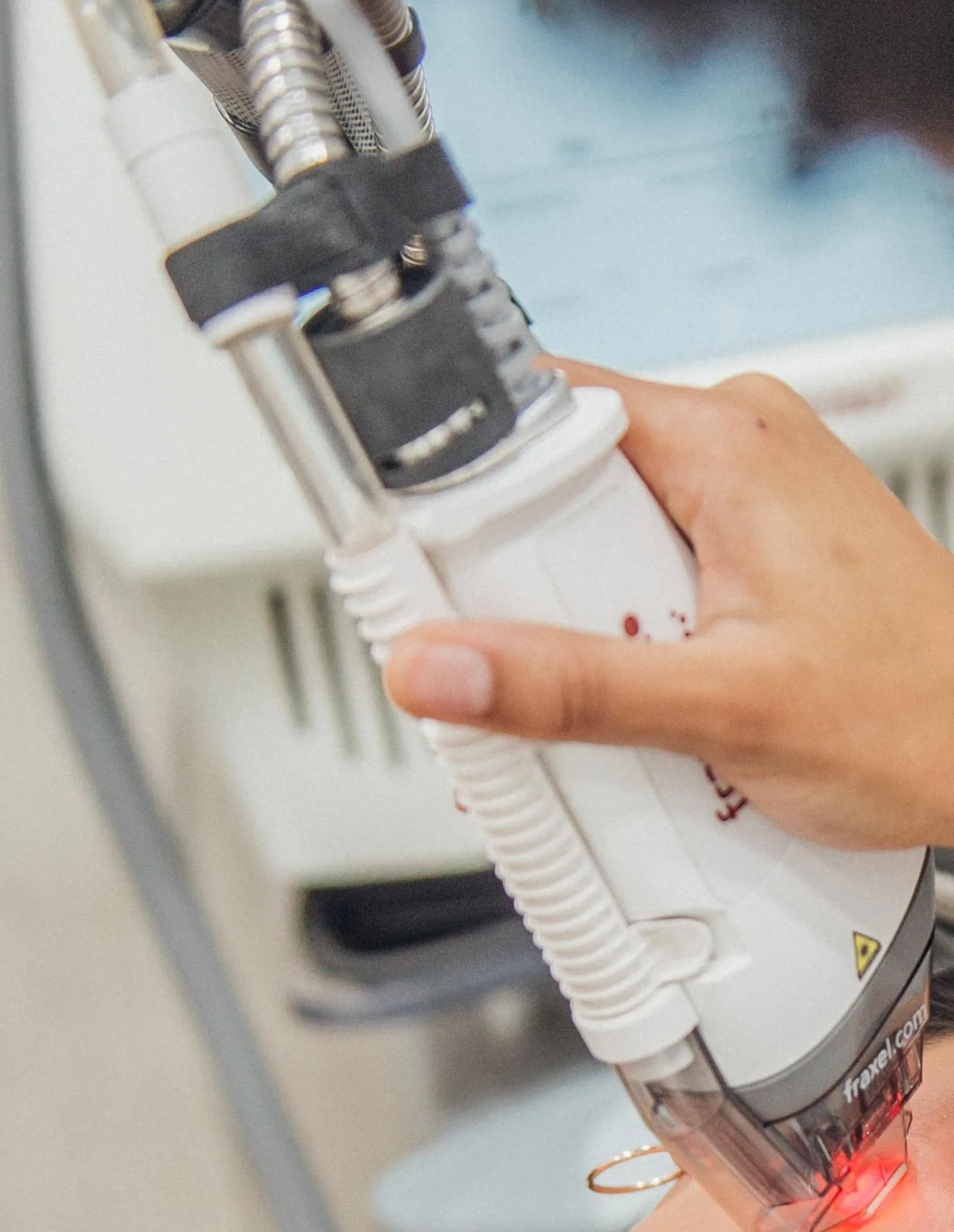
A Fraxel handpiece rolls across the cheek in passes; a non-ablative laser like this has little downtime but often needs a few sessions.
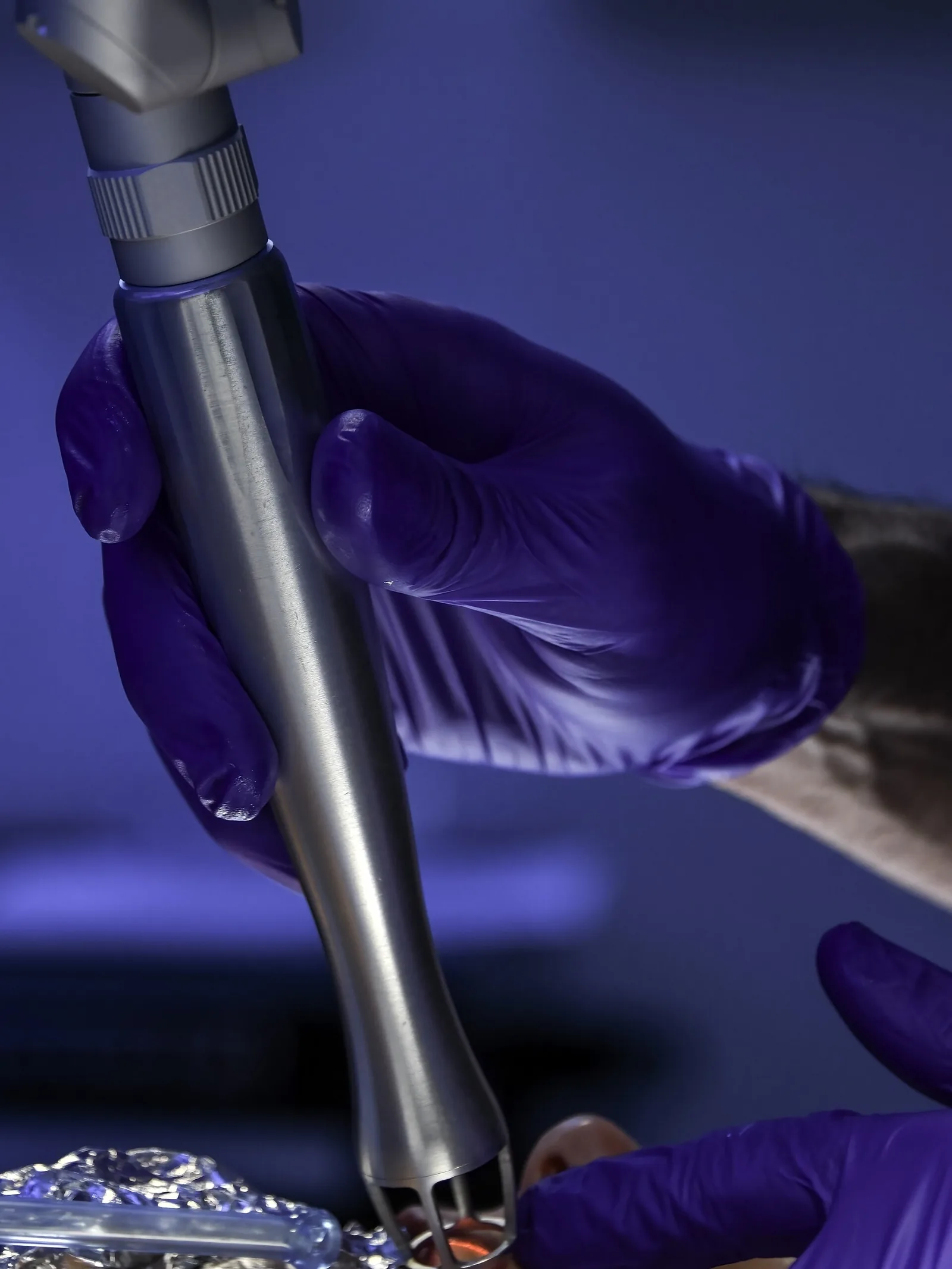
A CO2 laser handpiece treats the skin while foil shields the eyes; afterwards the area is typically red, swollen and hot.
Photo: BalikianFacialPlasticSurgery / CC BY 4.0 / CC BY 4.0 via Wikimedia Commons
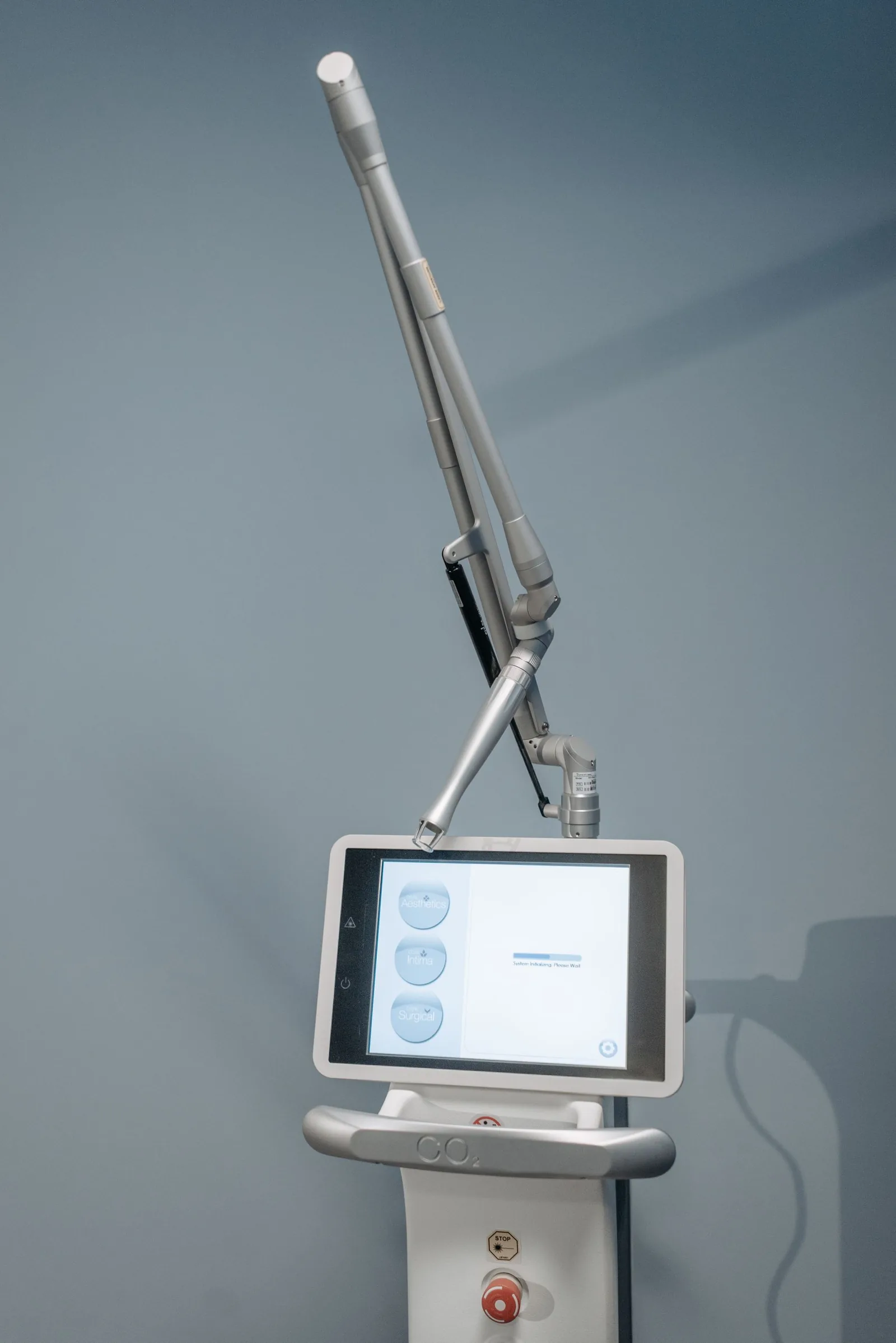
A CO2 laser system with an articulated arm that carries the beam to the handpiece; for scars, sessions are usually spaced 8 to 12 weeks apart.
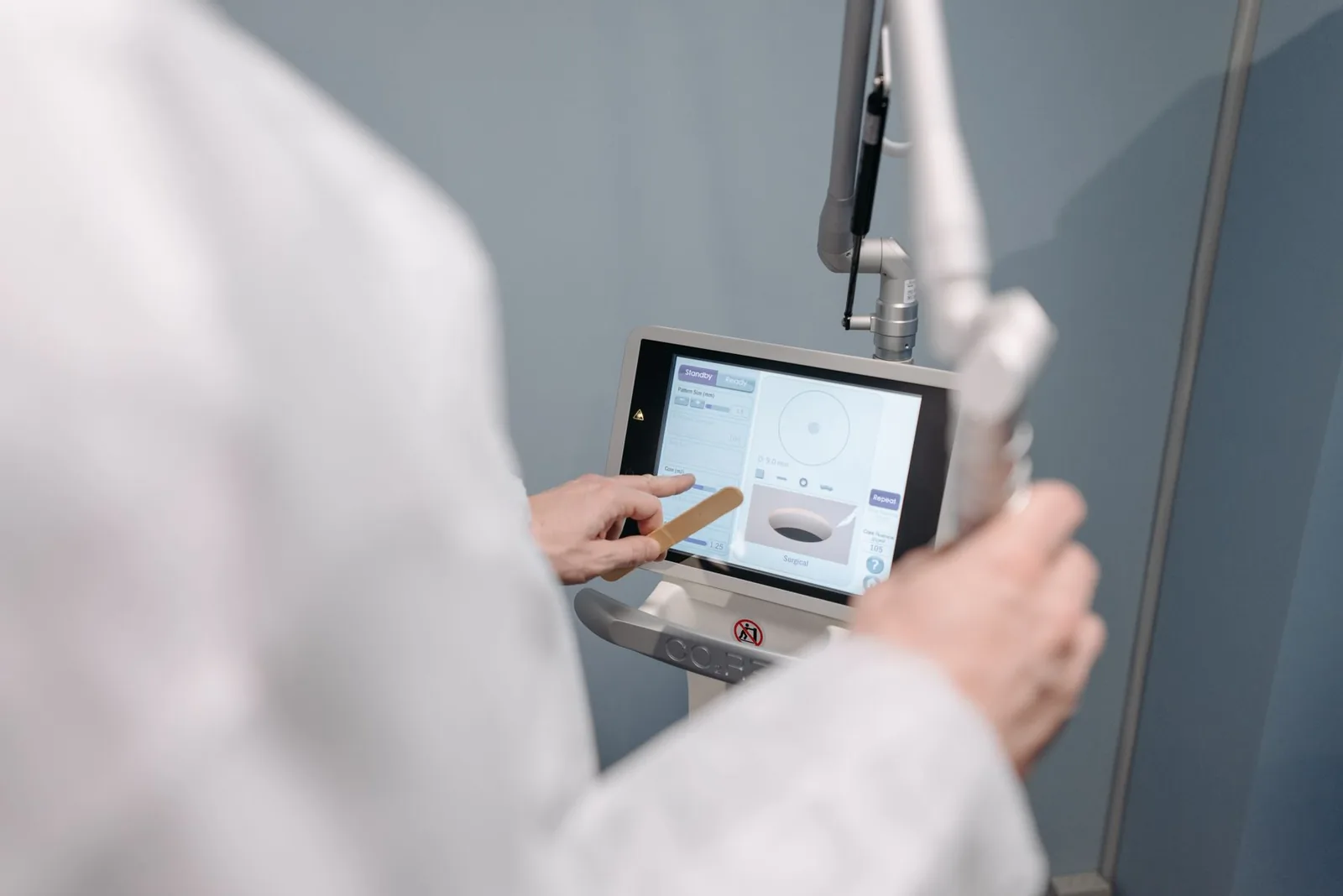
Before treatment, the practitioner sets the pattern size and energy on the laser's touchscreen; the plan for your skin is set by your doctor.
Device and procedure images are provided by the manufacturers / licensed stock; they do not show COMEDI patients.
At a glance
- How it works
- The beam is split into many microscopic columns, leaving untreated skin in between to speed healing. Ablative types (CO2 10,600 nm, Er:YAG 2940 nm) vaporise tissue by heating its water; non-ablative types (around 1550 nm) heat the skin without removing the surface.
- Session time
- For one non-ablative device the manufacturer gives about 20–25 minutes for a full face, plus the time needed for numbing cream to work.
- Anaesthesia
- Numbing cream is typically applied about an hour beforehand. For ablative resurfacing of larger areas, nerve blocks or sedation may be used.
- Sessions & interval
- Non-ablative treatment is usually given as a series; one manufacturer mentions up to five sessions, with spacing set by the doctor. Ablative treatment needs fewer sessions but longer healing.
- Recovery
- After non-ablative treatment a sunburn-like feeling fades within hours and peeling is typical around days 3–4. After ablative resurfacing, healing takes roughly 3–10 days depending on depth and laser type.
- Skin tone notes
- Darker skin is more prone to burns and dark marks after laser treatment, and dermatologic surgeons note that very dark skin is usually not suited to ablative resurfacing. Sun should be avoided beforehand, and antiviral tablets are prescribed for people with a history of cold sores.
The type of laser depends on the goal — pigment, redness, texture or hair — and it is often planned as a course rather than one session. Skin tone and the type of pigment change how the skin responds.
It needs downtime, and scars may improve without disappearing completely.
References 8
- Solta Medical – Fraxel
- Lumenis – UltraPulse
- US FDA 510(k) K091115 – Lutronic eCO2 Laser System
- Sciton – ZoomScan Er:YAG
- US FDA 510(k) K193500 – Lumenis Stellar M22 (ResurFX)
- American Society for Dermatologic Surgery – Laser resurfacing
- StatPearls – Laser Erbium-YAG Resurfacing
- American Academy of Dermatology – Skin conditions that lasers can treat
Real cases
A case only helps when you can see the conditions behind it.
Sign in to see the before & after photos
Free. We use your Google name and email only to answer questions about these cases. Clinic names are shared in your private consultation.
 Before
 After
- Sessions
- 3 sessions (example)
- Combined
- None
- Photo timing
- after 3 sessions (example)
 Before
 After
- Sessions
- 3 sessions (example)
- Combined
- None
- Photo timing
- after 3 sessions (example)
 Before
 After
- Sessions
- 3 sessions (example)
- Combined
- None
- Photo timing
- after 3 sessions (example)
- SessionsOne session, or the result of a course
- CombinedWhether other treatments or surgery were done together
- Photo timingHow long after the procedure the photo was taken
What to ask in a consultation
Questions about whether it suits you and what the alternatives are.
Often considered when
- People with acne scarring or sun-damaged skin. An NHS skin laser centre lists both among the problems CO2 laser resurfacing is used to reduce, and the ASDS lists acne scars, age spots, crow's feet, sun-damaged skin and wrinkles among what resurfacing can treat.
- People with scars from burns, injury or surgery. An NHS hospital leaflet says laser may improve a scar's colour, tightness, firmness, texture or thickness, but that occasionally only limited effects are achieved. The AAD notes that laser can make a scar less noticeable but cannot get rid of it.
- People with darker skin (Fitzpatrick IV to VI) considering a non-ablative fractional laser. A 2017 evidence review of non-ablative fractional resurfacing in skin of colour found level 1 evidence for acne, stretch marks and skin rejuvenation and level 2 evidence for acne scars, melasma and surgical or injury scars, while noting that high-quality studies in skin types V and VI are scarce. This review covers non-ablative lasers only, not ablative CO2 resurfacing.
- People who can set aside recovery time. The AAD says you will need to stay home for 5 to 7 days after laser resurfacing, and an NHS leaflet notes that most people prefer to take a week off work.
Checks in Korea
- Under Korea's Medical Service Act (Article 27), no one other than a licensed medical professional may perform medical procedures, and no one may have a non-licensed person perform them.
- Under Korean law, a clinic that wants to attract foreign patients must register with the city or provincial government, have at least one specialist for each department it plans to treat foreign patients in (except departments that are not specialties set by Presidential Decree), and hold medical malpractice liability insurance or belong to a medical liability mutual aid association. Registration is valid for 3 years.
- Korea's Ministry of Food and Drug Safety runs a medical device information platform (emedi.mfds.go.kr) where information on medical devices can be looked up.
- Q01Is this laser suitable for my skin tone and type of pigment? How does it compare with other options?
- Q02How many sessions fit into a short stay, and how would I continue afterwards?
- Q03Who will perform the treatment, and what is their specialty?
- Q04Which device or product will be used, and is it the original I asked about?
- Q05How many sessions are usually planned, and can they fit into my stay?
- Q06What should I avoid before and after — sun, alcohol, flights, exercise?
- Q07What is included in the written estimate, and what could change after the consultation?
Check these yourself at the consultation
- Ask whether the planned laser is ablative (CO2 or erbium) or non-ablative, and which wavelength and device it is.
- Ask how many days of redness, peeling or crusting to expect and when you can fly home or wear make-up.
- Tell the clinic about cold sores, acne medicines such as isotretinoin, retinoid creams and recent sun exposure.
Recovery & schedule
Check swelling, daily routine, activity limits and review visits separately.
At a glance
- Patch test first
- At one NHS laser clinic, the first appointment is a small patch test to see how your skin reacts, and the treatment session is then booked 8 to 12 weeks later. Ask whether your clinic tests first, as this affects how a short stay is planned.
- Sessions & spacing
- For CO2 laser on scars, the same NHS leaflet says most patients need multiple treatments spaced around 8 to 12 weeks apart. The AAD notes that a non-ablative laser has no downtime but you may need a few treatments. The actual plan is set by your doctor.
- Preparation
- AAD guidance on scar lasers recommends quitting smoking for at least 2 weeks, stopping vitamin E, aspirin and other products that delay healing, and pausing retinoid or glycolic acid skin care for 2 to 4 weeks. An NHS leaflet advises avoiding sun for 4 to 6 weeks and fake tan for 1 week beforehand, and another notes that blood thinners may need to be stopped for a short time.
- Under general anaesthetic
- An NHS leaflet says that after a general anaesthetic a responsible adult must collect you, someone should stay with you for the next 24 hours, and you must not drive yourself home. If you are travelling alone, ask the clinic in advance which anaesthetic is planned.
- When change shows
- Published guidance describes general timelines rather than a promise. The AAD's general description is that tightening and fewer wrinkles may show within about 2 weeks once the skin has healed after laser resurfacing, while results of laser scar treatment can take months and you may notice little improvement at first. ASPS notes that the new skin is pink and gradually lightens over two to three months, and it may take up to a year for the pinkness to go away. How much change you see, and when, differs from person to person; ask your doctor what to expect for your skin.
- 01Swelling & bruising
An NHS leaflet says the treated area will be red, swollen and hot straight afterwards, will leak a clear straw-like fluid for a few days, and then starts to scab 3 to 7 days after treatment. ASPS says that about five days to a week after resurfacing the skin usually becomes dry and peels.
- 02Back to routine
The AAD says you will need to stay home for 5 to 7 days after laser resurfacing, and ASPS notes that recovery times vary depending on your treatment, giving generally up to two weeks for CO2 and one full week for erbium. Your own timeline is set by your doctor. ASPS adds that make-up may be used once the treated areas have healed.
- 03Activity limits
NHS leaflets advise avoiding swimming, saunas and steam rooms until the area has fully healed, avoiding heavy sweating for 2 weeks, and using a high-SPF sunscreen every day for at least 6 months after treatment.
- 04Follow-up & flying home
One NHS centre books a review with the consultant 8 weeks after treatment to check healing and discuss further sessions, and another asks patients to note how long the area took to heal, as this may inform future treatments. Ask how the clinic will check your healing after you fly home and how any further sessions will be arranged.
Published guidance; your own clinic sets the actual plan.
Before your visit day
What clinics ask of international patients, in one place.
- Bring your passportClinics register international patients with their passport, and any estimate or prescription is issued in the name on it.
- Patients under 19Adulthood in Korea starts at 19. For a younger patient, clinics generally ask a parent or legal guardian to consent in writing, and many ask them to attend. Tell us the patient's age when you write, and we check what the clinic needs.
- Coming with someoneA family member or friend can usually join you in the consultation room. Treatment and recovery areas follow each clinic's rules, so we check this before your visit. If more than one person is booking, tell us what each person is interested in.
- Language helpCoordinators reply in English, Japanese, Chinese and Korean. Interpretation on the day is arranged for your dates, and we confirm in writing what it covers before you travel.
- Medicines and allergiesWrite down the medicines you take and any allergies. The clinic asks about both before any treatment.
What changes the price
The same treatment can be quoted differently depending on the items below.
What differs from clinic to clinic
- Ablative or non-ablative for your goal
- The AAD notes that a non-ablative laser has no downtime but may need a few treatments, while laser resurfacing means staying home for 5 to 7 days and carries a greater risk of side effects such as scarring. Clinics differ in which they recommend for the same concern.
- Patch test and pacing
- One NHS clinic starts with a patch test and books treatment 8 to 12 weeks later, and uses how your skin healed to plan the next session. Whether a clinic tests first, and how it paces sessions, decides how many trips you need.
- Anaesthesia and setting
- An NHS leaflet notes that a local anaesthetic cream can be used, but some people find the procedure too painful even so and need a general anaesthetic, especially for large areas, and the ASDS describes nerve blocks or conscious sedation for larger treatments. Whether a clinic can offer each option shapes your comfort, schedule and cost.
- Who treats you
- The AAD says laser results depend largely on the skill of the person performing the procedure, and ASPS warns that in the wrong or inexperienced hands laser resurfacing can be dangerous. Doctors differ in their experience with your skin type and concern.
- Combination plans
- The AAD notes that deep acne scars may be treated with a laser plus a filler, that different scar types such as ice pick and rolling scars need different treatment, and that a dermatologist may use more than one treatment. Clinics differ in which combinations they offer.
- Laser class and mode
- Whether the quote is for fully ablative CO2, fractional CO2 or erbium, or a non-ablative fractional laser, since recovery and session count differ.
- Depth, density and passes
- The planned settings and number of passes, and whether stronger single sessions or gentler repeated sessions are proposed.
- Anaesthesia type
- Numbing cream only, a local block or injection, sedation, or general anaesthesia, and whether an anaesthetist's fee is separate.
- Treated areas
- Face only, or also eyelids, neck, chest or hands, which may need different settings.
- Prescriptions and dressings
- Whether antiviral or antibiotic medicines, ointments, cleaning supplies and dressings are included.
- Patch test, combined treatments and reviews
- Whether a patch test, fillers or other add-ons are planned, and whether wound checks and follow-up photos are included.
- Device & method
- Which laser is used and how it is applied
- Area & size
- Size and number of treated areas
- Sessions
- Recommended sessions, price per session and any package terms
- Numbing & care
- Numbing cream and soothing or recovery care
Prices are set by the clinic after a consultation. Ask for an itemised, written estimate before you book, and check what is included and what could change.
Often charged separately
Ask whether each of these is in your estimate.
| Item | What to ask |
|---|---|
| Consultation fee | Whether the consultation is charged, and whether that amount comes off the treatment price. |
Clinics in Korea build a treatment estimate from the area, the amount used or the number of sessions.
The final figure is set after the doctor sees you at the consultation.
Ask for an itemised, written estimate that marks each item above as included or not, so you can compare two quotes on the same basis.
VAT before you compare quotes
The VAT refund for foreign visitors' cosmetic procedures covered only procedures received by 31 December 2025, so procedures received now are not refunded. Plan your budget without it, and ask each clinic whether VAT is included in the written quote so you compare the same total.
Ask COMEDI, for example
Clinics in Seoul differ in equipment, technique, specialist focus and what the price includes. Send us your question and we compare partner clinics for you.
- “For my acne scars, which partner clinics would use fractional CO2 and which a non-ablative laser, and how many days of crusting should I plan for?”
- “I have darker skin. Which clinics have doctors experienced with fractional lasers on skin like mine, and do they do a patch test first?”
- “I only have 10 days in Seoul. Which plan fits my stay, and how would further sessions and wound checks work after I fly home?”
- “Does each clinic's quote include anaesthesia, prescriptions, dressings and follow-up visits?”
Precautions & aftercare
General information. Follow the written instructions from your treating doctor for anything specific to you.
Side effects and precautions for CO2 & Fraxel laser are in one place at the top of this page.
Aftercare for this procedure
- An NHS leaflet advises a layer of ointment such as Vaseline, reapplied often through the day, to stop crusting, but not letting it build up into a thick layer. The ASDS describes soaking, applying ointment and re-dressing the area daily. Ask which routine your clinic wants.
- Do not pick or scratch the scabs. NHS and ASPS guidance warns this can lead to infection or scarring.
- Avoid exfoliating and soaps or perfumed products on the area until it has fully healed. ASPS says Retin-A or glycolic acid products can usually be resumed around six weeks after resurfacing.
- If the area is swollen, sleeping with extra pillows to raise it at night can help, according to an NHS leaflet.
- Use any prescribed antibiotic ointment or antiviral medicine as instructed. One NHS centre gives antibiotic ointment twice a day for 5 to 7 days and may advise an antiviral for 7 days before and 7 days after for people who get cold sores.
- Tell the clinic about recent tanning, medicines that increase light sensitivity, possible pregnancy, keloid tendency and skin conditions.
- Contact the clinic if pigment darkens or lightens, or if blisters or severe pain appear.
- Keep up sun protection for as long as the clinic advises.
Information only. Suitability, risks, recovery and price are assessed by the treating doctor in a consultation.
Sources for this section 13
- Nonablative Fractional Laser Resurfacing in Skin of Color: Evidence-based Review (J Clin Aesthet Dermatol 2017), abstract — PubMed
- Carbon Dioxide (CO2) Laser: Information for Patients (2025) — Queen Victoria Hospital NHS Foundation Trust
- Laser Resurfacing: Information and advice for patients (2013) — Sandwell and West Birmingham Hospitals NHS Trust
- 10 things to know before having laser treatment for your scar — American Academy of Dermatology
- Laser resurfacing — American Society for Dermatologic Surgery
- Skin conditions that lasers can treat — American Academy of Dermatology
- Laser Skin Resurfacing Candidates — American Society of Plastic Surgeons
- Laser Skin Resurfacing Recovery — American Society of Plastic Surgeons
- Many ways to firm sagging skin — American Academy of Dermatology
- Acne scars: Consultation and treatment — American Academy of Dermatology
- 의료 해외진출 및 외국인환자 유치 지원에 관한 법률 제6조 — 국가법령정보센터
- 의료법 제27조(무면허 의료행위 등 금지) — 국가법령정보센터
- 의료기기안심책방 (의료기기 종합정보 플랫폼) — 식품의약품안전처
Related questions & guides
Worth reading alongside this page.
Notes from people who used COMEDI
Written after a consultation we arranged, and matched to that request.
Common questions
How much does CO2 & Fraxel laser cost in Korea?+
Prices are set by each clinic after a consultation and depend on the technique, area and your needs. Ask for an itemised, written estimate before you book — it should list what is included and what could change. We help you request and compare estimates.
Can foreigners get CO2 & Fraxel laser in Korea?+
Yes. Many Seoul clinics see international patients. We help with clinic information, consultations in your language, written estimates and interpretation on the day.