
Facialfat grafting
Moves your own fat, taken by gentle liposuction, to add volume to areas of the face.

- Type
- Surgical
- Usually by
- Plastic surgeon
- Category
- Facelift & rejuvenation
- First step
- Consultation
Information only. Suitability, risks, recovery and price are assessed by the treating doctor in a consultation.
Side effects and precautionsWhat to know about Facial fat grafting before you book11
Reactions that usually settle, signs to tell the clinic about straight away, and times to wait. Your doctor goes through the risks that apply to you at the consultation.
Known risks
- Uneven contour or lumps, fat necrosis or cysts, and infection. Rare but serious events are loss of vision or stroke if fat enters a blood vessel.
Usually settles on its own
- Swelling and bruising, which an NHS leaflet describes as common for a few weeks but rarely lasting more than two months.
- Lumps and bulges in the treated area, which the same leaflet calls fairly common and says usually become smoother with time and massage.
- A lumpy or uneven look where the fat was taken, which an NHS factsheet says gentle massage helps to reduce.
Tell the clinic promptly
- Visible fat deposits, or fat moving to other, unintended areas, which an NHS leaflet lists as uncommon.
- Signs of infection around a wound: redness, fever, a burning feeling, increasing pain, swelling or bleeding, or ongoing discharge. An NHS factsheet asks patients to contact the hospital if any of these appear.
- Nerve injury, which the NHS face leaflet says has been reported but is extremely rare.
- Fat entering a blood vessel. In a systematic review of 61 reported patients, symptoms most often began within an hour of injection (66.0% of cases with timing data), so it matters who is on hand during and just after the procedure.
Wait or rethink when
- Smoking or vaping that you are not ready to stop. ASPS asks patients having liposuction, the step used to collect the fat, to stop smoking or vaping, and a 2017 study of 18 smokers concluded that cigarette smoking causes low fat survival rates and impairs the improvement of skin quality.
- Aspirin, anti-inflammatory drugs or herbal supplements that the surgeon does not yet know about. ASPS lists avoiding these among the preparations for liposuction.
- A life-threatening illness or a medical condition that can impair healing. ASPS describes ideal candidates for liposuction, the step used to collect the fat, as healthy individuals who do not have such conditions.
Sources for this section 16
- Autologous Fat Grafting for Facial Rejuvenation - StatPearls
- The Current State of Fat Grafting: A Review of Harvesting, Processing, and Injection Techniques (PMC)
- Autologous Fat Transfer, Corneo-Plastic Unit (Ref 0398) — Queen Victoria Hospital NHS Foundation Trust
- Recovering after a Coleman fat transfer (OU-1180-05) — The Royal Marsden NHS Foundation Trust
- Arterial Embolism After Facial Fat Grafting: A Systematic Literature Review — PMC
- Fat Injections as Dermal Fillers — American Society of Plastic Surgeons
- Facial fat grafting vs facial fillers — American Society of Plastic Surgeons
- What is nano fat grafting, and how is it enhancing aesthetic results? — American Society of Plastic Surgeons
- Most Plastic Surgeons Now Use Fat Grafting as Part of Facelift Surgery — American Society of Plastic Surgeons
- Liposuction Preparation — American Society of Plastic Surgeons
- Complications Associated with Facial Autologous Fat Grafting for Aesthetic Purposes: A Systematic Review of the Literature — PMC
- A Systemic Review of Autologous Fat Grafting Survival Rate and Related Severe Complications — PMC
- 의료 해외진출 및 외국인환자 유치 지원에 관한 법률 제6조 — 국가법령정보센터
- 의료법 제27조(무면허 의료행위 등 금지) — 국가법령정보센터
- The Effect of Smoking on Facial Fat Grafting Surgery (J Craniofac Surg 2017) — PubMed
- Liposuction Candidates — American Society of Plastic Surgeons
What is it?
The purpose, the change you can expect and the limits.
Moves your own fat, taken by gentle liposuction, to add volume to areas of the face.
Fat transfer to the face

Techniques & materials
- 01Centrifugation
Harvested fat is spun (about 3 minutes at 3,000 rpm in the standard description) to separate fat from fluid and oil.
- 02Sedimentation
The fat is left to settle by gravity for around 45 minutes before the fluid is drained off.
- 03Washing and filtering
The fat is rinsed with saline over a strainer or gauze to remove fluid and debris.
- 04Blunt-cannula micro-injection
Processed fat is placed with a blunt cannula in many tiny amounts (about 0.1 mL per pass) at different depths.
Clinics do not all carry the same devices, products or techniques. Ask which one will be used, by name, before you book.
How it is done, in photos
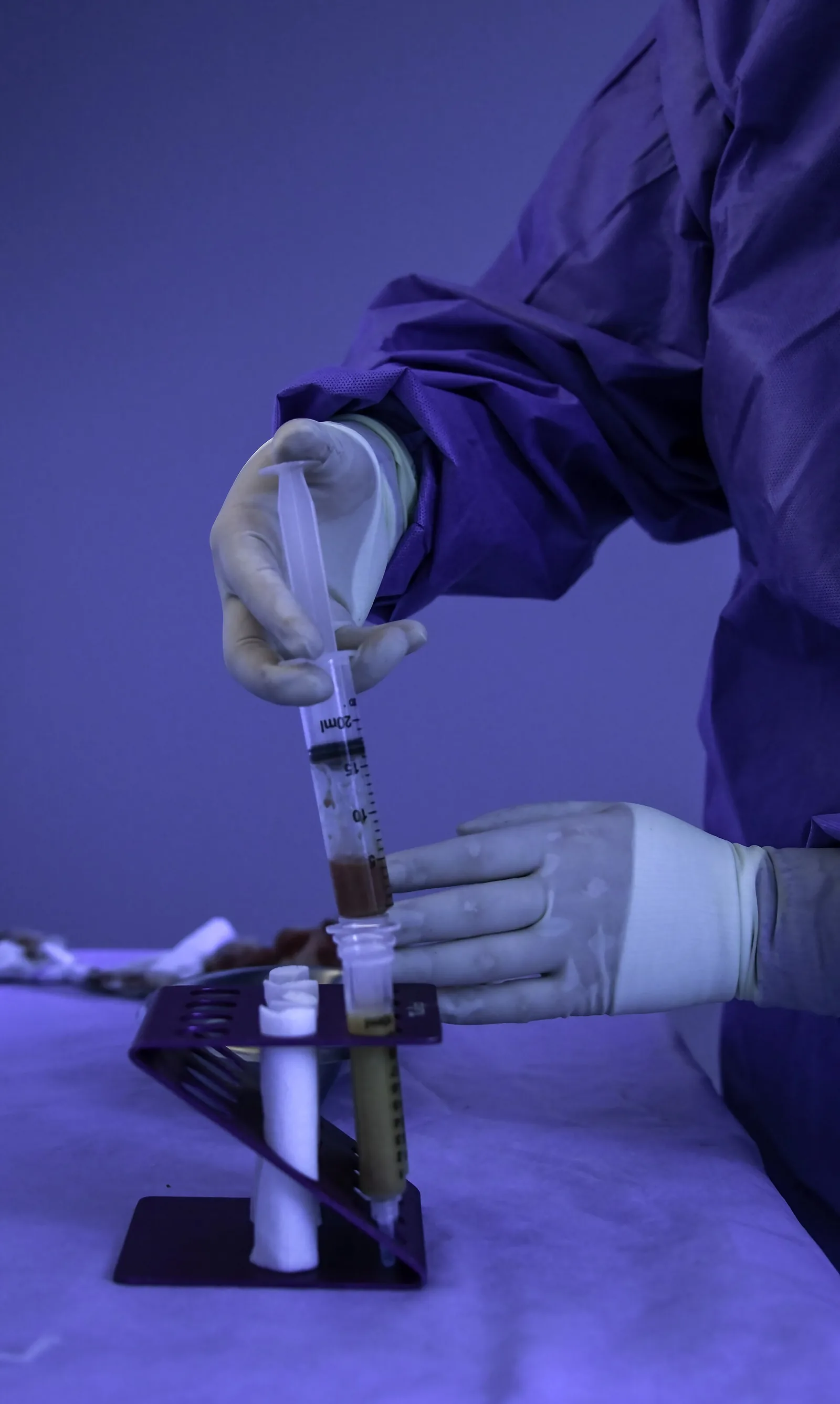
Harvested fat is cleaned before it goes back in; here a syringe stands upright so fat and fluid separate, one of the processing methods surgeons use.
Photo: BalikianFacialPlasticSurgery / CC BY 4.0 / CC BY 4.0 via Wikimedia Commons
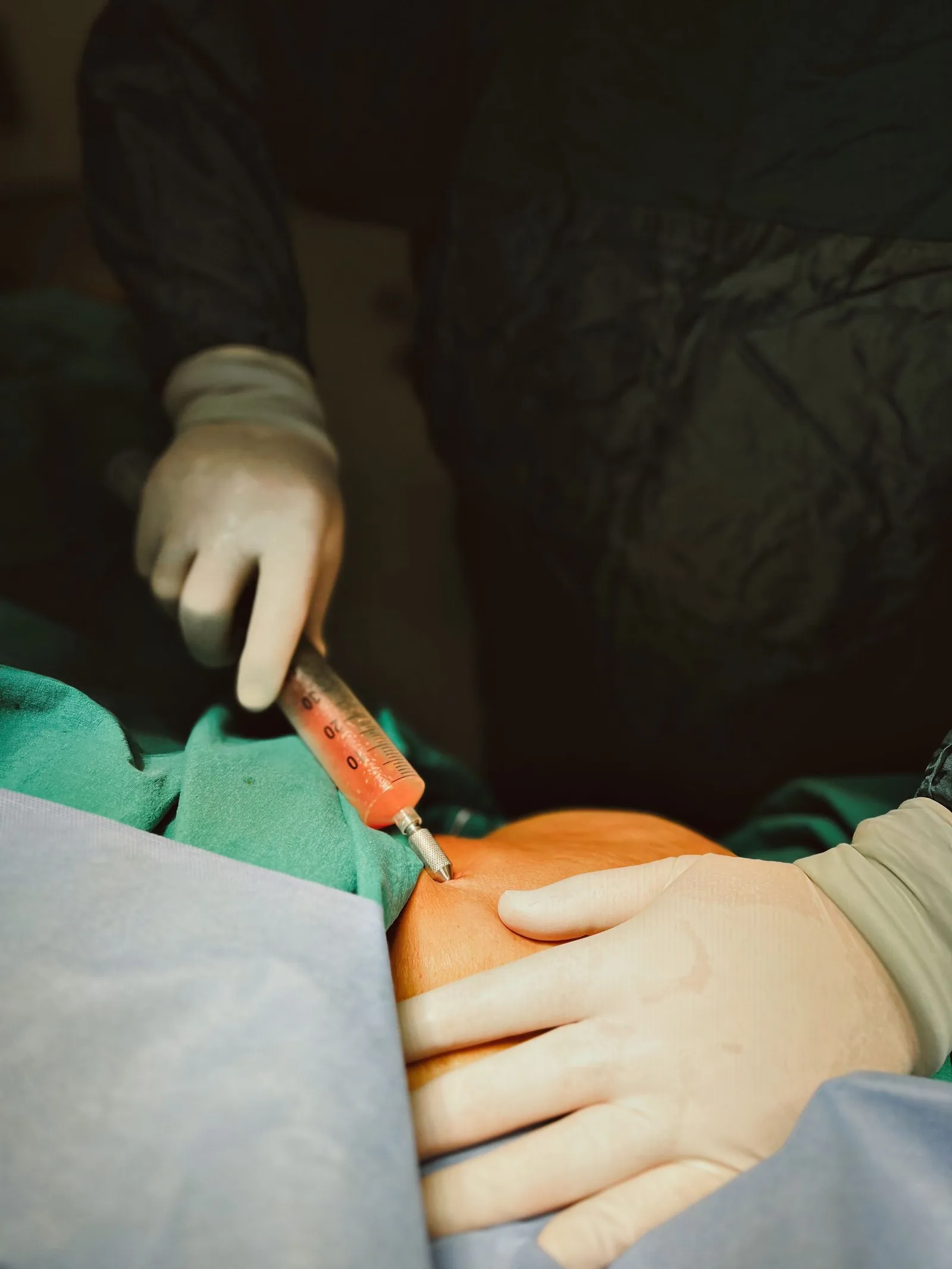
Fat is placed through a blunt cannula in small amounts at low pressure, with the surgeon's other hand pressing gently near the entry point.
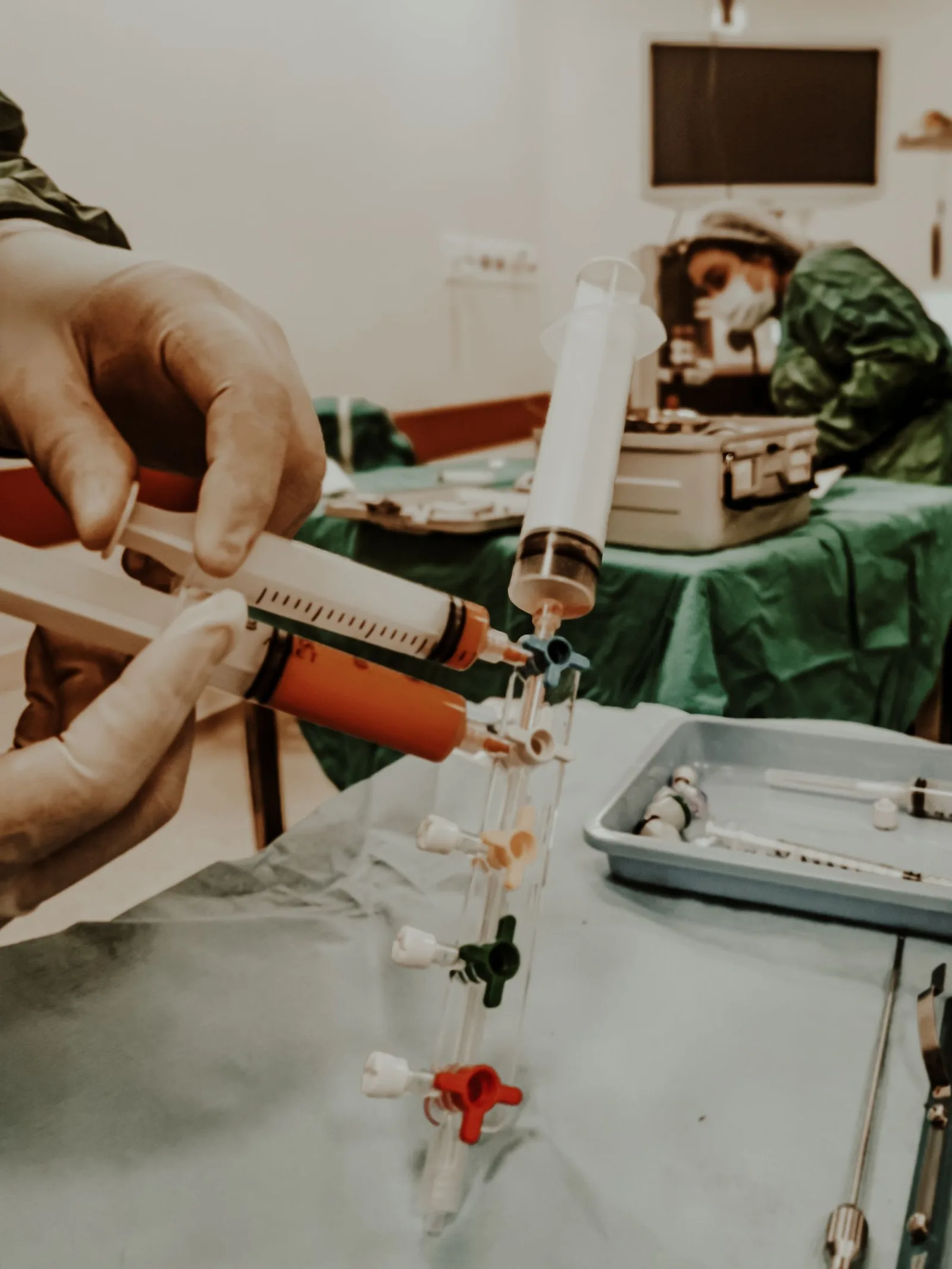
Harvested fat is passed between syringes through a connector, so it can be prepared and divided into small syringes for injection in small amounts.
Device and procedure images are provided by the manufacturers / licensed stock; they do not show COMEDI patients.
At a glance
- Approach
- Fat is taken from your own abdomen, thighs or buttocks with a blunt cannula under gentle suction, cleaned, and injected into the face in small amounts.
- Anaesthesia
- General anaesthesia is typical in the reference reviewed; local anaesthesia with nerve blocks is also used. This varies by clinic and by how many areas are treated.
- How much fat stays
- Not all transferred fat survives, and the amount that stays differs from person to person, so surgeons often place slightly more than needed. A second session may be required.
- Recovery
- Facial swelling is common and settles on its own, although it can last longer in the face than in other areas. Timelines vary by person.
Lifting and fat grafting change the position or volume of sagging tissue. They do not stop ageing, and where scars sit and how much fat survives differ from person to person.
Part of the grafted fat is absorbed, and how much survives is hard to predict.
Real cases
A case only helps when you can see the conditions behind it.
Sign in to see the before & after photos
Free. We use your Google name and email only to answer questions about these cases. Clinic names are shared in your private consultation.
 Before
 After
- Sessions
- Surgery (example)
- Combined
- None
- Photo timing
- 6 months after surgery (example)
 Before
 After
- Sessions
- Surgery (example)
- Combined
- None
- Photo timing
- 6 months after surgery (example)
 Before
 After
- Sessions
- Surgery (example)
- Combined
- None
- Photo timing
- 6 months after surgery (example)
- SessionsOne session, or the result of a course
- CombinedWhether other treatments or surgery were done together
- Photo timingHow long after the procedure the photo was taken
What to ask in a consultation
Questions about whether it suits you and what the alternatives are.
Often considered when
- People with hollows around the eyes or in the face. An NHS leaflet says fat transfer is performed to treat hollows around the eyelids and face, and ASPS says fat injections can be used to enhance facial fullness, fill creases or build up shallow contours.
- People who would rather use their own tissue than a manufactured filler. The same NHS leaflet notes that most people have fat to spare and will not have an allergic reaction to their own fat.
- People already planning a facelift. In an ASPS member survey published in 2015, 85 percent of the plastic surgeons said they used fat grafting during facelift procedures.
- People who can plan for a possible second visit. ASPS says multiple fat transfer procedures are typically needed, and in the facelift survey follow-up procedures, when necessary, were done after four to six months.
- People whose body weight is fairly stable. A review notes that body weight fluctuations can affect graft volume over time.
Checks in Korea
- Under Korea's Medical Service Act (Article 27), no one who is not a licensed medical professional may perform medical procedures, and medical professionals may not perform procedures outside the scope of their licence.
- Under Korean law, a medical institution that wants to attract foreign patients must register, have at least one specialist for each department in which it attracts foreign patients (unless the department is not one of the specialties set by Presidential Decree), and belong to medical malpractice liability insurance or a medical liability mutual aid association. Registration is valid for 3 years from the date of registration.
- Q01For my degree of sagging, what extent of surgery is appropriate, and how does it differ from non-surgical options?
- Q02Where will the incisions be, and what will the scars look like?
- Q03Who is the operating surgeon, and what is their specialty?
- Q04What type of anaesthesia is used, and who monitors it?
- Q05How many follow-up visits are needed before it is safe for me to fly home?
- Q06What are the possible risks and complications, and how are they handled if I am abroad?
- Q07What is included in the written estimate — revisions, medication, garments, stitches out?
Check these yourself at the consultation
- Where the fat is taken from and how it is processed before injection.
- What the plan is if less fat stays than expected, and whether a second session is likely.
- What the clinic does to avoid injecting into a blood vessel, and what its emergency plan is.
Recovery & schedule
Check swelling, daily routine, activity limits and review visits separately.
At a glance
- Setting
- ASPS describes fat injection as a minor surgical procedure that can be done in the surgeon's treatment room or in an operating room. One ASPS member surgeon notes that under local anaesthesia in the office, patients may not enjoy some of the pressure sensations.
- How much fat is used
- In an ASPS survey of plastic surgeons who use fat grafting during facelifts, surgeons typically injected between 11 and 25 cc. The amount you need is set by your surgeon.
- When it settles
- As a general expectation, an NHS leaflet says some swelling and fat loss will occur up to 12 weeks and then stabilise, and that skin tone and texture may keep improving even beyond 12 months. How quickly your own result settles varies from person to person, and your surgeon will judge it at your review visits.
- How much stays
- A review found reported survival rates of 30 to 83% in the face. An NHS leaflet says about a third of the fat disappears over the first six months and another third may disappear after a few years.
- Top-up timing
- In the ASPS facelift survey, follow-up procedures to refine the results were done after four to six months if needed. If you live abroad, this usually means a separate trip.
- 01Swelling & bruising
An NHS leaflet says most patients have some bruising and should expect significant swelling in the first week that decreases substantially by the end of the second week; it lists swelling and bruising as common for a few weeks but rarely lasting more than two months.
- 02Back to routine
The same NHS leaflet gives, as a general expectation, a return to normal social activities by the end of the second week. Recovery differs from person to person, so your surgeon will tell you when you can go back to your usual routine.
- 03Activity limits
An NHS factsheet on Coleman fat transfer advises avoiding strenuous exercise and heavy lifting until four weeks after the procedure, and stopping any activity that causes pain. The face leaflet asks you to sleep with your head slightly raised on pillows.
- 04Follow-up & flying home
The NHS face leaflet says the cut used to collect fat is closed with a dissolving stitch and the small cuts on the face do not usually need stitches. The sources reviewed give no set date for flying, so confirm the review visit and your surgeon's view on flying before booking your return.
Published guidance; your own clinic sets the actual plan.
Before your visit day
What clinics ask of international patients, in one place.
- Bring your passportClinics register international patients with their passport, and any estimate or prescription is issued in the name on it.
- Patients under 19Adulthood in Korea starts at 19. For a younger patient, clinics generally ask a parent or legal guardian to consent in writing, and many ask them to attend. Tell us the patient's age when you write, and we check what the clinic needs.
- Coming with someoneA family member or friend can usually join you in the consultation room. Treatment and recovery areas follow each clinic's rules, so we check this before your visit. If more than one person is booking, tell us what each person is interested in.
- Language helpCoordinators reply in English, Japanese, Chinese and Korean. Interpretation on the day is arranged for your dates, and we confirm in writing what it covers before you travel.
- Medicines and allergiesWrite down the medicines you take and any allergies. The clinic asks about both before any treatment.
What changes the price
The same surgery can be quoted differently depending on the items below.
What differs from clinic to clinic
- How the fat is handled
- A review says laboratory findings have not translated into a universal protocol, and in one surgeon survey it cites, 34 percent used centrifugation, 45 percent gravity separation, 34 percent filtration and 11 percent gauze rolling. Each clinic's method and reasoning is worth asking about.
- Volume fat or nanofat
- ASPS explains that nanofat is mechanically emulsified and filtered and does not give very much structural support; it is meant to improve skin colour and quality. Whether a clinic plans volume fat, nanofat or both changes what you are buying.
- Surgeon's background
- Facial fat grafting is done by plastic surgeons and also by oculoplastic (eye) surgeons; the NHS face leaflet comes from an eye surgery unit that treats hollows around the eyelids and face. A review notes that results depend on technique and surgeon expertise.
- Injection safety approach
- A systematic review of complications recommends multiple tunnels under the skin, a cannula larger than the one used for harvesting, small amounts with small syringes at low pressure, and finger pressure near the injection site. Ask how each clinic injects, especially around the eyes and forehead.
- Graft alone or with a facelift
- In an ASPS survey, 85 percent of plastic surgeons used fat grafting during facelifts. Some clinics plan grafting on its own, others as part of a lift, which changes the anaesthesia, recovery time and quote.
- Top-up session
- Whether a second grafting session, if needed, is included, discounted or charged in full.
- Volume or areas
- Whether the price is set by the number of facial areas or by the amount of fat injected.
- Type of fat graft
- Whether the plan uses standard volume-building fat, finely processed nanofat for skin quality, or both, and how each is priced.
- Processing method
- Which processing method or kit is used and whether it is charged separately.
- Combined surgery
- Whether the grafting is part of a facelift or other surgery and priced together or separately.
- Extent
- Face, neck, brow and any combined procedures
- Anaesthesia & stay
- Type of anaesthesia and whether you stay overnight
- Fat grafting
- Donor site and number of grafted areas
- What is included
- Tests, medication, compression band, review visits and the revision policy
Prices are set by the clinic after a consultation. Ask for an itemised, written estimate before you book, and check what is included and what could change.
Often charged separately
Ask whether each of these is in your estimate.
| Item | What to ask |
|---|---|
| Consultation fee | Whether the consultation is charged, and whether that amount comes off the surgery price. |
| Stitch removal and check-ups | How many follow-up visits are included, and how check-ups work once you have flown home. |
Clinics in Korea build a surgery estimate from the technique, the type of anaesthesia and the care around the operation.
The final figure is set after the surgeon examines you.
Ask for an itemised, written estimate that marks each item above as included or not, so you can compare two quotes on the same basis.
VAT before you compare quotes
The VAT refund for foreign visitors' cosmetic procedures covered only procedures received by 31 December 2025, so procedures received now are not refunded. Plan your budget without it, and ask each clinic whether VAT is included in the written quote so you compare the same total.
Ask COMEDI, for example
Clinics in Seoul differ in equipment, technique, specialist focus and what the price includes. Send us your question and we compare partner clinics for you.
- “Which partner clinics include a top-up session in the quote, and when would it be?”
- “How does each clinic process the fat, and do they offer nanofat as well as volume fat?”
- “I want to fill the hollows under my eyes. Which clinics have surgeons who focus on the eye area?”
- “I have 14 days in Seoul. Will the swelling and review visit fit before I fly?”
Precautions & aftercare
General information. Follow the written instructions from your treating doctor for anything specific to you.
Side effects and precautions for Facial fat grafting are in one place at the top of this page.
Aftercare for this procedure
- Apply cool packs to both the face and the area the fat was taken from, as an NHS leaflet advises.
- If fat was taken from your stomach or buttocks, wear supportive underwear; an NHS factsheet says this helps reduce swelling.
- Ask whether and when to massage. An NHS leaflet says lumps usually smooth out with time and massage, but the right timing is for your surgeon to decide.
- Do not smoke after the operation; an NHS factsheet says smoking increases the risk of complications.
- Try to keep your weight steady in the months after grafting, since a review notes that weight changes can affect graft volume.
- Tell the clinic about conditions such as high blood pressure or diabetes, medicines, smoking and earlier facial surgery or treatments.
- Contact the clinic immediately for sudden swelling on one side, severe pain or a change in skin colour.
- Ask how to look after the scars and for how long.
Information only. Suitability, risks, recovery and price are assessed by the treating doctor in a consultation.
Sources for this section 15
- Autologous Fat Transfer, Corneo-Plastic Unit (Ref 0398) — Queen Victoria Hospital NHS Foundation Trust
- Recovering after a Coleman fat transfer (OU-1180-05) — The Royal Marsden NHS Foundation Trust
- Fat Injections as Dermal Fillers — American Society of Plastic Surgeons
- Facial fat grafting vs facial fillers — American Society of Plastic Surgeons
- What is nano fat grafting, and how is it enhancing aesthetic results? — American Society of Plastic Surgeons
- Most Plastic Surgeons Now Use Fat Grafting as Part of Facelift Surgery — American Society of Plastic Surgeons
- Liposuction Preparation — American Society of Plastic Surgeons
- Complications Associated with Facial Autologous Fat Grafting for Aesthetic Purposes: A Systematic Review of the Literature — PMC
- Arterial Embolism After Facial Fat Grafting: A Systematic Literature Review — PMC
- A Systemic Review of Autologous Fat Grafting Survival Rate and Related Severe Complications — PMC
- The Current State of Fat Grafting: A Review of Harvesting, Processing, and Injection Techniques — PMC
- 의료 해외진출 및 외국인환자 유치 지원에 관한 법률 제6조 — 국가법령정보센터
- 의료법 제27조(무면허 의료행위 등 금지) — 국가법령정보센터
- The Effect of Smoking on Facial Fat Grafting Surgery (J Craniofac Surg 2017) — PubMed
- Liposuction Candidates — American Society of Plastic Surgeons
Related questions & guides
Worth reading alongside this page.
Notes from people who used COMEDI
Written after a consultation we arranged, and matched to that request.
Common questions
How much does Facial fat grafting cost in Korea?+
Prices are set by each clinic after a consultation and depend on the technique, area and your needs. Ask for an itemised, written estimate before you book — it should list what is included and what could change. We help you request and compare estimates.
Can foreigners get Facial fat grafting in Korea?+
Yes. Many Seoul clinics see international patients. We help with clinic information, consultations in your language, written estimates and interpretation on the day.