
Fillers(lip, nose, cheek)
A gel is injected to restore or add volume in areas such as the lips, cheeks, chin, nose bridge and under-eye hollows.

- Type
- Non-surgical
- Usually by
- Dermatologist
- Category
- Botox, fillers & boosters
- First step
- Consultation
Information only. Suitability, risks, recovery and price are assessed by the treating doctor in a consultation.
Side effects and precautionsWhat to know about Fillers before you book13
Reactions that usually settle, signs to tell the clinic about straight away, and times to wait. Your doctor goes through the risks that apply to you at the consultation.
Usually settles on its own
- Swelling, tenderness, bruising, firmness, lumps or bumps, redness and pain at the injection site — in the lip study most went away on their own within 30 days.
- An overfilled look, temporary numbness or redness, which ASPS says mostly improve within hours or a few days with ice and massage as advised.
- Itching or temporary discolouration at the injection site.
Tell the clinic promptly
- Unusual pain, changes in vision, white, grey or blue skin near the injection site, or signs of a stroke during or shortly after treatment — the FDA advises seeking immediate medical attention.
- Redness or swelling that lasts more than a few days, or any reaction that appears weeks or months later — contact the doctor.
- Raised bumps (nodules or granulomas) that may need injections, antibiotics or surgical removal, and infection.
- Swelling or redness near the filler after a viral or bacterial illness, a vaccination or dental work.
- For the nose, systematic reviews cited in a 2026 review report blood-vessel blockage in 0.35%, vision loss in 0.09% and skin necrosis in 0.08% of cases; filler placed too superficially can also show as a bluish tint, which with hyaluronic acid (HA) filler can be reversed with hyaluronidase, an enzyme that breaks down HA.
Wait or rethink when
- Severe allergies with a history of anaphylaxis, or several severe allergies; or an allergy to lidocaine or to the Gram-positive bacterial proteins used to make the gel (from the labelling of Juvéderm Volbella XC and Voluma XC; other products carry their own labels).
- Inflamed or infected skin at the injection site, such as cysts, pimples, rashes or hives: the FDA advises delaying injection until this has been managed.
- Pregnancy or breastfeeding, or being under 22: the FDA states the safety of dermal fillers is unknown in these groups.
- A tendency to keloids or thick, raised scars: the FDA states safety is unknown, and a bleeding disorder should be raised with the provider before treatment.
- For the nose, a 2026 review lists a severe hump or deviation, blocked breathing, recent nasal surgery or injury, and earlier silicone or unknown permanent filler among reasons to exclude or refer for surgical assessment; its separate table of common fillers lists previous nose implants as a contraindication for hyaluronic acid (HA) filler.
Sources for this section 11
- Dermal Fillers (Soft Tissue Fillers) — US Food and Drug Administration
- Dermal Fillers Recovery — American Society of Plastic Surgeons
- About JUVÉDERM VOLBELLA XC (lips and perioral) — Patient labeling, AbbVie
- About JUVÉDERM VOLUMA XC for Cheek Augmentation — Patient labeling, AbbVie
- Torres Céspedes SC et al. A Narrative Review of Evolving Techniques in Nonsurgical Rhinoplasty: Risk Profile and Clinical Outcomes of Fillers — Cureus 2026
- Dermal Filler Do's and Don'ts for Wrinkles, Lips and More — US Food and Drug Administration
- Dermal Fillers Risks and Safety — American Society of Plastic Surgeons
- Dermal Fillers Candidates — American Society of Plastic Surgeons
- Murray G et al. Guideline for the Management of Hyaluronic Acid Filler-induced Vascular Occlusion — Journal of Clinical and Aesthetic Dermatology 2021
- 성형용 필러 안전사용을 위한 안내서 — 식품의약품안전처
- 성형용 필러 시술 시 주의사항은? — 식품의약품안전처(대한민국 정책브리핑)
What is it?
The purpose, the change you can expect and the limits.
A gel is injected to restore or add volume in areas such as the lips, cheeks, chin, nose bridge and under-eye hollows.
Hyaluronic acid filler · lip filler · nose filler
- Juvéderm
- Restylane
- Belotero
- Neuramis
Devices & products used
- 01JuvédermAllergan Aesthetics (AbbVie), USA
A range of hyaluronic acid gels with lidocaine (Voluma, Volux, Vollure, Volbella, Ultra), used across cheeks, chin, jawline, temples, smile lines, lips and under-eyes.
- 02RestylaneGalderma
A range of hyaluronic acid fillers of differing firmness, with products for lips, cheeks, chin, folds, under-eyes and the backs of the hands.
- 03BeloteroMerz, Germany
A hyaluronic acid range running from Soft for fine lines to Volume for cheeks and chin; the manufacturer states it dissolves gradually over up to 18 months.
- 04NeuramisMedytox, Korea
A Korean-made hyaluronic acid filler range.
Clinics do not all carry the same devices, products or techniques. Ask which one will be used, by name, before you book.
How it is done, in photos
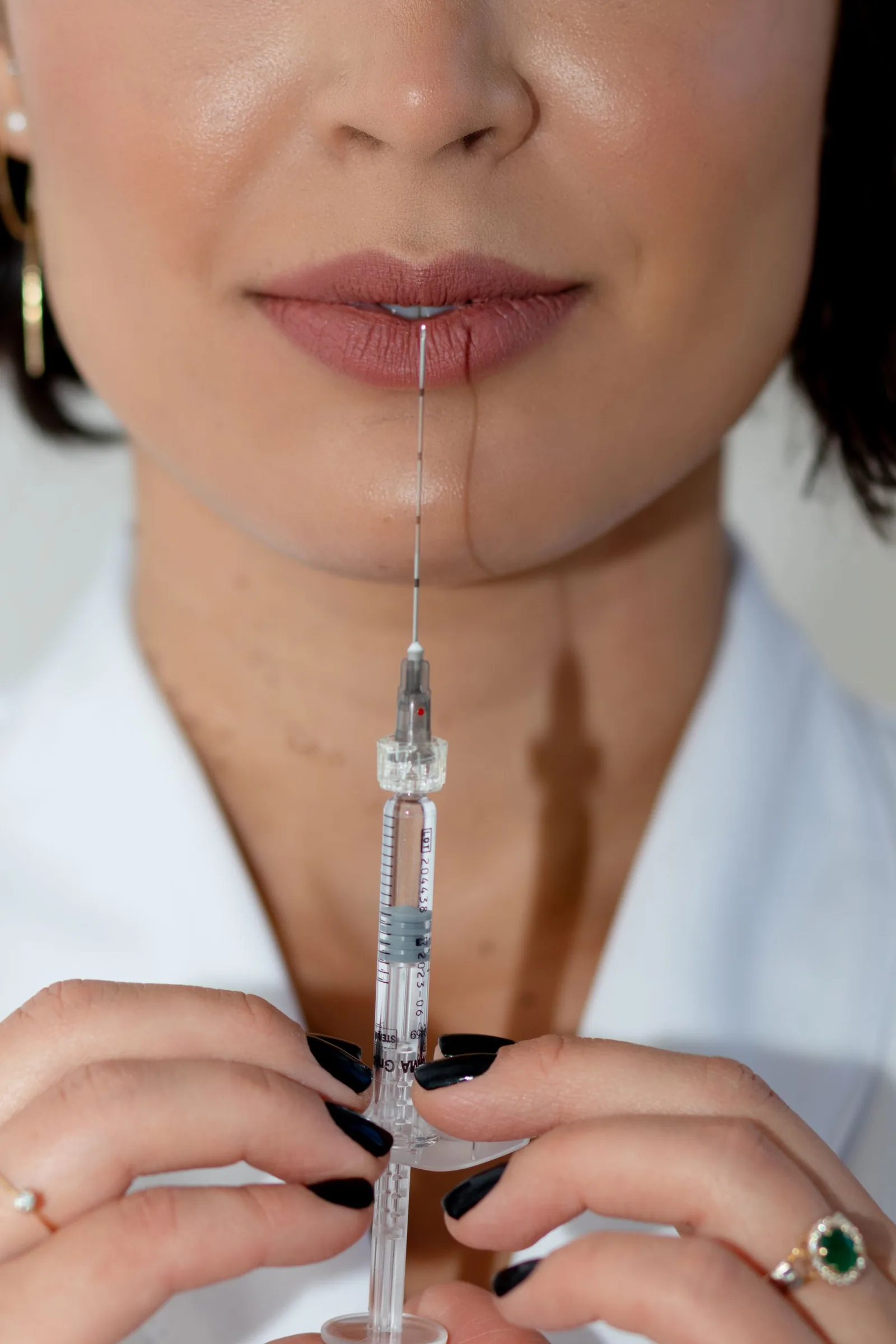
A pre-filled syringe with a fine needle is held ready; the amount of filler used varies widely from person to person.
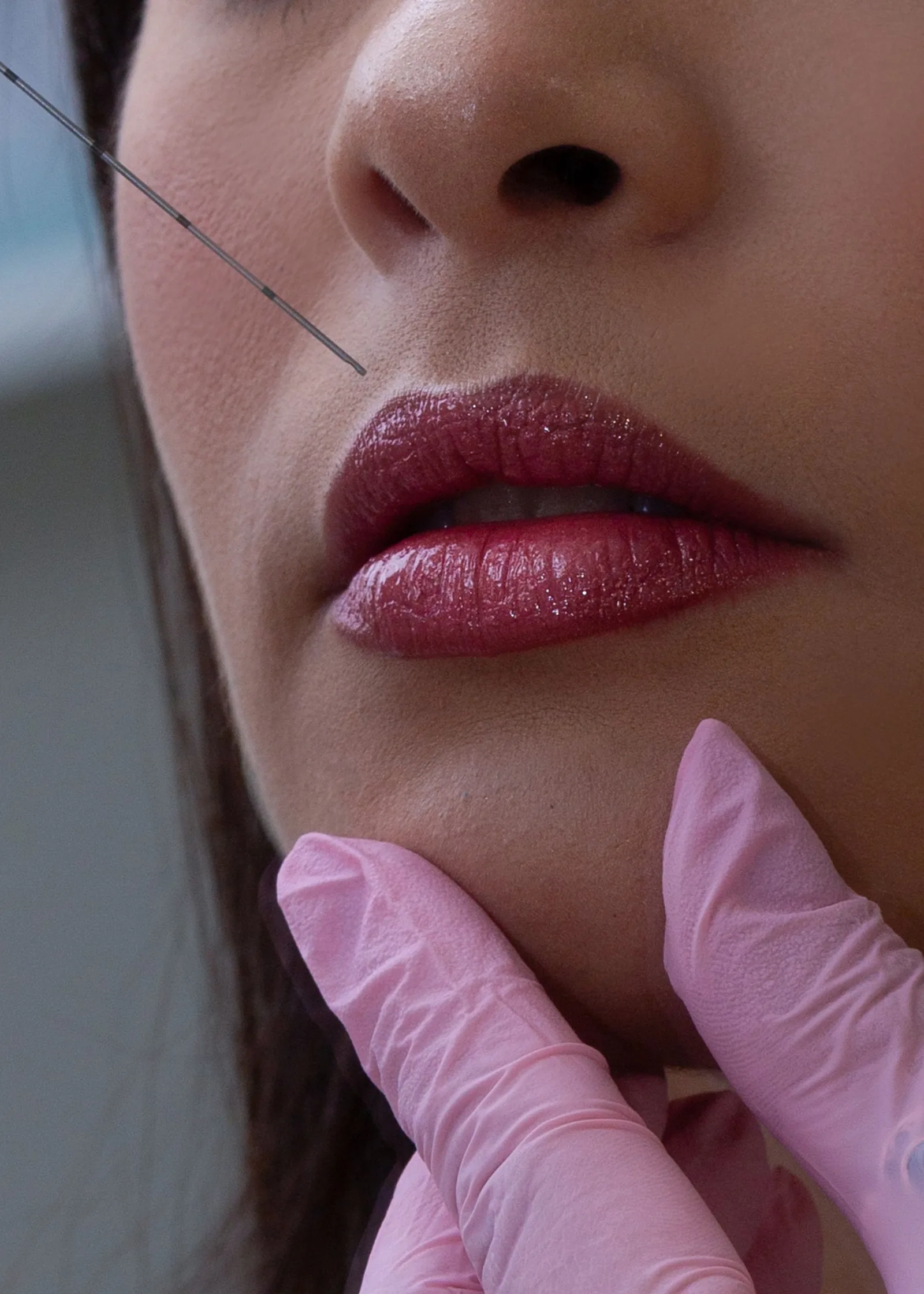
Steadying the chin with gloved fingers, the clinician guides a fine needle beside the upper lip to place small amounts of filler.
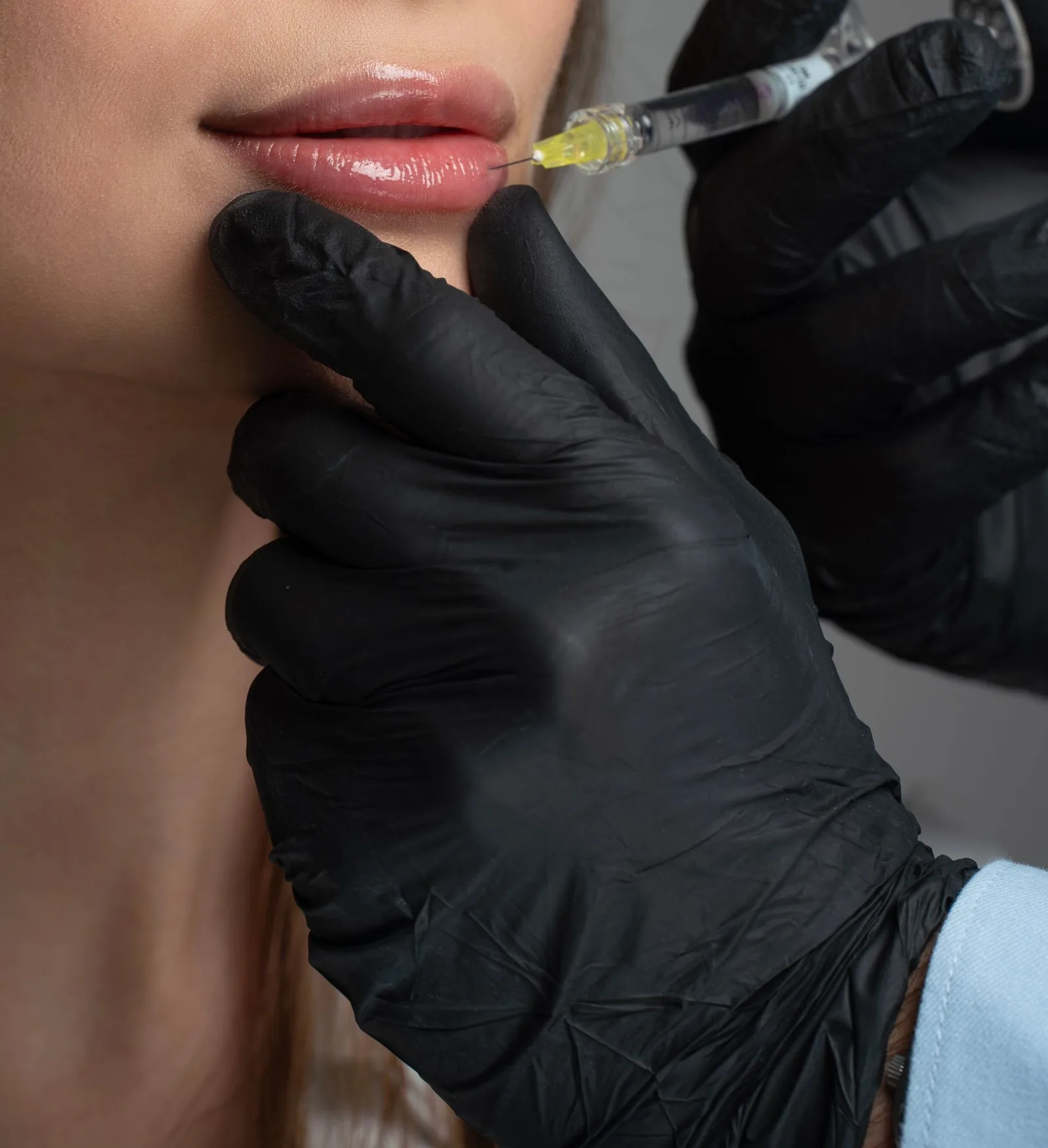
Holding the lower lip steady, the clinician injects filler with a fine needle; a touch-up, if needed, is usually given two weeks to a month later.
Device and procedure images are provided by the manufacturers / licensed stock; they do not show COMEDI patients.
At a glance
- Ingredient
- Hyaluronic acid, a sugar found naturally in the body, made into a gel. Some products also contain the local anaesthetic lidocaine.
- How it works
- The gel is injected under the skin to add volume or fill a line. Softer gels are used for fine lines and lips, firmer gels for cheeks and chin.
- Session time
- From about 15 minutes to an hour, depending on how many areas are treated.
- Anaesthesia
- Cooling, numbing cream or a local anaesthetic injection may be used, and many fillers have lidocaine mixed in.
- How long it lasts
- Temporary: the body gradually absorbs it. How long it lasts depends on the product and the area injected.
- Main risk
- Bruising, swelling and redness are common. Rarely, filler entering a blood vessel can cause skin damage, vision loss or stroke, so the injector's training matters.
Injectables differ in when a change shows and how long it lasts. Products that relax muscle, add volume or support skin quality each have a different purpose.
Most fillers are absorbed over time, and they do not change bone structure or lift sagging tissue.
References 8
- US FDA – Dermal Fillers (Soft Tissue Fillers)
- US FDA – Dermal Filler Do's and Don'ts
- American Society of Plastic Surgeons – Dermal filler types
- American Society of Plastic Surgeons – Dermal filler procedure steps
- Juvéderm official site (AbbVie)
- Restylane official site (Galderma)
- Belotero official site (Merz)
- Medytox official site
Real cases
A case only helps when you can see the conditions behind it.
Sign in to see the before & after photos
Free. We use your Google name and email only to answer questions about these cases. Clinic names are shared in your private consultation.
 Before
 After
- Sessions
- One session (example)
- Combined
- None
- Photo timing
- 2 weeks after (example)
 Before
 After
- Sessions
- One session (example)
- Combined
- None
- Photo timing
- 2 weeks after (example)
 Before
 After
- Sessions
- One session (example)
- Combined
- None
- Photo timing
- 2 weeks after (example)
- SessionsOne session, or the result of a course
- CombinedWhether other treatments or surgery were done together
- Photo timingHow long after the procedure the photo was taken
What to ask in a consultation
Questions about whether it suits you and what the alternatives are.
Often considered when
- Thin lips or fine lines around the mouth: lip augmentation is one of the uses the FDA has approved for dermal fillers.
- Cheeks that have flattened with age: one FDA-approved cheek filler is labelled to correct age-related volume loss in the mid-face.
- A nose that needs a small amount of volume rather than reduction, such as a low bridge between the eyes, a mild dip along the bridge, minor asymmetry, or small surface irregularities after an earlier rhinoplasty (as described in a 2026 review of nose filler).
- People who are physically healthy, do not smoke and have realistic goals, as ASPS describes good candidates.
Checks in Korea
- In Korea, cosmetic fillers are regulated as medical devices. The approved purpose of a product can be checked in the MFDS medical device database (emed.mfds.go.kr) by searching the item name 조직수복용생체재료 or 조직수복용재료.
- MFDS states that cosmetic fillers are mainly approved to improve facial wrinkles and facial volume, and that no product is approved for breast enlargement, volume in other body parts such as the buttocks or calves, or implantation into bone, tendon, ligament or muscle.
- MFDS advises treating filler as a medical procedure, being treated by an experienced doctor, and checking the labelling or attached document of the product to be used.
- Q01Which product fits my concern, and how does it differ from the other options?
- Q02If I am not happy with the change, can it be adjusted or reversed?
- Q03Who will perform the treatment, and what is their specialty?
- Q04Which device or product will be used, and is it the original I asked about?
- Q05How many sessions are usually planned, and can they fit into my stay?
- Q06What should I avoid before and after — sun, alcohol, flights, exercise?
- Q07What is included in the written estimate, and what could change after the consultation?
Check these yourself at the consultation
- Ask which brand and which product in the range will be used, and how many syringes.
- Ask to see the sealed, labelled pre-filled syringe and its box before it is opened.
- Ask for the lot-number sticker or the product name and lot number on your treatment record.
Recovery & schedule
Check swelling, daily routine, activity limits and review visits separately.
At a glance
- Touch-up
- In the clinical studies behind two Juvéderm labels, 62% of lip patients and 82% of cheek patients had a touch-up about 1 month after the first treatment. The labels describe a touch-up as usually given about 2 weeks to 1 month later.
- How long it lasted: lips
- In the Volbella XC lip study, results lasted 1 year in over 60% of patients, after which repeat injections are usually needed. Individual results vary.
- How long it lasted: cheeks
- In the Voluma XC cheek study, results lasted up to 2 years in a majority of patients, after which repeat injections are usually needed. Individual results vary.
- Amount used
- The amount varies widely by person: 0.5–6.0 mL (median 2.6 mL) for lips and 1.2–13.9 mL (median 6.6 mL) for cheeks in those studies, with less usually needed for touch-ups and repeat treatments.
- Nose and approvals
- The US FDA lists the nose among sites where dermal filler use is not FDA-approved. In Korea, the approved purpose of each product can be checked in the MFDS medical device database.
- Waiting after a nose injection
- A clinical guideline rates the nose as a very high-risk area for blood-vessel blockage and advises allowing 30–45 minutes to assess the patient after injecting high-risk areas such as the nose.
- 01Swelling & bruising
In the labelling studies, lip side effects such as swelling, tenderness and bruising usually lasted 2 weeks or less, and cheek side effects generally 2–4 weeks. A 2026 review of nose filler describes redness, swelling, tenderness and bruising typically settling within 7–10 days.
- 02Back to routine
According to ASPS, you can resume most activities right away, though the area may look overfilled at first. Ask the doctor when you can wear make-up.
- 03Activity limits
The product labels advise minimising strenuous exercise and strong sun or heat for the first 24 hours; ASPS generally recommends avoiding intense exercise for 24–48 hours. Korea's MFDS also advises avoiding saunas and jjimjilbang straight after treatment.
- 04Follow-up & flying home
Touch-ups are usually done about 2 weeks to 1 month after the first treatment, which may fall after you fly home. The labels also ask you to contact the doctor about redness or swelling lasting more than a few days, or any reaction that appears weeks or months later, so ask how the clinic follows up once you are home.
Published guidance; your own clinic sets the actual plan.
Before your visit day
What clinics ask of international patients, in one place.
- Bring your passportClinics register international patients with their passport, and any estimate or prescription is issued in the name on it.
- Patients under 19Adulthood in Korea starts at 19. For a younger patient, clinics generally ask a parent or legal guardian to consent in writing, and many ask them to attend. Tell us the patient's age when you write, and we check what the clinic needs.
- Coming with someoneA family member or friend can usually join you in the consultation room. Treatment and recovery areas follow each clinic's rules, so we check this before your visit. If more than one person is booking, tell us what each person is interested in.
- Language helpCoordinators reply in English, Japanese, Chinese and Korean. Interpretation on the day is arranged for your dates, and we confirm in writing what it covers before you travel.
- Medicines and allergiesWrite down the medicines you take and any allergies. The clinic asks about both before any treatment.
What changes the price
The same treatment can be quoted differently depending on the items below.
What differs from clinic to clinic
- Product range by area
- Products are approved for particular areas: one Juvéderm gel is labelled for lips and around the mouth, another for cheeks and chin, and safety elsewhere has not been established in controlled studies. Which ranges a clinic stocks shapes what it offers for each area.
- Needle or cannula
- Cheek filler has been studied with both a needle and a blunt cannula. A clinical guideline notes that blood-vessel complications can occur with either, and its authors advise avoiding cannulas finer than 25 gauge.
- Nose technique
- A 2026 review describes injecting the nose strictly in the midline, in a deep plane, in very small amounts and slowly, with ultrasound used to map vessels. Whether a clinic uses ultrasound for the nose differs.
- Doctor's background
- The FDA recommends a licensed provider with experience in dermatology or plastic surgery who is trained in filler injection. Which specialty and how much filler experience the doctor has varies by clinic.
- Complication readiness
- The FDA asks providers to have an up-to-date plan for treating a blood-vessel blockage, and a guideline advises 30–45 minutes of observation after nose injections. How a clinic prepares for this, and how long it keeps you after treatment, differs.
- Product for each area
- Which product is used for the lips, nose and cheeks; products are tested and labelled for specific areas.
- Volume per area
- How many mL or syringes are planned for each area, since the amount used varies widely from person to person.
- Touch-up visit
- Whether a touch-up 2–4 weeks later is included, and whether it can be done before you fly home.
- Dissolving if needed
- For hyaluronic acid (HA) fillers, whether hyaluronidase, an enzyme that breaks down HA, is included if the result needs correcting or a complication occurs; other types such as CaHA or PMMA are not reversible.
- Ultrasound guidance
- For nose filler, whether ultrasound is used to map blood vessels during the injection, and whether it costs extra.
- Product
- Product name and manufacturer, and how authenticity is shown
- Amount
- Units, syringes or vials used
- Areas & sessions
- Number of areas and planned sessions
- Numbing & care
- Numbing cream, soothing care and whether a touch-up is included
Prices are set by the clinic after a consultation. Ask for an itemised, written estimate before you book, and check what is included and what could change.
Often charged separately
Ask whether each of these is in your estimate.
| Item | What to ask |
|---|---|
| Consultation fee | Whether the consultation is charged, and whether that amount comes off the treatment price. |
Clinics in Korea build a treatment estimate from the area, the amount used or the number of sessions.
The final figure is set after the doctor sees you at the consultation.
Ask for an itemised, written estimate that marks each item above as included or not, so you can compare two quotes on the same basis.
VAT before you compare quotes
The VAT refund for foreign visitors' cosmetic procedures covered only procedures received by 31 December 2025, so procedures received now are not refunded. Plan your budget without it, and ask each clinic whether VAT is included in the written quote so you compare the same total.
Ask COMEDI, for example
Clinics in Seoul differ in equipment, technique, specialist focus and what the price includes. Send us your question and we compare partner clinics for you.
- “Which partner clinics use ultrasound for nose filler, and which products would they suggest for my lips and cheeks?”
- “How many mL would each quote include per area, and is a touch-up included?”
- “Can I have the touch-up before my flight, and how does the clinic follow up after I am home?”
- “Is dissolving the filler included if I need a correction?”
Precautions & aftercare
General information. Follow the written instructions from your treating doctor for anything specific to you.
Side effects and precautions for Fillers are in one place at the top of this page.
Aftercare for this procedure
- If there is swelling, place an ice pack over the area as the labels suggest.
- Do not press hard on, touch or strongly massage the treated area unless your doctor tells you to; after nose filler, the 2026 review notes massage is avoided so the filler is not displaced and vessels are not compressed.
- Avoid alcohol and smoking, which Korea's MFDS says slow healing.
- Tell your doctor if you plan laser treatment, a chemical peel or another procedure afterwards, as the label notes a possible inflammatory reaction at the treated site.
- Ask for the patient labeling of the exact product used and read it, as both the FDA and MFDS advise.
- Tell the clinic about allergies, pregnancy or breastfeeding, medicines (including those that affect clotting) and earlier injectable treatments.
- Contact the clinic immediately for severe pain, a change in skin colour or any change in vision.
- Keep a record of the product name, amount and date.
Information only. Suitability, risks, recovery and price are assessed by the treating doctor in a consultation.
Sources for this section 11
- Dermal Fillers (Soft Tissue Fillers) — US Food and Drug Administration
- Dermal Filler Do's and Don'ts for Wrinkles, Lips and More — US Food and Drug Administration
- Dermal Fillers Recovery — American Society of Plastic Surgeons
- Dermal Fillers Risks and Safety — American Society of Plastic Surgeons
- Dermal Fillers Candidates — American Society of Plastic Surgeons
- About JUVÉDERM VOLBELLA XC (lips and perioral) — Patient labeling, AbbVie
- About JUVÉDERM VOLUMA XC for Cheek Augmentation — Patient labeling, AbbVie
- Murray G et al. Guideline for the Management of Hyaluronic Acid Filler-induced Vascular Occlusion — Journal of Clinical and Aesthetic Dermatology 2021
- Torres Céspedes SC et al. A Narrative Review of Evolving Techniques in Nonsurgical Rhinoplasty: Risk Profile and Clinical Outcomes of Fillers — Cureus 2026
- 성형용 필러 안전사용을 위한 안내서 — 식품의약품안전처
- 성형용 필러 시술 시 주의사항은? — 식품의약품안전처(대한민국 정책브리핑)
Related questions & guides
Worth reading alongside this page.
Notes from people who used COMEDI
Written after a consultation we arranged, and matched to that request.
Common questions
How much does Fillers cost in Korea?+
Prices are set by each clinic after a consultation and depend on the technique, area and your needs. Ask for an itemised, written estimate before you book — it should list what is included and what could change. We help you request and compare estimates.
Can foreigners get Fillers in Korea?+
Yes. Many Seoul clinics see international patients. We help with clinic information, consultations in your language, written estimates and interpretation on the day.