
Ptosiscorrection
Adjusts the muscle that lifts the upper eyelid, for lids that sit low over the eye.

- Type
- Surgical
- Usually by
- Plastic surgeon
- Category
- Eyes
- First step
- Consultation
Information only. Suitability, risks, recovery and price are assessed by the treating doctor in a consultation.
Side effects and precautionsWhat to know about Ptosis correction before you book12
Reactions that usually settle, signs to tell the clinic about straight away, and times to wait. Your doctor goes through the risks that apply to you at the consultation.
Known risks
- Reported problems include a lid left too low or lifted too high, uneven lids, a gritty feeling in the eye, and dryness or surface irritation if the eye does not close fully. People who already have dry eyes are more exposed to these problems.
Usually settles on its own
- Not being able to close the eye fully for a while. One NHS leaflet calls this common after ptosis surgery, and another says it usually corrects itself with time as the muscles relax, particularly after large corrections; lubricating drops and ointment help in the meantime.
- Aching of the lids as the local anaesthetic wears off, which NHS leaflets describe as quite common and treat with a mild painkiller.
- Bruising and swelling of the lids, which NHS leaflets describe as settling over several weeks.
Tell the clinic promptly
- A lid set too high or still too low. One NHS hospital reports that surgery reaches a satisfactory height 80 to 90% of the time, with a 10 to 20% chance of over-correction and, rarely, under-correction.
- Uneven height or a change in the curve of the lid. An NHS leaflet notes that perfect symmetry in height and contour is sometimes not achieved, and that more than one operation is occasionally required.
- The front of the eye left exposed, which an NHS leaflet says needs the lid to be lowered again urgently with another operation, though this is very uncommon.
- Infection of the wound, and severe bleeding that very rarely can cause loss of vision; one NHS hospital puts this at 1 in many thousands. Contact the clinic for discharge, pain or bleeding that keeps coming back.
Wait or rethink when
- Dry eye that has not been checked. EyeWiki says it is very important to examine for dry eye, including the cornea and tears, to determine whether surgery is safe.
- Blood-thinning medicines or a bleeding problem that the surgeon has not yet been told about. The American Academy of Ophthalmology says it is important for the surgeon to know if you take aspirin or blood thinners or have a bleeding problem. An NHS leaflet says medicines such as warfarin, apixaban, aspirin and clopidogrel increase the risk of bleeding and bruising and may need to be stopped before surgery, but that you should consult your GP and/or cardiologist before stopping them to confirm it is safe.
- A droop whose cause has not yet been assessed. An NHS leaflet explains that the ophthalmologist measures the droop and the muscle function and may request blood tests, X-rays and other tests to find the cause before planning treatment.
- A schedule that cannot allow time off eye make-up and contact lenses. One NHS leaflet advises no eye make-up for 2 weeks and avoiding contact lenses for 4 weeks so the lid can heal inside.
Sources for this section 11
- EyeWiki (American Academy of Ophthalmology) – Blepharoptosis
- EyeWiki (American Academy of Ophthalmology) – Müller's Muscle-Conjunctival Resection
- American Academy of Ophthalmology – What Is Ptosis?
- Ptosis correction (adults) — Cambridge University Hospitals NHS Foundation Trust
- Adult Ptosis (patient information 5511-2) — West Suffolk NHS Foundation Trust
- Eye Unit: Ptosis (RUH OPT/039, March 2025) — Royal United Hospitals Bath NHS Foundation Trust
- Drooping of the upper eyelid (ptosis) — The Dudley Group NHS Foundation Trust
- Muller's muscle conjunctival resection versus external levator advancement for ptosis repair: systematic review and meta-analysis (Int Ophthalmol 2023, PMID 36692699) — Europe PMC
- Subclinical upper eyelid ptosis in Asian patients: the role of levator advancement in optimizing outcomes in 'cosmetic' upper blepharoplasty (Aesthetic Plast Surg 2023) — PMC
- 의료 해외진출 및 외국인환자 유치 지원에 관한 법률 제6조 — 국가법령정보센터
- 의료법 제27조(무면허 의료행위 등 금지) — 국가법령정보센터
What is it?
The purpose, the change you can expect and the limits.
Adjusts the muscle that lifts the upper eyelid, for lids that sit low over the eye.
Eye-opening surgery
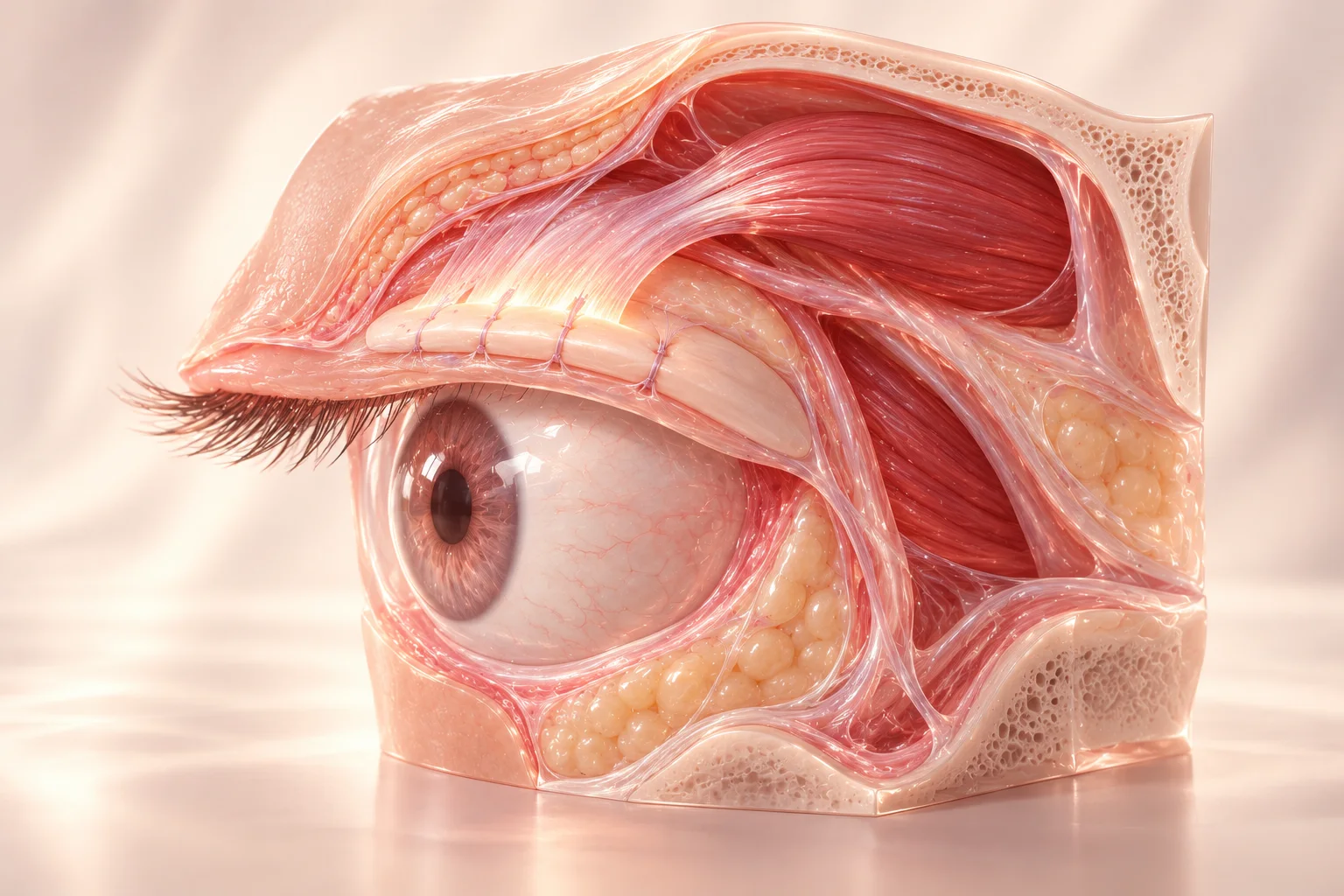
Techniques & materials
- 01Levator advancement or resection (external approach)
Through a cut in the eyelid crease, the muscle layer that lifts the lid is shortened and re-attached; it is used when that muscle still works reasonably well.
- 02Müller's muscle-conjunctival resection (internal approach)
A strip of the inner lining of the lid and the small muscle beneath it is removed from the underside of the eyelid, with no cut in the skin; it is used for mild to moderate drooping when the lifting muscle works well.
- 03Frontalis sling
The eyelid is linked to the forehead muscle with a strip of the patient's own tissue or another sling material so that the forehead lifts the lid; it is reserved for lids whose own lifting muscle is weak or not working.
Clinics do not all carry the same devices, products or techniques. Ask which one will be used, by name, before you book.
How it is done, in photos
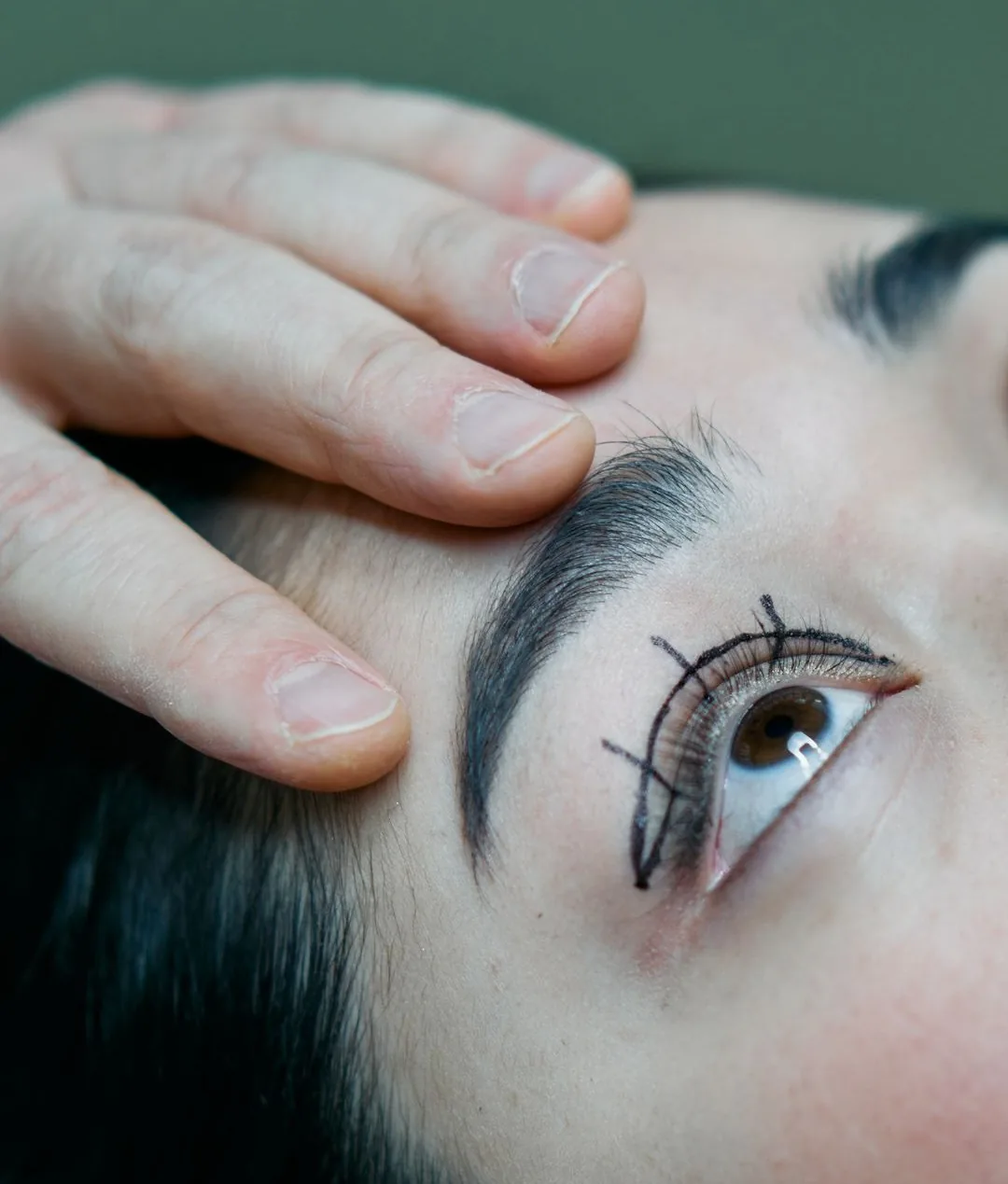
Before surgery the lid is measured to see how far it droops and how well the lifting muscle works, with the brow held still while you look up.
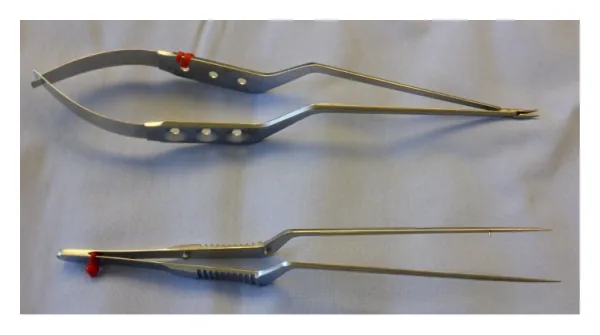
Fine microsurgical scissors and forceps of the kind used for delicate eyelid work, where the lid-lifting muscle is shortened or re-attached through a small crease cut.
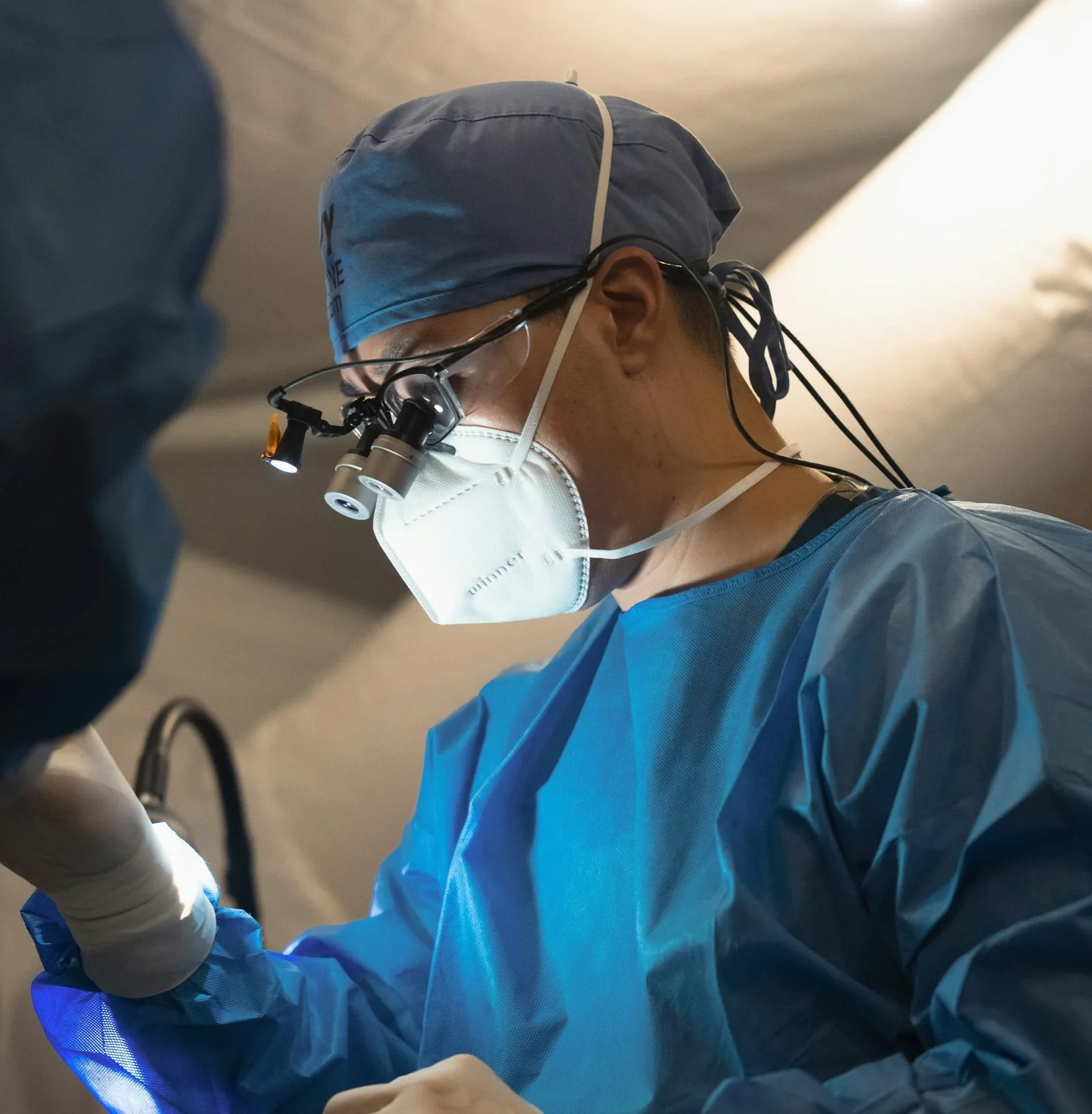
Ptosis repair is generally done under local anaesthetic in an operating room; with the external approach you may stay awake so lid height can be checked.
Device and procedure images are provided by the manufacturers / licensed stock; they do not show COMEDI patients.
At a glance
- Approach
- The method is chosen mainly by how well the lid-lifting muscle works and how much the lid droops. It may be done through the eyelid crease, from the inside of the lid, or by linking the lid to the forehead muscle.
- Anaesthesia
- It is generally done under local anaesthetic. With the external approach the patient may be kept awake so the surgeon can check lid height and shape during surgery; the internal approach can also be done under general anaesthetic.
- Hospital stay
- Ptosis surgery is usually an outpatient procedure, with the patient going home the same day. This can differ by clinic and by the patient's condition.
- Stitches & follow-up
- The internal approach leaves no skin wound, and the first check-up is generally about 1 to 2 weeks after surgery. When stitches come out after the external approach depends on the clinic, so ask at the consultation.
The method is chosen from the structure of your eyelids and the amount of skin and fat. The shape settles as swelling goes down, which takes time, and the two sides may not be perfectly identical.
Some asymmetry can remain, and the eye may not close fully for a period.
Real cases
A case only helps when you can see the conditions behind it.
Sign in to see the before & after photos
Free. We use your Google name and email only to answer questions about these cases. Clinic names are shared in your private consultation.
 Before
 After
- Sessions
- Surgery (example)
- Combined
- None
- Photo timing
- 3 months after surgery (example)
 Before
 After
- Sessions
- Surgery (example)
- Combined
- None
- Photo timing
- 3 months after surgery (example)
 Before
 After
- Sessions
- Surgery (example)
- Combined
- None
- Photo timing
- 3 months after surgery (example)
- SessionsOne session, or the result of a course
- CombinedWhether other treatments or surgery were done together
- Photo timingHow long after the procedure the photo was taken
What to ask in a consultation
Questions about whether it suits you and what the alternatives are.
Often considered when
- Adults whose upper lid has dropped because the lifting muscle has stretched or come away from the lid. The American Academy of Ophthalmology names ageing and eye injury as causes, and an NHS leaflet adds that it can happen in people who have worn contact lenses for many years.
- People whose lid edge covers part of the pupil and blocks the upper part of their view. An NHS leaflet notes that in severe cases people tilt their head back or lift the lid with a finger to see, and another says the need for surgery depends on how severe the droop is and how much it affects vision.
- People considering double-eyelid surgery who may have a subtle droop. A 2023 study in Aesthetic Plastic Surgery, which prospectively included 97 patients, says this kind of mild, 'subclinical' ptosis is much more common in Asian patients, and cites a report that 30% of young Korean patients presenting for cosmetic eyelid surgery would need it treated.
- People with a small droop that improves after a test eye drop and whose lifting muscle works well. EyeWiki (American Academy of Ophthalmology) describes them as the ideal candidate for repair from the inside of the lid.
Checks in Korea
- Under Korea's Medical Service Act (Article 27), no one who is not a licensed medical professional may perform medical procedures, and medical professionals may not perform procedures outside the scope of their licence.
- Under Korean law, a clinic that attracts foreign patients must register for it, have at least one specialist for each department in which it attracts foreign patients (unless the department is not one of the specialties set by Presidential Decree), and belong to medical malpractice liability insurance or a medical liability mutual aid association. Registration is valid for 3 years from the date of registration.
- Q01Which method suits my eyelid structure, and why would you not recommend the others?
- Q02If the result differs from what I expected, when and on what terms is a revision possible?
- Q03Who is the operating surgeon, and what is their specialty?
- Q04What type of anaesthesia is used, and who monitors it?
- Q05How many follow-up visits are needed before it is safe for me to fly home?
- Q06What are the possible risks and complications, and how are they handled if I am abroad?
- Q07What is included in the written estimate — revisions, medication, garments, stitches out?
Check these yourself at the consultation
- How strong your lid-lifting muscle was measured to be, and which method that leads to.
- Whether the surgery will be done through the skin crease or from inside the lid, and what anaesthesia is used.
- How under-correction, over-correction or uneven lids are handled afterwards.
Recovery & schedule
Check swelling, daily routine, activity limits and review visits separately.
At a glance
- Measurements first
- An NHS leaflet describes lid measurements taken to measure how far the lid droops and how much the muscle works, sometimes with further tests to find the cause. Ask for these numbers; they are what the choice of method is based on.
- Eye-drop test
- EyeWiki describes a test with phenylephrine drops, which make the small inner lid muscle contract; the lid height is measured before any drops are put in, and again 5 minutes after the last drop. A good response points towards repair from the inside of the lid.
- Operating time
- NHS leaflets give about 45 minutes to 1 hour for each eye in one hospital, and around 60 to 90 minutes in another. The time depends on the method and whether both eyes are done.
- Dressing on the day
- Some NHS hospitals put a firm pressure pad over the eye for about 24 hours or overnight to limit swelling and bruising; if both eyes are done, one pad is usually removed before going home so you can see. Another hospital says that generally no dressing is used when bruising is minimal.
- When the result can be judged
- An NHS leaflet says it is often too early to judge the final outcome straight after surgery, and that scars fade gradually over the first year but tend not to be obvious because they sit in the lid crease.
- 01Swelling & bruising
NHS leaflets describe bruised, swollen lids at first. One says swelling usually lasts 10 to 14 days; another says bruising can take 2 to 3 weeks to clear, with mild swelling of the upper lid for up to 6 weeks. The lids commonly ache as the local anaesthetic wears off, and a mild painkiller such as paracetamol is used.
- 02Back to routine
One NHS hospital says you can shower normally if the wound is dried carefully, and can usually drive the next day if your vision is unaffected, although the eye ointment can blur vision for a while. Another advises no eye make-up for 2 weeks and no contact lenses for 4 weeks.
- 03Activity limits
An NHS leaflet advises not exerting yourself for the first 24 to 48 hours and using an ice pack for 15 to 20 minutes up to twice a day for the next few days. EyeWiki describes a more frequent routine of cold compresses for 20 minutes every 1 to 2 hours while awake for 2 to 3 days, so ask which routine your clinic uses.
- 04Follow-up & flying home
Follow-up timing varies: one NHS hospital sees patients after about one week and often removes stitches then, another usually reviews at 1 to 2 weeks (sometimes the day after surgery), and another at 2 to 4 weeks, removing non-dissolving stitches about three weeks after surgery. Check which schedule applies before booking your flights.
Published guidance; your own clinic sets the actual plan.
Before your visit day
What clinics ask of international patients, in one place.
- Bring your passportClinics register international patients with their passport, and any estimate or prescription is issued in the name on it.
- Patients under 19Adulthood in Korea starts at 19. For a younger patient, clinics generally ask a parent or legal guardian to consent in writing, and many ask them to attend. Tell us the patient's age when you write, and we check what the clinic needs.
- Coming with someoneA family member or friend can usually join you in the consultation room. Treatment and recovery areas follow each clinic's rules, so we check this before your visit. If more than one person is booking, tell us what each person is interested in.
- Language helpCoordinators reply in English, Japanese, Chinese and Korean. Interpretation on the day is arranged for your dates, and we confirm in writing what it covers before you travel.
- Medicines and allergiesWrite down the medicines you take and any allergies. The clinic asks about both before any treatment.
What changes the price
The same surgery can be quoted differently depending on the items below.
What differs from clinic to clinic
- Inside or through the skin
- Clinics lean towards different approaches. A 2023 meta-analysis of 7 studies covering 1,038 eyelids found that repair through the skin had significantly higher rates of over-correction and re-operation than repair from the inside of the lid, with no significant difference in under-correction.
- How the decision is measured
- Whether a clinic measures muscle function and runs the eye-drop test before choosing a method differs. EyeWiki links a good drop response to the inside approach and explains that weaker muscle function may need a different operation.
- Ptosis correction within double-eyelid surgery
- The authors of a 2023 study of 97 patients argue that correcting the lifting muscle should come before creating the crease, and notes that mild droop is much more common in Asian patients. Whether a double-eyelid consultation checks for it varies by surgeon.
- Stitches and review schedule
- Some clinics use dissolving stitches, others remove them at about one or three weeks, and first reviews range from the next day to 2 to 4 weeks. For a short stay this decides whether everything is finished before you fly.
- Dressing and first-day routine
- One hospital usually applies a double eye pad overnight as a pressure dressing, but if both eyes are done it usually leaves one or both eyes uncovered; another uses a pressure pad for 24 hours, and another generally uses no dressing when bruising is minimal. This affects how you get back to your hotel and what you can see on day one.
- Pre-surgery measurements
- Whether lid measurements, the eye-drop test and a dry-eye check are part of the consultation fee or charged separately.
- One eye or both
- Whether the quote is for one lid or both.
- Combined double-eyelid work
- Whether crease creation or skin removal is added to the ptosis correction and priced together or separately.
- Post-surgery medicines
- Whether antibiotic ointment and lubricating drops for the healing weeks are supplied.
- Height adjustment terms
- Whether adjustment for a lid that ends up too high, too low or uneven is included, and within what period.
- Method
- Incisional or non-incisional, and any combined procedures
- Anaesthesia
- Local or sedation, and who manages it
- Primary or revision
- Whether this is a first operation or a revision
- What is included
- Tests, medication, stitch removal, review visits and the revision policy
Prices are set by the clinic after a consultation. Ask for an itemised, written estimate before you book, and check what is included and what could change.
Often charged separately
Ask whether each of these is in your estimate.
| Item | What to ask |
|---|---|
| Medicine, dressings and garments | Whether prescriptions, dressings, splints or compression garments are included. |
| Recovery stay | Whether an overnight stay at the clinic or a recovery facility is in the estimate. |
Clinics in Korea build a surgery estimate from the technique, the type of anaesthesia and the care around the operation.
The final figure is set after the surgeon examines you.
Ask for an itemised, written estimate that marks each item above as included or not, so you can compare two quotes on the same basis.
VAT before you compare quotes
The VAT refund for foreign visitors' cosmetic procedures covered only procedures received by 31 December 2025, so procedures received now are not refunded. Plan your budget without it, and ask each clinic whether VAT is included in the written quote so you compare the same total.
Ask COMEDI, for example
Clinics in Seoul differ in equipment, technique, specialist focus and what the price includes. Send us your question and we compare partner clinics for you.
- “My eyes look tired and I am also thinking about double eyelids. Which partner clinics measure for ptosis first, and which approach do they usually use?”
- “Which clinics use dissolving stitches, and when is the first review? I have 10 days in Seoul.”
- “If one lid ends up higher than the other, what does each clinic's adjustment policy cover?”
- “Do the quotes include the eye-drop test, medicines and both eyes?”
Precautions & aftercare
General information. Follow the written instructions from your treating doctor for anything specific to you.
Side effects and precautions for Ptosis correction are in one place at the top of this page.
Aftercare for this procedure
- Use the antibiotic ointment on the stitch line and the lubricating drops or ointment in the eye as prescribed; one NHS hospital gives them for two weeks.
- When applying ointment, wash your hands, gently pull the lower lid down, run the ointment along the inside of the lower lid without letting the tube touch the eye, and also apply it to the stitches.
- If the eye does not close fully, keep it well lubricated; EyeWiki says patients expected to have this need plenty of lubrication.
- When the pad comes off there may be a little blood or discharge around the eye; one NHS leaflet suggests cleaning it with cooled boiled water.
- Sleep with one or two extra pillows until the swelling settles, as one NHS leaflet advises.
- Tell the clinic about dry eye, eye conditions or surgery, medicines, smoking and any earlier eyelid surgery.
- Contact the clinic immediately for a change in vision, severe pain or sudden swelling on one side.
- Keep the clinic's contact point and emergency number for after you fly home.
Information only. Suitability, risks, recovery and price are assessed by the treating doctor in a consultation.
Sources for this section 11
- Blepharoptosis — EyeWiki (American Academy of Ophthalmology)
- Müller's Muscle-Conjunctival Resection (MMCR) Blepharoptosis Repair — EyeWiki (American Academy of Ophthalmology)
- What Is Ptosis? — American Academy of Ophthalmology
- Ptosis correction (adults) — Cambridge University Hospitals NHS Foundation Trust
- Adult Ptosis (patient information 5511-2) — West Suffolk NHS Foundation Trust
- Eye Unit: Ptosis (RUH OPT/039, March 2025) — Royal United Hospitals Bath NHS Foundation Trust
- Drooping of the upper eyelid (ptosis) — The Dudley Group NHS Foundation Trust
- Muller's muscle conjunctival resection versus external levator advancement for ptosis repair: systematic review and meta-analysis (Int Ophthalmol 2023, PMID 36692699) — Europe PMC
- Subclinical upper eyelid ptosis in Asian patients: the role of levator advancement in optimizing outcomes in 'cosmetic' upper blepharoplasty (Aesthetic Plast Surg 2023) — PMC
- 의료 해외진출 및 외국인환자 유치 지원에 관한 법률 제6조 — 국가법령정보센터
- 의료법 제27조(무면허 의료행위 등 금지) — 국가법령정보센터
Related questions & guides
Worth reading alongside this page.
Notes from people who used COMEDI
Written after a consultation we arranged, and matched to that request.
Common questions
How much does Ptosis correction cost in Korea?+
Prices are set by each clinic after a consultation and depend on the technique, area and your needs. Ask for an itemised, written estimate before you book — it should list what is included and what could change. We help you request and compare estimates.
Can foreigners get Ptosis correction in Korea?+
Yes. Many Seoul clinics see international patients. We help with clinic information, consultations in your language, written estimates and interpretation on the day.