
Breastaugmentation (boob job)
Increases breast volume with implants or with your own fat.

- Type
- Surgical
- Usually by
- Plastic surgeon
- Category
- Breast & body
- First step
- Consultation
Information only. Suitability, risks, recovery and price are assessed by the treating doctor in a consultation.
Side effects and precautionsWhat to know about Breast augmentation before you book15
Reactions that usually settle, signs to tell the clinic about straight away, and times to wait. Your doctor goes through the risks that apply to you at the consultation.
Known risks
- Hardening of the scar tissue around the implant (capsular contracture), rupture, rippling, changes in nipple sensation, infection and, rarely, BIA-ALCL. The FDA states implants are not lifetime devices and recommends MRI or ultrasound checks for silent rupture of silicone implants.
Usually settles on its own
- Soreness and swelling for a few weeks after surgery, as ASPS describes.
- Acute pain that typically subsides after one to five days.
Tell the clinic promptly
- More or less feeling in the nipple or breast; the FDA says this can vary in degree and may be temporary or permanent.
- Capsular contracture, where scar tissue tightens around the implant; the FDA notes the hardening can be painful.
- Implant leakage or rupture, fluid build-up (seroma), haematoma, infection, persistent pain, poor scarring, wrinkling and an implant in the wrong position, as listed by ASPS.
- BIA-ALCL, a lymphoma linked to implants; the FDA says the risk is higher with textured implants and that persistent swelling, a lump or pain near the implant, often years later, should be checked.
- Symptoms such as fatigue, memory loss, rash, 'brain fog' and joint pain, which the FDA says may be associated with breast implants.
- With fat transfer, calcifications and oil cysts that can show on later mammograms, as reported in a 2021 review.
Wait or rethink when
- Being pregnant or breastfeeding (ASPS lists not being pregnant or breastfeeding as part of being a candidate).
- Not being physically healthy (ASPS lists being physically healthy as part of being a candidate).
- Breasts that are not yet fully developed (ASPS lists fully developed breasts).
- Expectations that are not realistic (ASPS lists realistic expectations).
- Being under the ages the FDA approved for augmentation: 18 or older for saline implants and 22 or older for silicone gel implants.
- Not yet being sure why you want implants; the NHS advises being sure about why you want them before you go ahead.
Sources for this section 20
- NHS - Breast enlargement (implants)
- FDA - Risks and Complications of Breast Implants
- FDA - Types of Breast Implants
- FDA - Labeling for Approved Breast Implants
- ASPS - Types of breast implants
- ASPS - Breast augmentation procedure steps
- Breast Augmentation - StatPearls
- Motiva - Implants (manufacturer site)
- A 10-Year Prospective Study of Implant-Based Breast Augmentation and Reconstruction (Sebbin, PMC)
- NHS - Cosmetic surgery abroad
- Breast Augmentation Recovery — American Society of Plastic Surgeons
- Breast Augmentation Risks and Safety — American Society of Plastic Surgeons
- Hanson SE et al. Autologous fat grafting in breast reconstruction: implications for follow-up and surveillance — Gland Surgery 2021 (PMC7882329)
- Questions and Answers about Breast Implant-Associated Anaplastic Large Cell Lymphoma (BIA-ALCL) — U.S. FDA
- Breast enlargement (implants) — NHS
- Breast Augmentation Candidates — American Society of Plastic Surgeons
- Cosmetic surgery abroad — NHS
- Dyrberg DL et al. Breast animation deformity — Archives of Plastic Surgery 2019 (PMC6369057)
- Foreign Patient Attraction Information System (MEDICALKOREA) — Korea Health Industry Development Institute
- Things to Consider Before Getting Breast Implants — U.S. FDA
What is it?
The purpose, the change you can expect and the limits.
Increases breast volume with implants or with your own fat.
Implants · fat transfer
Techniques & materials
- 01Motiva Ergonomix / RoundEstablishment Labs
Silicone gel implants with the maker's SmoothSilk smooth surface; the maker also offers an optional built-in identification microchip (Qid).
- 02Mentor MemoryGel / MemoryShapeMentor
Silicone gel implants listed among FDA-approved breast implants, in round (MemoryGel) and shaped (MemoryShape) lines.
- 03NatrelleAllergan
Saline and silicone gel implants listed by the FDA; the maker recalled its BIOCELL textured models in 2019, and smooth models remain available.
- 04Sebbin round silicone implantsGroupe Sebbin, France
Round silicone gel implants from a French maker, produced with textured or smooth surfaces and followed in a 10-year French study.
- 05Smooth vs textured surface
Implant shells are smooth or textured; the FDA and ASPS state that the rare lymphoma BIA-ALCL occurs more often with textured implants.
- 06Pocket: under or over the muscle
The implant sits either behind the chest muscle or in front of it, directly behind the breast tissue.
Clinics do not all carry the same devices, products or techniques. Ask which one will be used, by name, before you book.
How it is done, in photos
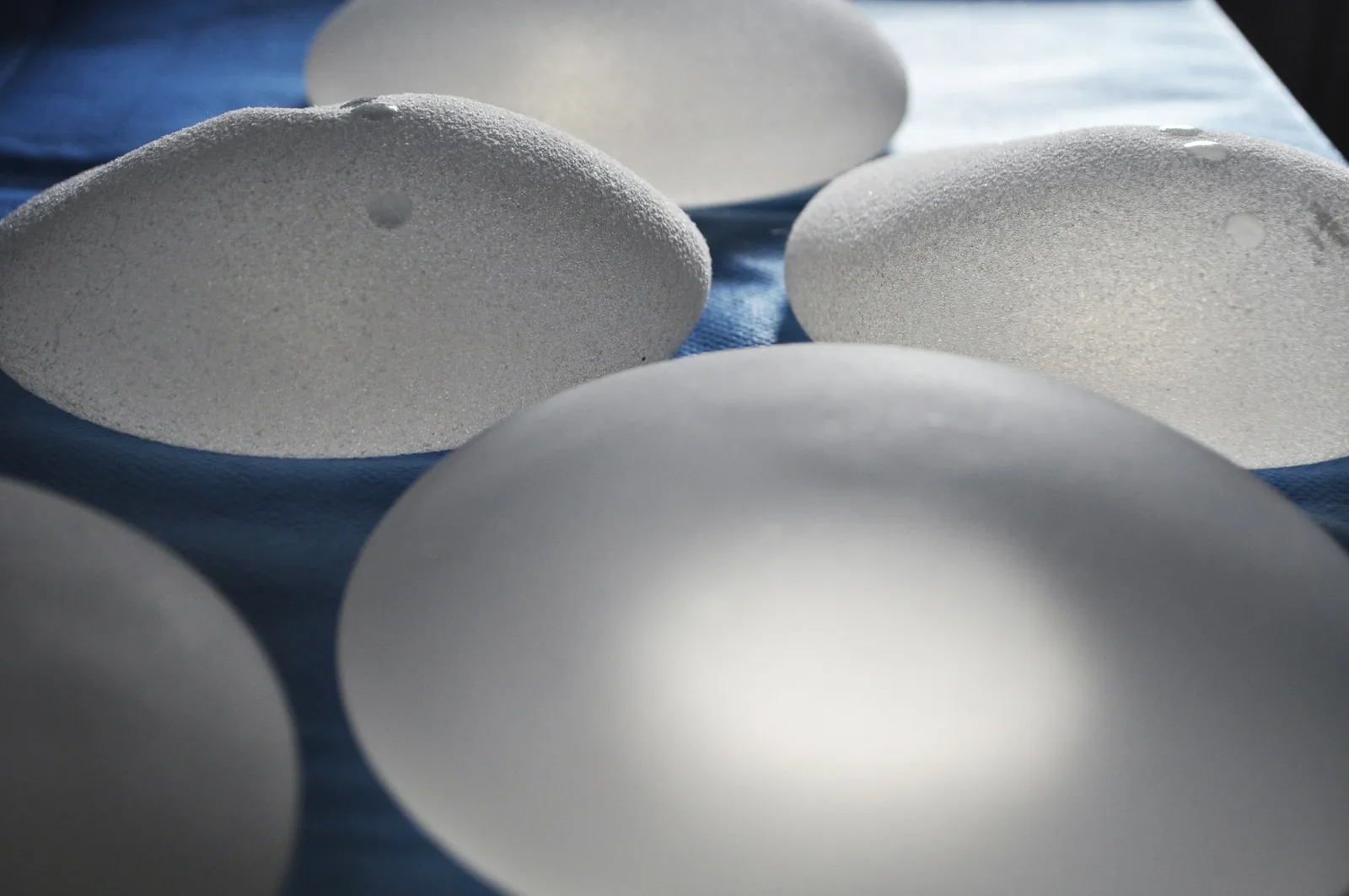
Silicone gel implants come in different shapes, sizes and surface types; these have a textured surface, and the type is chosen with the surgeon at consultation.
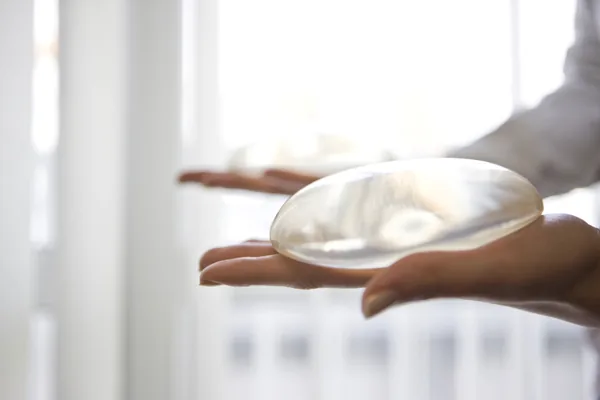
A smooth-surfaced silicone gel implant held in the hand; ask which maker and product line your quote includes, and keep the patient device card you receive.
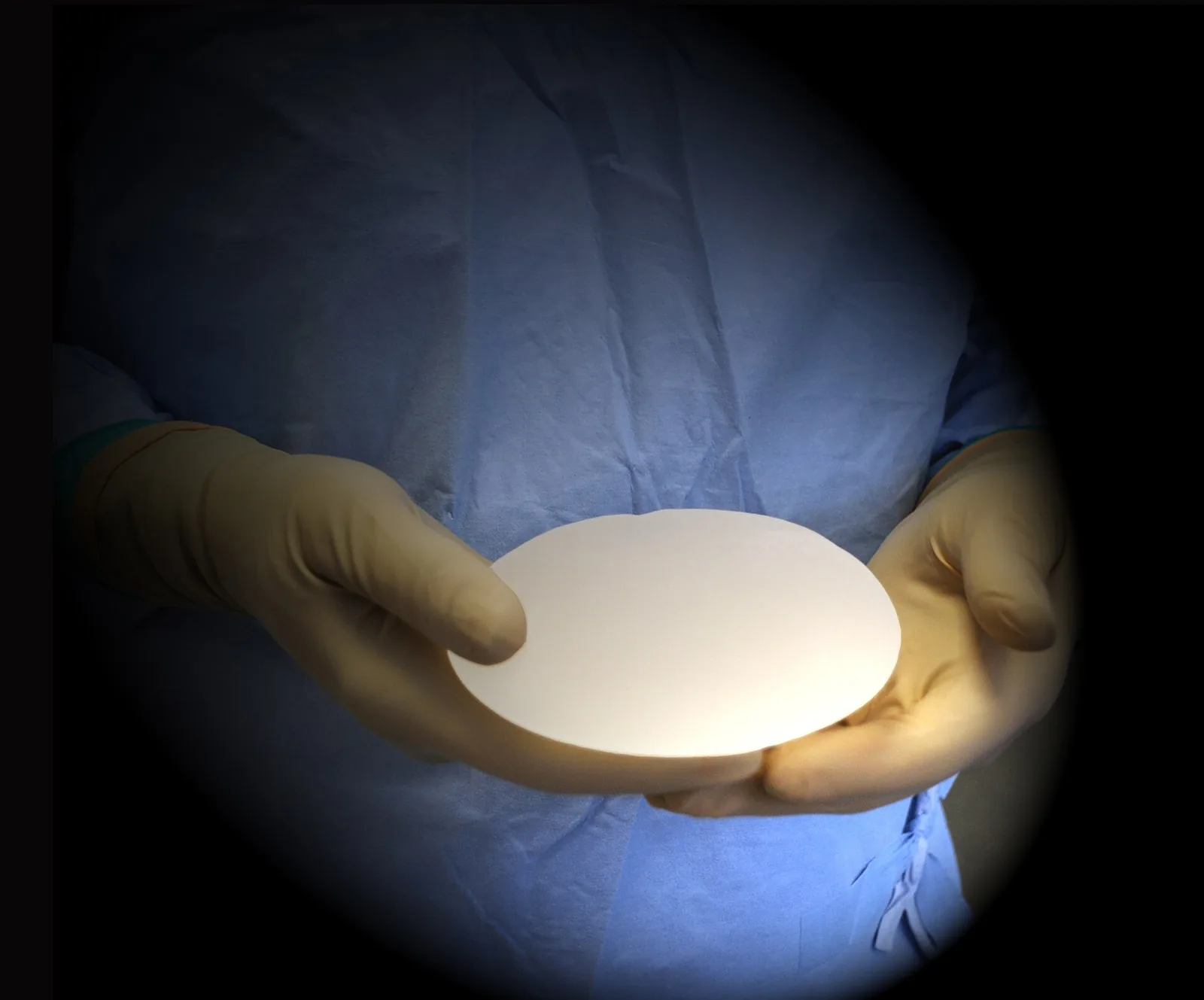
In theatre the implant is handled with sterile gloves; the incision and whether it sits under or over the muscle depend on implant type, anatomy and the surgeon's advice.
Photo: Docteur Spitalier Philippe / CC BY-SA 2.0 / CC BY-SA 2.0 via Wikimedia Commons
Device and procedure images are provided by the manufacturers / licensed stock; they do not show COMEDI patients.
At a glance
- Approach
- The implant is inserted through a cut in the fold under the breast, around the edge of the areola, or in the armpit, and placed under or over the chest muscle.
- Anaesthesia
- Generally general anaesthesia; sedation is used in some cases.
- Operating time
- Generally 60 to 90 minutes, depending on the clinic and the method.
- Hospital stay
- You may go home the same day or stay one night. The NHS advises waiting 5 to 7 days after breast surgery before flying because of blood-clot risk.
- Stitches & garments
- Stitches are generally removed after 1 to 2 weeks unless they dissolve. Some surgeons advise a sports bra day and night for up to 3 months.
The method depends on your build, skin elasticity and the size and shape you want. Scars remain, and the final shape settles after swelling goes down.
Implants are not lifetime devices; regular checks and later surgery may be needed.
References 10
- NHS - Breast enlargement (implants)
- FDA - Risks and Complications of Breast Implants
- FDA - Types of Breast Implants
- FDA - Labeling for Approved Breast Implants
- ASPS - Types of breast implants
- ASPS - Breast augmentation procedure steps
- Breast Augmentation - StatPearls
- Motiva - Implants (manufacturer site)
- A 10-Year Prospective Study of Implant-Based Breast Augmentation and Reconstruction (Sebbin, PMC)
- NHS - Cosmetic surgery abroad
Real cases
A case only helps when you can see the conditions behind it.
Sign in to see the before & after photos
Free. We use your Google name and email only to answer questions about these cases. Clinic names are shared in your private consultation.
 Before
 After
- Sessions
- Surgery (example)
- Combined
- None
- Photo timing
- 6 months after surgery (example)
- SessionsOne session, or the result of a course
- CombinedWhether other treatments or surgery were done together
- Photo timingHow long after the procedure the photo was taken
What to ask in a consultation
Questions about whether it suits you and what the alternatives are.
Often considered when
- Adults who are physically healthy and are not pregnant or breastfeeding, as ASPS describes candidates.
- People whose breasts are fully developed and who are bothered by the feeling that their breasts are too small.
- People unhappy that their breasts have lost shape and volume after pregnancy, weight loss or with ageing, or that the upper part looks 'empty'.
- People with breasts of noticeably different sizes, or a breast that did not develop normally, which ASPS also lists.
- People who want only a modest change using their own fat and can plan for more than one session, which a review notes may be required.
Checks in Korea
- Korea's Foreign Patient Attraction Information System (MEDICALKOREA), run by the Korea Health Industry Development Institute, lets you search registered medical institutions and facilitators by name; leaving the name blank lists all registered ones.
- Q01Which method, size or extent suits my build?
- Q02Where will the scars be, and what long-term checks or care are needed?
- Q03Who is the operating surgeon, and what is their specialty?
- Q04What type of anaesthesia is used, and who monitors it?
- Q05How many follow-up visits are needed before it is safe for me to fly home?
- Q06What are the possible risks and complications, and how are they handled if I am abroad?
- Q07What is included in the written estimate — revisions, medication, garments, stitches out?
Check these yourself at the consultation
- The exact implant brand, model, surface and size planned, and why it suits you.
- That you will receive the implant product card and the maker's warranty documents.
- Whether a board-certified anaesthesiologist is present and how implant checks can continue in your home country.
Recovery & schedule
Check swelling, daily routine, activity limits and review visits separately.
At a glance
- Who decides the plan
- ASPS says the incision and the way the implant is placed depend on the type of implant, how much enlargement you want, your body type or anatomy, and the surgeon's recommendation.
- Pocket trade-offs
- A 2019 review states that placing the implant under the muscle reduces rippling and visibility and has a lower rate of capsular contracture, while placing it over the muscle means less tissue cover and a more visible implant. Under-muscle placement can cause 'animation deformity', where the breast shape distorts when the chest muscle contracts.
- Fat transfer instead of implants
- A 2021 review reports a mean fat graft retention of about 62% in the studies it pooled, with retention generally settling 2 to 4 months after grafting. In its recommendations for fat grafting in breast reconstruction, the authors advise at least 3 to 6 months between grafting sessions.
- Breast imaging first
- The same review recommends screening mammography before fat grafting for patients 40 or older, and for younger patients with a family history of breast cancer or dense or cystic breasts on examination.
- Long-term checks
- ASPS reports the FDA recommendation to screen silicone implants with MRI or ultrasound five to six years after placement and every two to three years after that.
- 01Swelling & bruising
ASPS says you may have soreness and swelling for a few weeks, and that acute pain typically subsides after one to five days. Dressings and a support bra or elastic band help limit swelling.
- 02Back to routine
The NHS suggests taking a week or 2 off work, not driving for at least 1 week, and says most normal activities are usually possible after about 6 weeks.
- 03Activity limits
The NHS advises avoiding heavy lifting or strenuous exercise for at least a month. ASPS advises wearing the support garment around the clock as instructed and increasing activity only when your surgeon allows.
- 04Follow-up & flying home
The NHS describes stitch removal after 1 or 2 weeks, unless dissolvable stitches were used, and recommends not flying for 5 to 7 days after breast surgery. It also advises agreeing beforehand where follow-up appointments will be and what happens if there are complications.
Published guidance; your own clinic sets the actual plan.
Before your visit day
What clinics ask of international patients, in one place.
- Bring your passportClinics register international patients with their passport, and any estimate or prescription is issued in the name on it.
- Patients under 19Adulthood in Korea starts at 19. For a younger patient, clinics generally ask a parent or legal guardian to consent in writing, and many ask them to attend. Tell us the patient's age when you write, and we check what the clinic needs.
- Coming with someoneA family member or friend can usually join you in the consultation room. Treatment and recovery areas follow each clinic's rules, so we check this before your visit. If more than one person is booking, tell us what each person is interested in.
- Language helpCoordinators reply in English, Japanese, Chinese and Korean. Interpretation on the day is arranged for your dates, and we confirm in writing what it covers before you travel.
- Medicines and allergiesWrite down the medicines you take and any allergies. The clinic asks about both before any treatment.
What changes the price
The same surgery can be quoted differently depending on the items below.
What differs from clinic to clinic
- Under or over the muscle
- A 2019 review describes less rippling and lower capsular contracture under the muscle, but a risk of the breast distorting when the muscle contracts. Which pocket a clinic tends to recommend, and how it decides for your tissue thickness, differs.
- Smooth or textured shells
- The FDA states the risk of BIA-ALCL is higher with textured than smooth implants, and both shell types are made for saline and silicone implants. Which surfaces a clinic stocks is worth comparing.
- Implants or your own fat
- Fat transfer avoids an implant, but a 2021 review reports only part of the fat stays and further sessions spaced months apart may be needed. Whether a clinic offers fat transfer, implants or both changes the whole plan and the length of your trips.
- Surgeon experience and information
- The NHS suggests asking about the surgeon's qualifications, how many operations they have done, complication rates, and the implant type and manufacturer. How openly clinics share this varies.
- Care after you fly home
- Implants need monitoring for as long as you have them, and the FDA advises assuming further surgery will be needed. How a clinic supports remote follow-up and later replacement differs.
- Implant brand and model
- Which maker and product line is quoted, and whether a different brand changes the price.
- Fill, surface and shape
- Saline or silicone gel, smooth or textured shell, round or shaped, and the size and profile.
- Fat transfer sessions
- If using your own fat, how many sessions are quoted and whether the liposuction areas are included.
- Anaesthesia and stay
- General anaesthesia or sedation, who gives it, and whether an overnight stay is included.
- Pre-surgery imaging
- Whether breast ultrasound or mammography before surgery is included.
- Garments and follow-up
- Support bra, stitch removal, review visits before you fly, and the revision or warranty terms.
- Method
- Implants, fat transfer, incision approach
- Implant & extent
- Implant type, or the number and size of liposuction areas
- Anaesthesia & stay
- General anaesthesia, the anaesthesiologist and whether you stay overnight
- What is included
- Tests, medication, compression garment, review visits and the revision policy
Prices are set by the clinic after a consultation. Ask for an itemised, written estimate before you book, and check what is included and what could change.
Often charged separately
Ask whether each of these is in your estimate.
| Item | What to ask |
|---|---|
| Consultation fee | Whether the consultation is charged, and whether that amount comes off the surgery price. |
Clinics in Korea build a surgery estimate from the technique, the type of anaesthesia and the care around the operation.
The final figure is set after the surgeon examines you.
Ask for an itemised, written estimate that marks each item above as included or not, so you can compare two quotes on the same basis.
VAT before you compare quotes
The VAT refund for foreign visitors' cosmetic procedures covered only procedures received by 31 December 2025, so procedures received now are not refunded. Plan your budget without it, and ask each clinic whether VAT is included in the written quote so you compare the same total.
Ask COMEDI, for example
Clinics in Seoul differ in equipment, technique, specialist focus and what the price includes. Send us your question and we compare partner clinics for you.
- “Which partner clinics use smooth implants, and which brands do they offer?”
- “Which clinics do fat transfer for the breast, and how many sessions do they usually plan?”
- “Which clinics would place the implant under the muscle for my build, and which over it?”
- “Do the quotes include imaging before surgery, the support bra and review visits before I fly home?”
Precautions & aftercare
General information. Follow the written instructions from your treating doctor for anything specific to you.
Side effects and precautions for Breast augmentation are in one place at the top of this page.
Aftercare for this procedure
- Wear the support bra or band day and night for as long as your surgeon instructs; the NHS notes some surgeons advise up to 3 months.
- Avoid heavy lifting and strenuous exercise for at least a month, and do not drive for at least a week.
- Keep the patient device card and implant documents; the FDA lists a patient device card among the labeling for approved implants.
- For silicone implants, plan MRI or ultrasound screening at five to six years and every two to three years after that.
- See a doctor for persistent swelling, a lump or pain around an implant, even years after surgery.
- Tell the clinic about medical conditions, any history of blood clots, medicines (including hormones), smoking and plans for pregnancy or breastfeeding.
- Contact the clinic immediately for shortness of breath, leg pain or swelling, fever or marked swelling on one side.
- Get your surgeon's written advice before a long-haul flight.
Information only. Suitability, risks, recovery and price are assessed by the treating doctor in a consultation.
Sources for this section 13
- Breast enlargement (implants) — NHS
- Breast Augmentation Candidates — American Society of Plastic Surgeons
- Breast Augmentation Recovery — American Society of Plastic Surgeons
- Breast Augmentation Procedure Steps — American Society of Plastic Surgeons
- Breast Augmentation Risks and Safety — American Society of Plastic Surgeons
- Cosmetic surgery abroad — NHS
- Dyrberg DL et al. Breast animation deformity — Archives of Plastic Surgery 2019 (PMC6369057)
- Hanson SE et al. Autologous fat grafting in breast reconstruction: implications for follow-up and surveillance — Gland Surgery 2021 (PMC7882329)
- Risks and Complications of Breast Implants — U.S. FDA
- Questions and Answers about Breast Implant-Associated Anaplastic Large Cell Lymphoma (BIA-ALCL) — U.S. FDA
- Foreign Patient Attraction Information System (MEDICALKOREA) — Korea Health Industry Development Institute
- Types of Breast Implants — U.S. FDA
- Things to Consider Before Getting Breast Implants — U.S. FDA
Related questions & guides
Worth reading alongside this page.
Notes from people who used COMEDI
Written after a consultation we arranged, and matched to that request.
Common questions
How much does Breast augmentation cost in Korea?+
Prices are set by each clinic after a consultation and depend on the technique, area and your needs. Ask for an itemised, written estimate before you book — it should list what is included and what could change. We help you request and compare estimates.
Can foreigners get Breast augmentation in Korea?+
Yes. Many Seoul clinics see international patients. We help with clinic information, consultations in your language, written estimates and interpretation on the day.