
Epicanthoplasty
Adjusts the fold of skin at the inner corner of the eye.

- Type
- Surgical
- Usually by
- Plastic surgeon
- Category
- Eyes
- First step
- Consultation
Information only. Suitability, risks, recovery and price are assessed by the treating doctor in a consultation.
Side effects and precautionsWhat to know about Epicanthoplasty before you book13
Reactions that usually settle, signs to tell the clinic about straight away, and times to wait. Your doctor goes through the risks that apply to you at the consultation.
Known risks
- Reported problems include a raised or red scar, the fold coming back, uneven corners, over-correction, and small lumps around deep stitches. Some of these need a further procedure.
Usually settles on its own
- Puffy, numb eyelids that are difficult to close, which the NHS lists among temporary effects of eyelid surgery.
- Irritated, sensitive or watery eyes, which the NHS says may last a few weeks.
Tell the clinic promptly
- A thickened scar: in the 306-patient series, 85 cases were treated with silicone gel, steroid injection and laser, and the scars gradually resolved after 12 months.
- Bleeding or a collection of blood: the 2025 review notes that bleeding from vessels near the inner corner can sometimes be difficult to control, and the 306-patient series treated 2 cases of hematoma and swelling promptly.
- The fold coming back or uneven corners: in the same series 2 recurrences and 4 asymmetries had another operation.
- Too much opening: one technique paper notes an overcorrected result can over-expose the pink tissue at the corner and give an aggressive look.
- Severe pain or any unexpected symptom: the NHS advises contacting the clinic that did the surgery.
Wait or rethink when
- Children and teenagers whose face is still developing: EyeWiki generally recommends observation until the face matures if there are no other eyelid abnormalities.
- Inverted epicanthus (epicanthus inversus) or folds caused by injury or earlier surgery: these were excluded from a 306-patient cosmetic series, and EyeWiki notes inverted epicanthus typically needs surgical correction as a separate problem.
- Mild folds: the same 306-patient series excluded patients with mild epicanthic folds.
- Drooping eyelid (ptosis), an inward- or outward-turning eyelid, or another eye condition: also excluded from that series, so these are assessed first.
- A tendency to raised scars: the 2025 review notes most candidates are more susceptible to hypertrophic scarring for genetic reasons, so tell the surgeon about any past raised scars.
Sources for this section 10
- Journal of Cosmetic Dermatology 2025 – Minimizing Postoperative Scars in Epicanthoplasty: A Concise Review (PMC12690353)
- Medicine (Baltimore) 2026 – Meta-analysis of the skin redraping method and the Z-plasty method in epicanthus correction (PMC13138403)
- BMC Ophthalmology 2025 – The five-step medial epicanthoplasty (PMC12080135)
- EyeWiki (American Academy of Ophthalmology) – Epicanthal Folds
- Medial Epicanthoplasty with the Skin-Redraping Technique: Technical Refinements for Predictable Outcomes (PMC11845064)
- Eyelid surgery (blepharoplasty) — NHS
- Reoperation of epicanthal reconstruction using a modified reverse skin-redraping method (PMC9794256)
- Cosmetic outcomes of epicanthoplasty for epicanthus tarsalis (PMC10365251)
- Cosmetic surgery abroad — NHS
- Foreign Patient Attraction Information System (MEDICALKOREA) — Korea Health Industry Development Institute
What is it?
The purpose, the change you can expect and the limits.
Adjusts the fold of skin at the inner corner of the eye.
Inner corner surgery

Techniques & materials
- 01Skin redraping method
The tight tissue under the fold is released and the skin is laid back down along the lower lash line, without swapping skin flaps and without a cut on the side of the nose.
- 02Z-plasty
Two small triangular skin flaps at the inner corner are swapped to open the fold and change the direction of the scar; it is the most frequently published technique.
- 03Y-V advancement
A Y-shaped cut at the inner corner is closed as a V to move the corner inward, usually with part of the underlying muscle released.
- 04V-W plasty
A W-shaped pattern of small flaps is used for moderate to marked folds; it allows more correction but leaves more scar line.
- 05Mustardé four-flap technique
Four small flaps are rearranged at the inner corner; it is reserved for pronounced folds.
Clinics do not all carry the same devices, products or techniques. Ask which one will be used, by name, before you book.
How it is done, in photos
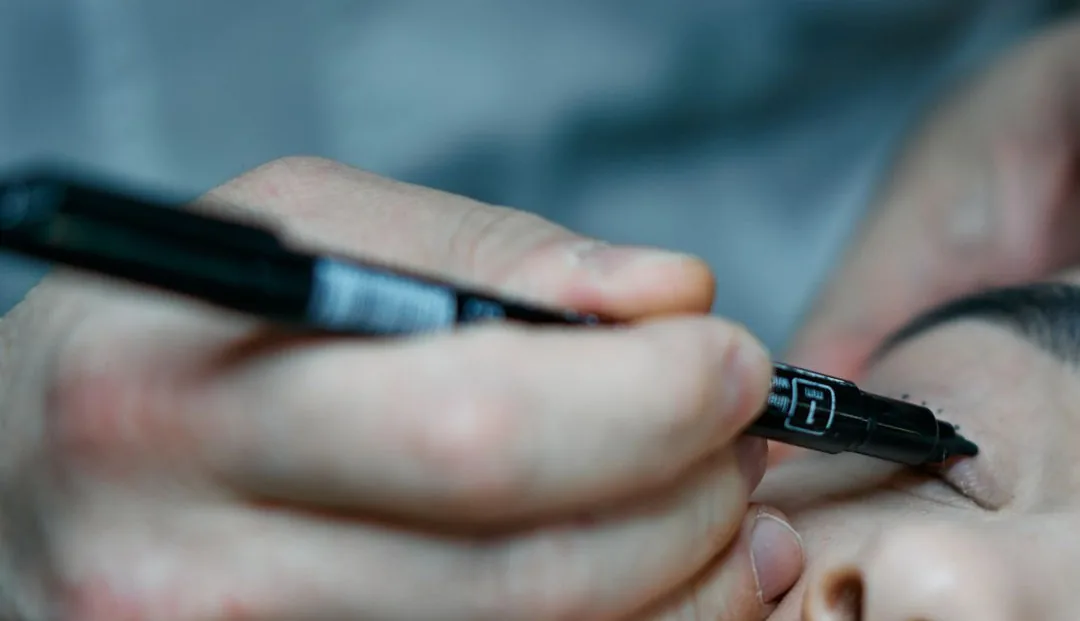
Before the cut, the surgeon marks the planned position of the new inner corner of the eye with a fine pen while the eyes are closed.
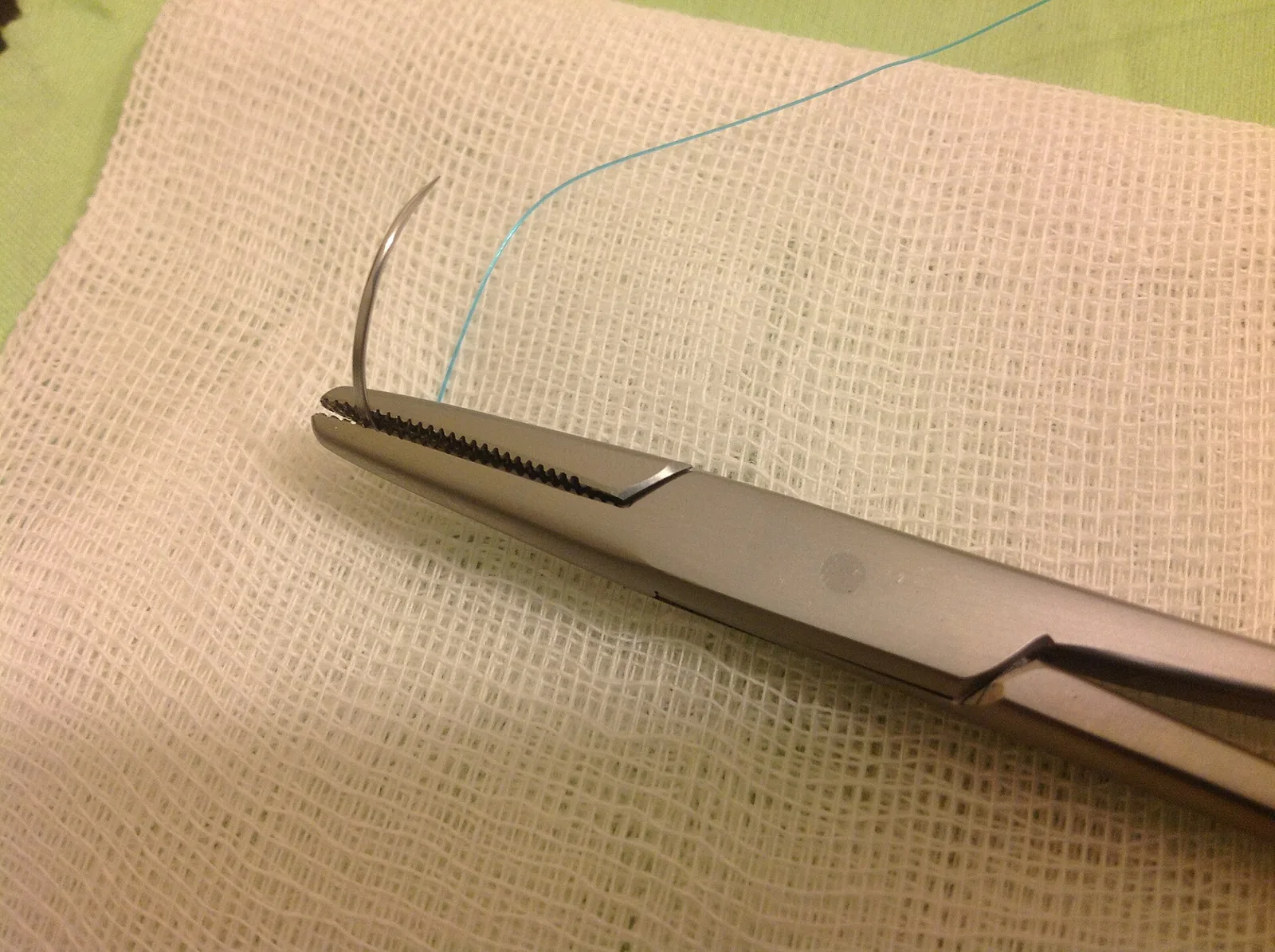
A needle holder with a curved needle and fine thread on sterile gauze; the inner-corner skin is closed with very fine stitches, some of them fast-dissolving.

Published series describe the inner-corner procedure under local anaesthesia injected at the corner, often in the same session as double eyelid surgery.
Device and procedure images are provided by the manufacturers / licensed stock; they do not show COMEDI patients.
At a glance
- Approach
- A small cut at the inner corner of the eye is used to release the fold of skin covering it. Published reviews find that no single technique suits every eye, so the method depends on how marked the fold is.
- Often combined with
- It is often done in the same session as double eyelid surgery. In one published series of 306 patients, most had both procedures together.
- Stitches
- The skin is closed with very fine stitches; some surgeons use fast-dissolving thread that does not need removing. Ask the clinic when and whether stitches are taken out.
- Scar
- A visible scar at the inner corner is the complaint reported most often. Releasing the tight bands under the fold so the skin closes without tension is described as the key step in limiting it.
The method is chosen from the structure of your eyelids and the amount of skin and fat. The shape settles as swelling goes down, which takes time, and the two sides may not be perfectly identical.
Scars can be visible in this area, and it is not advised for every eye spacing.
References 4
- Journal of Cosmetic Dermatology 2025 – Minimizing Postoperative Scars in Epicanthoplasty: A Concise Review (PMC12690353)
- Medicine (Baltimore) 2026 – Meta-analysis of the skin redraping method and the Z-plasty method in epicanthus correction (PMC13138403)
- BMC Ophthalmology 2025 – The five-step medial epicanthoplasty (PMC12080135)
- EyeWiki (American Academy of Ophthalmology) – Epicanthal Folds
Real cases
A case only helps when you can see the conditions behind it.
Sign in to see the before & after photos
Free. We use your Google name and email only to answer questions about these cases. Clinic names are shared in your private consultation.
 Before
 After
- Sessions
- Surgery (example)
- Combined
- None
- Photo timing
- 3 months after surgery (example)
 Before
 After
- Sessions
- Surgery (example)
- Combined
- None
- Photo timing
- 3 months after surgery (example)
 Before
 After
- Sessions
- Surgery (example)
- Combined
- None
- Photo timing
- 3 months after surgery (example)
- SessionsOne session, or the result of a course
- CombinedWhether other treatments or surgery were done together
- Photo timingHow long after the procedure the photo was taken
What to ask in a consultation
Questions about whether it suits you and what the alternatives are.
Often considered when
- Adults with a fold of skin over the inner corner of the eye that widens the distance between the corners and shortens the eye opening, as a 2025 review describes.
- People planning double eyelid surgery; one technique paper notes epicanthoplasty can be done on its own but is more commonly combined with upper eyelid surgery.
- People of Asian descent having upper eyelid skin removed for medical reasons; the 2025 review advises doing epicanthoplasty at the same time so the fold is not made more prominent.
- Adults whose face has finished growing; EyeWiki notes that mild folds in children are generally temporary.
Checks in Korea
- Korea's Foreign Patient Attraction Information System (MEDICALKOREA), run by the Korea Health Industry Development Institute, has a search for registered medical institutions and facilitators by name, type, region and status.
- Q01Which method suits my eyelid structure, and why would you not recommend the others?
- Q02If the result differs from what I expected, when and on what terms is a revision possible?
- Q03Who is the operating surgeon, and what is their specialty?
- Q04What type of anaesthesia is used, and who monitors it?
- Q05How many follow-up visits are needed before it is safe for me to fly home?
- Q06What are the possible risks and complications, and how are they handled if I am abroad?
- Q07What is included in the written estimate — revisions, medication, garments, stitches out?
Check these yourself at the consultation
- Which technique is planned for your fold and where exactly the scar line will sit.
- Whether it will be done together with double eyelid surgery or on its own.
- How scar problems or over-correction are managed afterwards, and on what terms.
Recovery & schedule
Check swelling, daily routine, activity limits and review visits separately.
At a glance
- Anaesthesia
- Published series describe the procedure under local anaesthesia injected at the inner corner. Ask the clinic what is planned, especially if it is combined with other eyelid surgery.
- New corner position
- The desired position of the new inner corner is marked before the cut. One technique paper advises keeping some cover over the inner third of the pink tissue at the corner (the caruncle) for people who want a more natural correction.
- Stitch removal
- Where non-dissolving stitches are used, published series remove them between 4 and 7 days after surgery; one describes day 6.
- Scar care schedule
- In one published protocol, scar massage with silicone gel starts about 2 weeks after surgery, and injections for a thickening scar, if needed, generally start from 1 month.
- Judging the result
- Published studies judge scars and results after 6 months or more. In one study of 389 people who had a further operation after an earlier inner-corner reconstruction, that operation was done at least 6 months after the previous one. Early appearance is not the final result.
- 01Swelling & bruising
In one 306-patient series, the inner corner was covered with gauze and ice compresses were used in the first period after surgery. For eyelid surgery in general, the NHS lists puffy, numb eyelids and irritated or watery eyes that may last a few weeks.
- 02Back to routine
For eyelid surgery in general, the NHS says most people take about 2 weeks off work, depending on their job. Inner-corner surgery alone may differ, so ask your surgeon.
- 03Activity limits
For eyelid surgery the NHS advises avoiding strenuous activity and swimming for a few days, smoking, wearing contact lenses and rubbing your eyes.
- 04Follow-up & flying home
Stitches are usually out within the first week, but scar care can continue for months. The NHS recommends not flying for 7 to 10 days after facial cosmetic procedures and agreeing in advance where follow-up appointments will be.
Published guidance; your own clinic sets the actual plan.
Before your visit day
What clinics ask of international patients, in one place.
- Bring your passportClinics register international patients with their passport, and any estimate or prescription is issued in the name on it.
- Patients under 19Adulthood in Korea starts at 19. For a younger patient, clinics generally ask a parent or legal guardian to consent in writing, and many ask them to attend. Tell us the patient's age when you write, and we check what the clinic needs.
- Coming with someoneA family member or friend can usually join you in the consultation room. Treatment and recovery areas follow each clinic's rules, so we check this before your visit. If more than one person is booking, tell us what each person is interested in.
- Language helpCoordinators reply in English, Japanese, Chinese and Korean. Interpretation on the day is arranged for your dates, and we confirm in writing what it covers before you travel.
- Medicines and allergiesWrite down the medicines you take and any allergies. The clinic asks about both before any treatment.
What changes the price
The same surgery can be quoted differently depending on the items below.
What differs from clinic to clinic
- Technique
- A 2026 meta-analysis of 14 Chinese studies (1,539 patients) found both Z-plasty and skin redraping narrowed the distance between the corners similarly with similar complication rates, while Z-plasty had better 6-month scar scores, higher satisfaction and fewer recurrences. Clinics favour different methods, so ask which they use for your fold.
- How much to open
- One technique paper warns that an overcorrected result can over-expose the pink tissue at the corner and look aggressive, and advises keeping some cover for a natural look. How boldly a clinic opens the corner varies.
- Scar-care routine
- The 2025 review found practice varies: only some published series used steroid injections or steroid ointment routinely after surgery, while another protocol uses silicone gel from 2 weeks and injections from 1 month.
- Joining with double eyelid surgery
- When both are done together, the review says the inner-corner incision should either continue from the new eyelid crease or be hidden along the line just below the lower lashes. Ask which approach a clinic plans for your combined design.
- Revision experience
- A study of 389 people who had revision inner-corner surgery calls revision technically challenging; 5.6% needed a further operation. If you have had this surgery before, a clinic's revision experience matters more.
- Surgeon's experience & language
- The NHS advises asking how many procedures like yours the surgeon has done, and whether they speak a language you understand.
- Technique & scar line
- Which technique is planned (for example Z-plasty or skin redraping) and where the scar will sit.
- Planned corner position
- How far the corner will be opened and how much of the pink inner tissue will stay covered.
- Combined double eyelid design
- If done with double eyelid surgery, whether both are priced together and how the two incision lines are joined.
- Scar-care package
- Whether silicone gel, scar injections or laser for a thickening scar are included or charged separately.
- Correction terms
- On what terms the clinic corrects recurrence, uneven corners or too much opening, and how long after surgery it would consider a correction.
- Method
- Incisional or non-incisional, and any combined procedures
- Anaesthesia
- Local or sedation, and who manages it
- Primary or revision
- Whether this is a first operation or a revision
- What is included
- Tests, medication, stitch removal, review visits and the revision policy
Prices are set by the clinic after a consultation. Ask for an itemised, written estimate before you book, and check what is included and what could change.
Often charged separately
Ask whether each of these is in your estimate.
| Item | What to ask |
|---|---|
| Consultation fee | Whether the consultation is charged, and whether that amount comes off the surgery price. |
| Medicine, dressings and garments | Whether prescriptions, dressings, splints or compression garments are included. |
| Recovery stay | Whether an overnight stay at the clinic or a recovery facility is in the estimate. |
Clinics in Korea build a surgery estimate from the technique, the type of anaesthesia and the care around the operation.
The final figure is set after the surgeon examines you.
Ask for an itemised, written estimate that marks each item above as included or not, so you can compare two quotes on the same basis.
VAT before you compare quotes
The VAT refund for foreign visitors' cosmetic procedures covered only procedures received by 31 December 2025, so procedures received now are not refunded. Plan your budget without it, and ask each clinic whether VAT is included in the written quote so you compare the same total.
Ask COMEDI, for example
Clinics in Seoul differ in equipment, technique, specialist focus and what the price includes. Send us your question and we compare partner clinics for you.
- “Which partner clinics would use Z-plasty or skin redraping for my fold, and why?”
- “Can each clinic show how far they would open the corner on my photos?”
- “Do the quotes include scar care such as silicone gel or injections after I fly home?”
- “I had inner corner surgery before — which clinics regularly do revisions?”
Precautions & aftercare
General information. Follow the written instructions from your treating doctor for anything specific to you.
Side effects and precautions for Epicanthoplasty are in one place at the top of this page.
Aftercare for this procedure
- Keep the gauze on and use ice compresses as instructed in the first days.
- Do not rub your eyes or the inner corners while they heal.
- Start silicone gel scar massage only when your surgeon says so; one published protocol starts it at about 2 weeks.
- Tell the clinic if the scar becomes raised or thick; one protocol starts injections from about 1 month, which may be after you fly home.
- Tell the clinic about dry eye, eye conditions or surgery, medicines, smoking and any earlier eyelid surgery.
- Contact the clinic immediately for a change in vision, severe pain or sudden swelling on one side.
- Keep the clinic's contact point and emergency number for after you fly home.
Information only. Suitability, risks, recovery and price are assessed by the treating doctor in a consultation.
Sources for this section 10
- Epicanthal Folds — EyeWiki, American Academy of Ophthalmology
- Minimizing Postoperative Scars in Epicanthoplasty: A Concise Review — Journal of Cosmetic Dermatology 2025 (PMC12690353)
- Meta-analysis of the skin redraping method and the Z-plasty method in epicanthus correction — Medicine (Baltimore) 2026 (PMC13138403)
- The five-step medial epicanthoplasty: simple and standardized — BMC Ophthalmology 2025 (PMC12080135)
- Medial Epicanthoplasty with the Skin-Redraping Technique: Technical Refinements for Predictable Outcomes (PMC11845064)
- Reoperation of epicanthal reconstruction using a modified reverse skin-redraping method (PMC9794256)
- Cosmetic outcomes of epicanthoplasty for epicanthus tarsalis (PMC10365251)
- Eyelid surgery (blepharoplasty) — NHS
- Cosmetic surgery abroad — NHS
- Foreign Patient Attraction Information System (MEDICALKOREA) — Korea Health Industry Development Institute
Related questions & guides
Worth reading alongside this page.
Notes from people who used COMEDI
Written after a consultation we arranged, and matched to that request.
Common questions
How much does Epicanthoplasty cost in Korea?+
Prices are set by each clinic after a consultation and depend on the technique, area and your needs. Ask for an itemised, written estimate before you book — it should list what is included and what could change. We help you request and compare estimates.
Can foreigners get Epicanthoplasty in Korea?+
Yes. Many Seoul clinics see international patients. We help with clinic information, consultations in your language, written estimates and interpretation on the day.