
Alar reduction
Narrows the width of the nostrils through small incisions at the base of the nose.

- Type
- Surgical
- Usually by
- Plastic surgeon
- Category
- Nose
- First step
- Consultation
Information only. Suitability, risks, recovery and price are assessed by the treating doctor in a consultation.
Side effects and precautionsWhat to know about Alar reduction before you book13
Reactions that usually settle, signs to tell the clinic about straight away, and times to wait. Your doctor goes through the risks that apply to you at the consultation.
Known risks
- Reported problems include a visible or widened scar, a nostril that becomes too narrow or changes shape, and loss of the natural curve where the nostril meets the cheek.
Usually settles on its own
- Initial swelling, which ASPS says subsides within a few weeks after nose surgery.
- Swelling that comes and goes and is worse in the morning during the first year, as ASPS describes for nose surgery.
Tell the clinic promptly
- Noticeable scars beside the nostril. Long-term reviews report dermabrasion for visible scars in 25% and 26.3% of patients.
- Nostrils that become too narrow. A 2016 review says base surgery should be conservative to prevent narrowing, and a 2009 paper warns that excision alone can distort or narrow the nostril.
- A notched nostril floor, a flattened nostril wing or a shallow groove beside the nostril. A 2024 paper on 16 people treated for these problems links them to removing too much tissue, and corrected them with ear cartilage grafts and small flaps.
- Uneven nostrils or nostril bases, which a 2016 paper names among the problems of an improper correction.
- Infection and poor wound healing, which ASPS lists among the risks of nose surgery. The NHS advises contacting the clinic as soon as possible for severe pain or any unexpected symptoms.
Wait or rethink when
- A wide base that cutting alone cannot fix. A 2009 paper in Plastic and Reconstructive Surgery says a broad nasal base is occasionally not correctable by excision alone because the nostril may become distorted or narrowed, and that not all causes of a broad base can be treated by removing tissue.
- Facial growth that is not yet complete. ASPS lists completed facial growth among the signs of a good candidate for nose surgery.
- Smoking. ASPS lists not smoking among the signs of a good candidate for nose surgery.
- Health that is not yet in good shape. ASPS lists being physically healthy among the signs of a good candidate for nose surgery.
- Doing it for someone else. ASPS says nose surgery should be done for yourself, not to fulfil someone else's desires or to fit any sort of ideal image, and the NHS advises being sure why you want it before you go ahead.
Sources for this section 17
- Archives of Plastic Surgery 2016 – A Refined Technique for Management of Nasal Flaring (PMC5122555)
- Brazilian Journal of Otorhinolaryngology 2022 – Scar outcomes of alar flare region using absorbable and non-absorbable sutures (PMC9801037)
- World Journal of Plastic Surgery 2024 – Simultaneous open rhinoplasty, alar reduction and upper lip-lift (PMC11088724)
- American Society of Plastic Surgeons – Rhinoplasty: Procedure Steps
- Rhinoplasty: Recovery — American Society of Plastic Surgeons
- Rhinoplasty: Risks and Safety — American Society of Plastic Surgeons
- Nose reshaping (rhinoplasty) — NHS
- Treatment of Alar Deformity After Cosmetic Surgery (Plast Reconstr Surg Glob Open 2024) — PMC
- Update in alar base reduction in rhinoplasty (Curr Opin Otolaryngol Head Neck Surg 2016) — PubMed
- A simplified approach to alar base reduction: a review of 124 patients over 20 years (Arch Facial Plast Surg 2005) — PubMed
- Reducing the Alar Base While Minimizing Visible Sequalae: A Review of Three Alar Base Reduction Techniques over 35 Years (Facial Plast Surg Aesthet Med 2023) — PubMed
- Nasal base reduction: a treatment algorithm including alar release with medialization (Plast Reconstr Surg 2009) — PubMed
- Rhinoplasty: Candidates — American Society of Plastic Surgeons
- Preservation of nostril morphology in nasal base reduction (Aesthetic Plast Surg 2016) — PubMed
- Three-Part Analysis for Designing Nasal Alar Reduction Surgery in Asian Patients (J Craniofac Surg 2025) — PubMed
- 의료 해외진출 및 외국인환자 유치 지원에 관한 법률 제6조 — 국가법령정보센터
- 의료법 제27조(무면허 의료행위 등 금지) — 국가법령정보센터
What is it?
The purpose, the change you can expect and the limits.
Narrows the width of the nostrils through small incisions at the base of the nose.
Nostril reduction
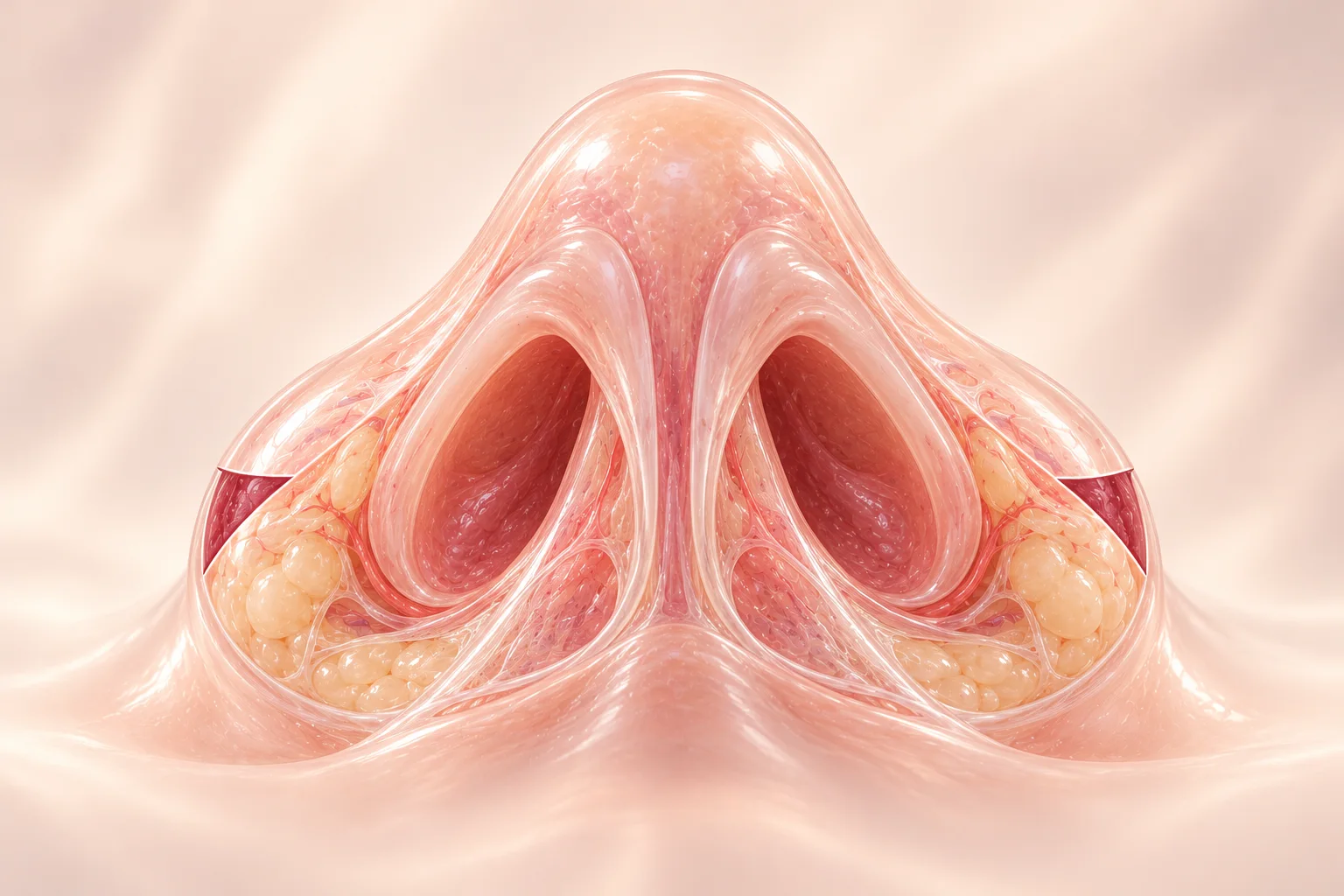
Techniques & materials
- 01Alar wedge excision (Weir technique)
A wedge of skin is removed where the side of the nostril meets the cheek; it is used when the nostril walls flare outward.
- 02Nostril sill excision
Tissue is removed from the floor of the nostril opening; it is used when the base of the nostril is wide.
- 03Combined wedge and sill excision
Both areas are reduced in one design when the nostril walls flare and the base is also wide.
- 04Excision extended into the nostril floor
The cut is carried inside onto the floor of the nostril so that the inside is narrowed along with the outside.
Clinics do not all carry the same devices, products or techniques. Ask which one will be used, by name, before you book.
How it is done, in photos
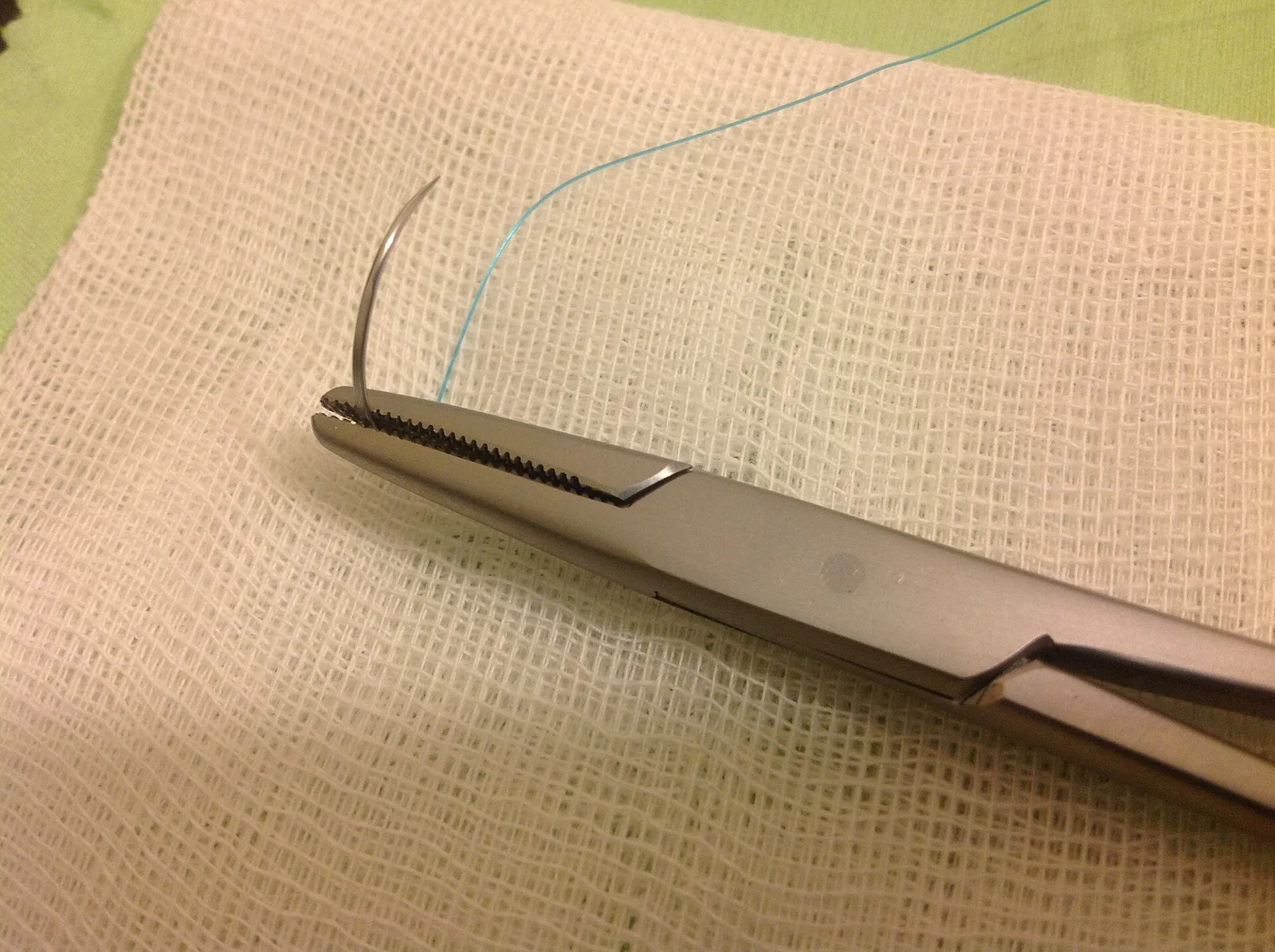
A needle holder with a curved needle and fine thread; nostril-base cuts are closed with stitches, and non-dissolving ones generally come out after 5 to 7 days.
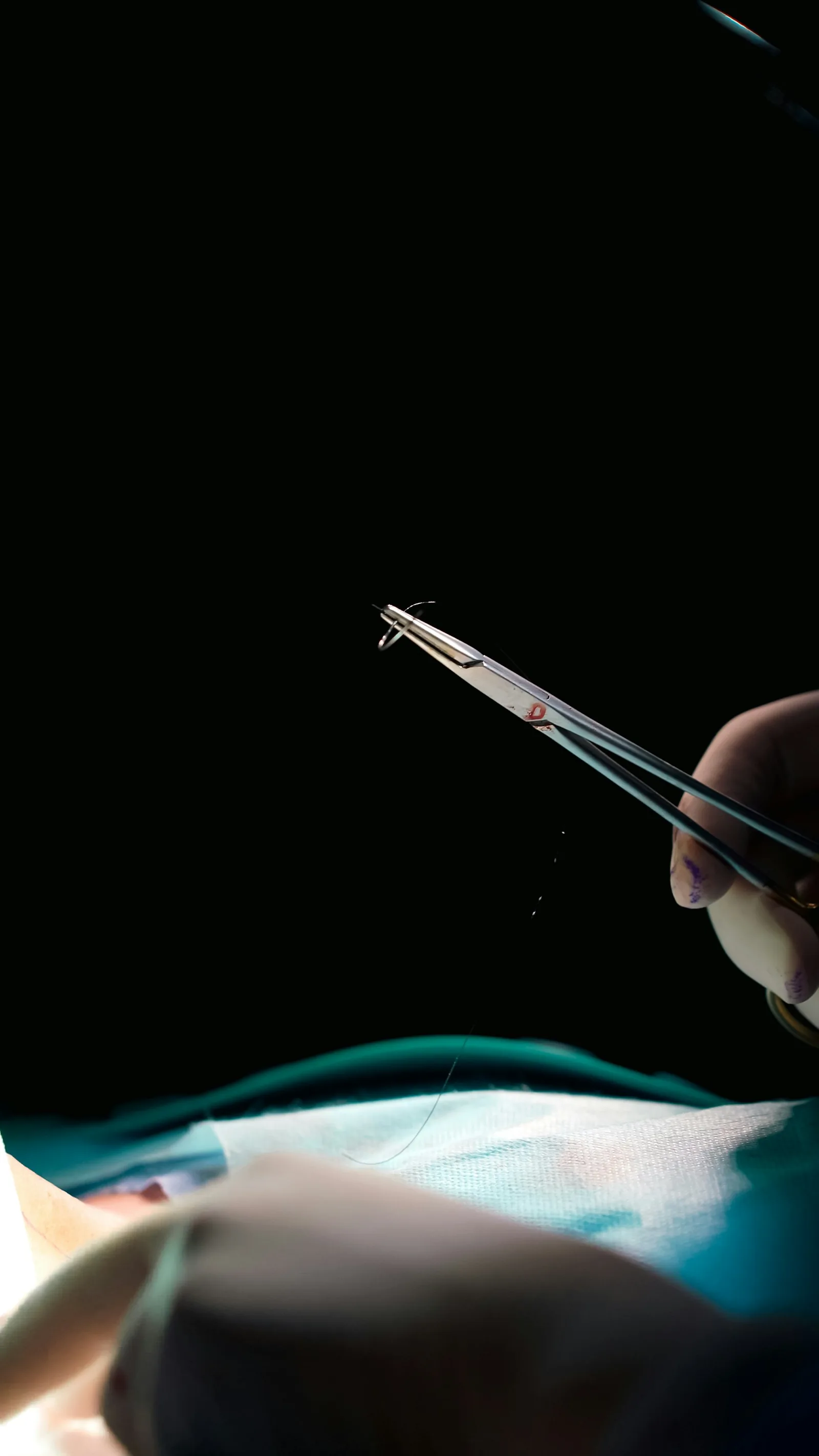
A gloved hand holds fine forceps in the operating room; the cut is placed in or close to the groove where the nostril meets the cheek.
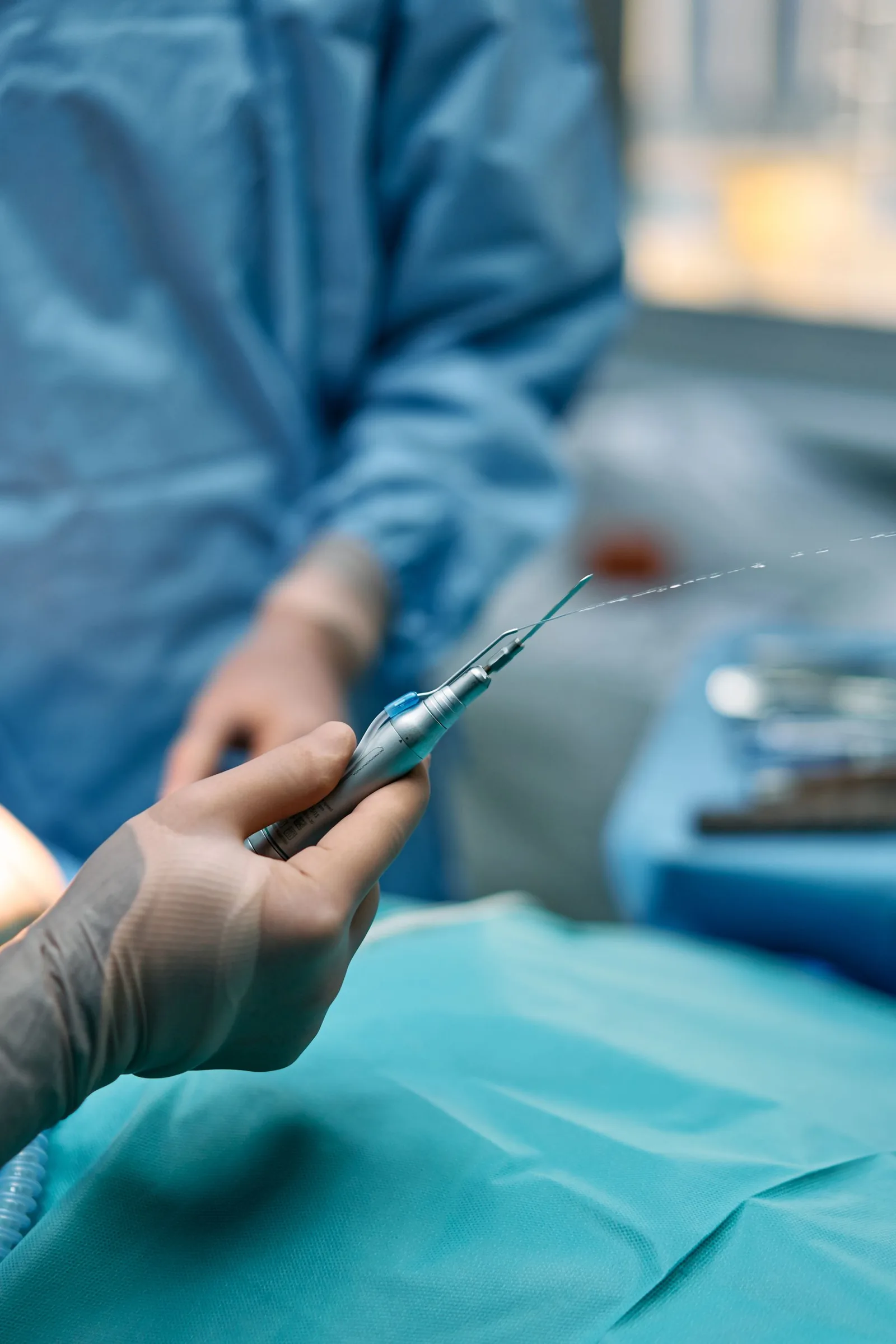
Local anaesthetic is injected at the nostril base, or, when alar reduction is part of a full nose operation, it is done last under the main anaesthesia.
Device and procedure images are provided by the manufacturers / licensed stock; they do not show COMEDI patients.
At a glance
- Approach
- Skin is removed at the side of the nostril, at the nostril floor, or both, depending on whether the nostril flares, the base is wide, or the two sides differ.
- Incision placement
- The cut is placed in, or 1 to 2 mm from, the natural groove where the nostril meets the cheek so that the scar follows that line. Exact placement varies by surgeon.
- Anaesthesia
- Published studies describe local anaesthetic injected at the nostril base. When it is done as part of a full nose operation, the anaesthesia is that of the main surgery.
- Stitches
- Non-dissolving skin stitches are generally removed about 5 to 7 days after surgery; dissolving stitches do not need removing. One study comparing the two found no significant difference in the scar.
What is possible depends on skin thickness, the state of your cartilage and any earlier surgery. Swelling takes a long time to settle before the final shape shows.
A scar may remain, and over-reduction is difficult to reverse.
References 4
- Archives of Plastic Surgery 2016 – A Refined Technique for Management of Nasal Flaring (PMC5122555)
- Brazilian Journal of Otorhinolaryngology 2022 – Scar outcomes of alar flare region using absorbable and non-absorbable sutures (PMC9801037)
- World Journal of Plastic Surgery 2024 – Simultaneous open rhinoplasty, alar reduction and upper lip-lift (PMC11088724)
- American Society of Plastic Surgeons – Rhinoplasty: Procedure Steps
Real cases
A case only helps when you can see the conditions behind it.
Sign in to see the before & after photos
Free. We use your Google name and email only to answer questions about these cases. Clinic names are shared in your private consultation.
 Before
 After
- Sessions
- Surgery (example)
- Combined
- None
- Photo timing
- 6 months after surgery (example)
 Before
 After
- Sessions
- Surgery (example)
- Combined
- None
- Photo timing
- 6 months after surgery (example)
 Before
 After
- Sessions
- Surgery (example)
- Combined
- None
- Photo timing
- 6 months after surgery (example)
- SessionsOne session, or the result of a course
- CombinedWhether other treatments or surgery were done together
- Photo timingHow long after the procedure the photo was taken
What to ask in a consultation
Questions about whether it suits you and what the alternatives are.
Often considered when
- People whose nostrils flare outward or whose nose looks wide at the base. A 2016 paper in Archives of Plastic Surgery lists alar flaring, a wide distance between the nostril wings, a wide nostril sill and uneven nostril wings as indications, and says reduction is generally considered when the distance between the nostril wings is wider than the distance between the inner corners of the eyes.
- People of East Asian heritage who want a narrower nasal base. A 2016 paper in Aesthetic Plastic Surgery notes that Asian patients often ask for reduction of the base and nostril wings, and describes a method designed to keep the nostril rim smooth.
- People planning a full nose operation who also have a wide nasal base or flaring nostrils. A 2016 review says changing the nasal base is not a routine part of rhinoplasty; when a wide base or flaring calls for it, it should be the last step, because it cannot be properly judged until every other step is done.
- Adults who meet the general candidate points ASPS lists for nose surgery: facial growth is complete, you are physically healthy, you don't smoke, and your goals are realistic.
Checks in Korea
- Under Korea's Medical Service Act (Article 27), no one who is not a licensed medical professional may perform medical procedures, and medical professionals may not perform procedures outside the scope of their licence.
- Under Korean law, a clinic that attracts foreign patients must register for it, have at least one specialist for each department in which it attracts foreign patients (unless the department is not one of the specialty fields set by Presidential Decree), and belong to medical malpractice liability insurance or a medical liability mutual aid association. Registration is valid for 3 years from the date of registration, and a clinic that wants to keep attracting foreign patients after it expires must renew it before it expires.
- Q01With my nose, which changes are realistic and which are difficult?
- Q02Which material would you use, and why that one?
- Q03Who is the operating surgeon, and what is their specialty?
- Q04What type of anaesthesia is used, and who monitors it?
- Q05How many follow-up visits are needed before it is safe for me to fly home?
- Q06What are the possible risks and complications, and how are they handled if I am abroad?
- Q07What is included in the written estimate — revisions, medication, garments, stitches out?
Check these yourself at the consultation
- Where exactly the cut will be (side of the nostril, nostril floor or both) and how much will be removed.
- Whether dissolving or removable stitches are used and when they come out.
- How a visible scar or uneven nostrils are managed afterwards, and on what terms.
Recovery & schedule
Check swelling, daily routine, activity limits and review visits separately.
At a glance
- Where it fits in a nose operation
- A 2016 review says changing the nasal base is not a routine part of rhinoplasty, should be done conservatively to avoid narrowing the nostrils, and should always come last, after every other step. ASPS describes it within rhinoplasty as additional incisions placed in the natural creases of the nostrils to alter their size.
- How the design is decided
- A 2025 paper on Asian patients plans the operation from three separate findings: a flared nostril wing, a wide nasal base and a drooping nostril wing, noting that reduction from the outside can lead to misshapen nostrils and noticeable scars.
- Review visits in published series
- In a 2024 study of 51 people who had alar reduction together with open rhinoplasty and a lip lift, patients were seen at 6 days to remove stitches and again at one and two months. Your own schedule is set by your surgeon.
- When the shape settles
- For nose surgery in general, ASPS says initial swelling settles within a few weeks but the new contour may take up to a year to fully refine, and swelling may come and go and be worse in the morning during the first year.
- Scar touch-ups afterwards
- In a 20-year review of 124 patients, 25% had dermabrasion (skin smoothing) for noticeable scars, and the authors say patients should be told this may be needed in the groove beside the nostril. A 35-year review of 312 patients found 26.3% had dermabrasion and called visible incisions the most common downside.
- 01Swelling & bruising
For nose surgery in general, ASPS says initial swelling settles within a few weeks and lists skin discoloration and swelling among the effects. When alar reduction is part of a full nose operation, the NHS describes soreness, swelling and bruising around the eyes that can last 3 weeks.
- 02Back to routine
The NHS says you may need up to 2 weeks off work after full nose reshaping; no comparable official figure was found for alar reduction on its own, so ask your surgeon. In one 2022 study, patients cleaned the incision lines and applied an antibiotic ointment twice a day for seven days.
- 03Activity limits
A 2016 paper advises not touching or massaging the stitch line, to avoid widening the scar. If the nostril work is part of a full nose operation, the NHS advises avoiding strenuous exercise or contact sports for 4 to 6 weeks.
- 04Follow-up & flying home
Published series remove stitches within the first week and review again at one and two months. ASPS suggests asking when stitches come out and when you return for follow-up care, so both can be matched to your flight home and to photo reviews after you leave.
Published guidance; your own clinic sets the actual plan.
Before your visit day
What clinics ask of international patients, in one place.
- Bring your passportClinics register international patients with their passport, and any estimate or prescription is issued in the name on it.
- Patients under 19Adulthood in Korea starts at 19. For a younger patient, clinics generally ask a parent or legal guardian to consent in writing, and many ask them to attend. Tell us the patient's age when you write, and we check what the clinic needs.
- Coming with someoneA family member or friend can usually join you in the consultation room. Treatment and recovery areas follow each clinic's rules, so we check this before your visit. If more than one person is booking, tell us what each person is interested in.
- Language helpCoordinators reply in English, Japanese, Chinese and Korean. Interpretation on the day is arranged for your dates, and we confirm in writing what it covers before you travel.
- Medicines and allergiesWrite down the medicines you take and any allergies. The clinic asks about both before any treatment.
What changes the price
The same surgery can be quoted differently depending on the items below.
What differs from clinic to clinic
- Cut, stitch or flap
- A 2016 review says a wide base with flaring is managed in three ways: cinching stitches that pull the nostril wings together, excisions that remove tissue from the nostril wing or from inside the nostril, and flap advancement. Surgeons differ in which they reach for.
- How the nostril floor is closed
- A 2016 paper notes that the common nostril-floor excision may leave an angular or notched nostril rim, and describes an internal method with small triangular flaps; none of its patients had notching at the stitch site. Ask how each surgeon protects the nostril rim.
- How much is removed
- A 2024 paper treating 16 people for flattened or notched nostrils traces these problems to removing too much tissue in aggressive cosmetic surgery. How conservative a surgeon's plan is matters as much as the technique.
- Plan for the scar
- Long-term reviews report dermabrasion for visible scars in about a quarter of patients, and recommend telling patients in advance. Whether a clinic discusses scar touch-ups up front, and how, differs.
- Reading your nose first
- One 2025 approach designs the operation from three separate findings (flaring, a wide base and a drooping nostril wing), and a 2009 paper notes that some wide bases need more than excision. How a surgeon analyses your nostrils shapes the plan.
- Excision pattern
- Whether the quote covers a wedge at the side of the nostril, the nostril floor, both, or a flap advancement.
- Excision or cinching stitch
- Whether the plan removes skin or uses a stitch that pulls the nostril wings together without removing skin.
- Alone or with rhinoplasty
- Whether alar reduction is priced as a stand-alone operation or as the final step of a full nose operation.
- Scar refinement
- Whether a later scar touch-up such as dermabrasion is included or charged separately.
- Asymmetry correction
- Whether a small correction for uneven nostrils is covered, and within what period.
- Extent
- Bridge, tip, nostrils and any combined procedures
- Materials
- Your own cartilage, donor tissue or the type of implant
- Anaesthesia
- Type of anaesthesia and whether an anaesthesiologist manages it
- Primary or revision
- Whether this is a first operation or a revision
- What is included
- Tests, medication, splint and stitch removal, review visits and the revision policy
Prices are set by the clinic after a consultation. Ask for an itemised, written estimate before you book, and check what is included and what could change.
Often charged separately
Ask whether each of these is in your estimate.
| Item | What to ask |
|---|---|
| Consultation fee | Whether the consultation is charged, and whether that amount comes off the surgery price. |
| Recovery stay | Whether an overnight stay at the clinic or a recovery facility is in the estimate. |
Clinics in Korea build a surgery estimate from the technique, the type of anaesthesia and the care around the operation.
The final figure is set after the surgeon examines you.
Ask for an itemised, written estimate that marks each item above as included or not, so you can compare two quotes on the same basis.
VAT before you compare quotes
The VAT refund for foreign visitors' cosmetic procedures covered only procedures received by 31 December 2025, so procedures received now are not refunded. Plan your budget without it, and ask each clinic whether VAT is included in the written quote so you compare the same total.
Ask COMEDI, for example
Clinics in Seoul differ in equipment, technique, specialist focus and what the price includes. Send us your question and we compare partner clinics for you.
- “My nostrils flare but the base isn't very wide. Which partner clinics would cut, and which would use a cinching stitch?”
- “I'm also having rhinoplasty. Is the nostril reduction priced separately or as part of it?”
- “How does each clinic handle a visible scar or uneven nostrils after surgery, and is that in the quote?”
- “I have 8 days in Seoul. When would stitches come out at each clinic, and how would they review my nostrils from photos afterwards?”
Precautions & aftercare
General information. Follow the written instructions from your treating doctor for anything specific to you.
Side effects and precautions for Alar reduction are in one place at the top of this page.
Aftercare for this procedure
- Keep the stitch line clean. A 2016 paper describes regular cleaning of the suture line to prevent the skin from softening and breaking down.
- Do not touch or massage the stitch line, which the same paper advises to avoid widening the scar.
- If you had a full nose operation at the same time, avoid blowing your nose and prop your head up with pillows when resting, as the NHS advises.
- Follow your surgeon's written instructions. ASPS says these may cover how to care for the surgical site, medicines to apply or take to aid healing and reduce the chance of infection, and specific concerns to look for.
- Tell the clinic about rhinitis or sinus problems, nasal injury or surgery, medicines and smoking.
- Contact the clinic immediately for heavy bleeding, fever, a change in skin colour or severe pain.
- Agree in advance how the clinic will review your progress from photos after you fly home.
Information only. Suitability, risks, recovery and price are assessed by the treating doctor in a consultation.
Sources for this section 17
- Nose reshaping (rhinoplasty) — NHS
- Rhinoplasty: Recovery — American Society of Plastic Surgeons
- Rhinoplasty: Risks and Safety — American Society of Plastic Surgeons
- Rhinoplasty: Candidates — American Society of Plastic Surgeons
- Rhinoplasty: Procedure Steps — American Society of Plastic Surgeons
- A Refined Technique for Management of Nasal Flaring (Arch Plast Surg 2016) — PMC
- Scar outcomes of alar flare region using absorbable and non-absorbable sutures (Braz J Otorhinolaryngol 2022) — PMC
- The Safety and Outcomes of Simultaneous Open Rhinoplasty, Alar Reduction, and Upper Lip-Lift through One Surgery (World J Plast Surg 2024) — PMC
- Treatment of Alar Deformity After Cosmetic Surgery (Plast Reconstr Surg Glob Open 2024) — PMC
- Update in alar base reduction in rhinoplasty (Curr Opin Otolaryngol Head Neck Surg 2016) — PubMed
- A simplified approach to alar base reduction: a review of 124 patients over 20 years (Arch Facial Plast Surg 2005) — PubMed
- Reducing the Alar Base While Minimizing Visible Sequalae: A Review of Three Alar Base Reduction Techniques over 35 Years (Facial Plast Surg Aesthet Med 2023) — PubMed
- Preservation of nostril morphology in nasal base reduction (Aesthetic Plast Surg 2016) — PubMed
- Three-Part Analysis for Designing Nasal Alar Reduction Surgery in Asian Patients (J Craniofac Surg 2025) — PubMed
- Nasal base reduction: a treatment algorithm including alar release with medialization (Plast Reconstr Surg 2009) — PubMed
- 의료 해외진출 및 외국인환자 유치 지원에 관한 법률 제6조 — 국가법령정보센터
- 의료법 제27조(무면허 의료행위 등 금지) — 국가법령정보센터
Related questions & guides
Worth reading alongside this page.
Notes from people who used COMEDI
Written after a consultation we arranged, and matched to that request.
Common questions
How much does Alar reduction cost in Korea?+
Prices are set by each clinic after a consultation and depend on the technique, area and your needs. Ask for an itemised, written estimate before you book — it should list what is included and what could change. We help you request and compare estimates.
Can foreigners get Alar reduction in Korea?+
Yes. Many Seoul clinics see international patients. We help with clinic information, consultations in your language, written estimates and interpretation on the day.