
Sculptra& collagen stimulators
Injectables designed to prompt the skin's own collagen response gradually over time.

- Type
- Non-surgical
- Usually by
- Dermatologist
- Category
- Botox, fillers & boosters
- First step
- Consultation
Information only. Suitability, risks, recovery and price are assessed by the treating doctor in a consultation.
Side effects and precautionsWhat to know about Sculptra & collagen stimulators before you book14
Reactions that usually settle, signs to tell the clinic about straight away, and times to wait. Your doctor goes through the risks that apply to you at the consultation.
Usually settles on its own
- Swelling, redness, pain or tenderness, bruising, itching and small lumps at the injection sites: in the Sculptra study diaries these were mostly mild to moderate and disappeared within 1–2 weeks.
- An early 'corrected' look from swelling and the mixing water, which usually settles within several hours to a few days (Sculptra).
- A firm feeling where Radiesse was injected, which the guide says goes away over the next several weeks.
Tell the clinic promptly
- Changes in vision, signs of a stroke, white skin near the injection site, or unusual pain during or shortly after treatment: both labels say the chance of injecting into a blood vessel is very small but the complications can be serious and permanent, so tell your provider immediately.
- Lumps (nodules) or delayed swollen lumps (granulomas) appearing months after Sculptra, some lasting up to 2 years; they may settle on their own or need steroid injections or surgery. The risk may be higher with large volumes in one place, especially deep smile lines at the corners of the mouth.
- Swelling or inflammation near the filler after a viral or bacterial illness, a vaccination or dental work (Radiesse).
- Infection at the injection site, or a flare of cold sores (herpes) if you have had them before.
- Any worsening or longer-lasting symptom should be reported to your provider.
Wait or rethink when
- Allergies: Sculptra should not be used with severe allergies with a history of severe reactions (anaphylaxis) or multiple severe allergies; Radiesse and Radiesse (+) should not be used with a history of severe allergies. Neither should be used with an allergy to any ingredient (PLLA, carboxymethylcellulose or mannitol for Sculptra; CaHA, sterile water, carboxymethylcellulose or glycerin for Radiesse), and Radiesse (+) not with an allergy to lidocaine or medicines like it.
- A history of, or risk factors for, keloids or thick raised (hypertrophic) scars: the Sculptra labeling lists this as a reason not to use it.
- A bleeding disorder: the Radiesse labeling lists this as a reason not to use it.
- Skin sores, pimples, rashes, hives, cysts or infection: the Sculptra labeling says treatment should be postponed until healing is complete; the Radiesse labeling says it should not be used with active skin inflammation or infection in or near the treatment area until this has been controlled.
- Pregnancy or breastfeeding, or being under 18: the safety of Sculptra and Radiesse has not been studied or established in these groups.
- Lips and the area around the eyes: Radiesse safety and effectiveness have not been established there, and Sculptra post-marketing reports include delayed lumps under the eyes or in the red part of the lips that needed hospital care.
Sources for this section 7
- A Patient's Guide to Treatment with SCULPTRA (Rev. April 2023) — Galderma Laboratories
- RADIESSE Patient Information Guide (nasolabial folds) — Merz North America
- RADIESSE and RADIESSE (+) Important Safety Information, patient brochure (April 2026) — Merz North America
- Dermal Fillers (Soft Tissue Fillers) — US Food and Drug Administration
- Christen MO. Collagen Stimulators in Body Applications: A Review Focused on Poly-L-Lactic Acid (PLLA) — Clinical, Cosmetic and Investigational Dermatology 2022 (PMC9233565, full text via Europe PMC)
- Lin JY, Lin CY. Adjusting Thickness before Injection: A New Trend for Preparing Collagen-stimulating Fillers — Plastic and Reconstructive Surgery Global Open 2021 (PMC8225369, full text via Europe PMC)
- 성형용 필러 시술 시 주의사항은? — 식품의약품안전처(대한민국 정책브리핑)
What is it?
The purpose, the change you can expect and the limits.
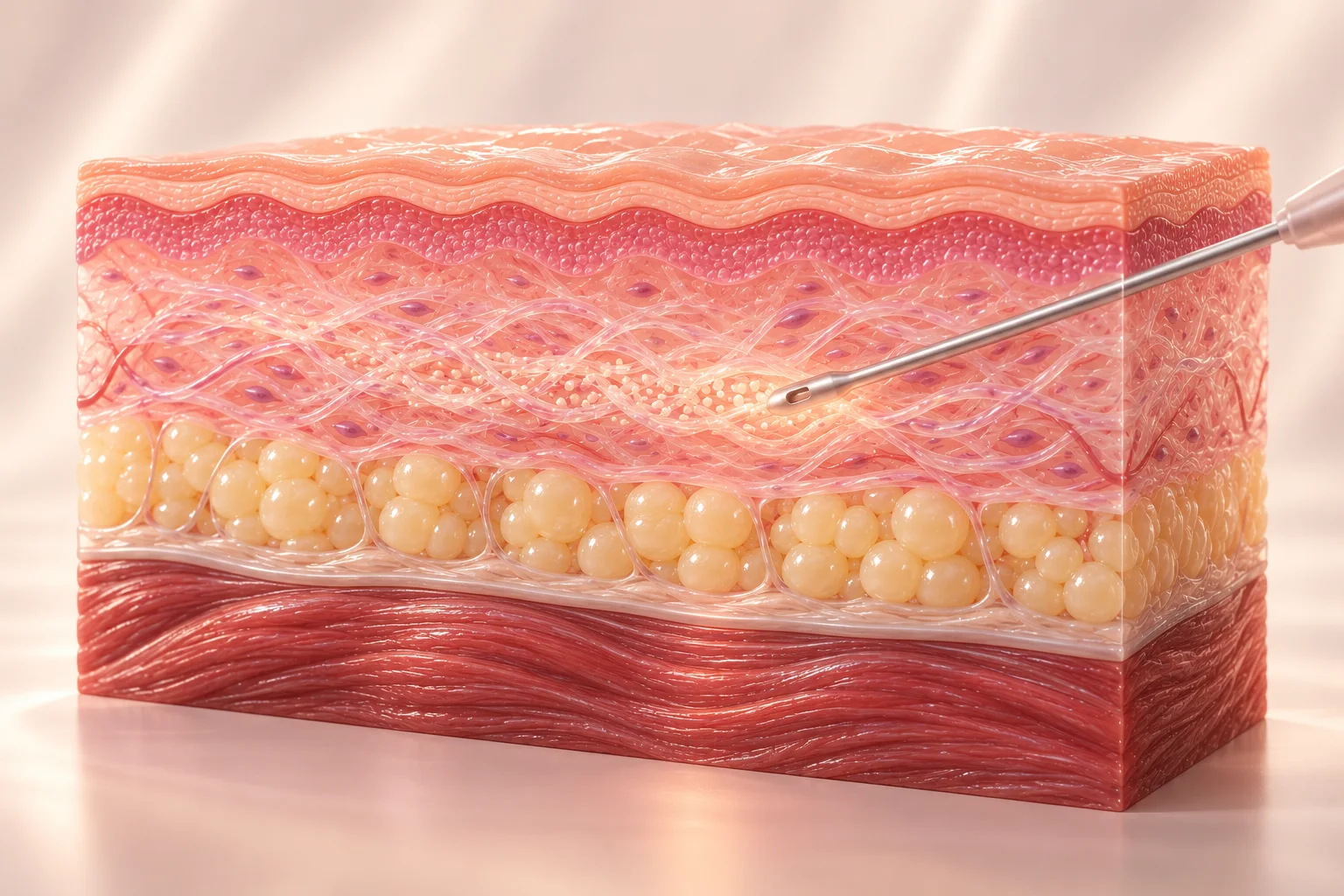
Injectables designed to prompt the skin's own collagen response gradually over time.
Sculptra (PLLA) · Radiesse
- Sculptra
- Ellansé
- Radiesse
Devices & products used
- 01SculptraGalderma
Poly-L-lactic acid (PLLA) particles that prompt the skin to make its own collagen; US-approved for nasolabial folds and fine lines and wrinkles in the cheeks.
- 02EllanséAQTIS Medical, Netherlands
Polycaprolactone (PCL) microspheres in a carboxymethylcellulose gel: the gel gives immediate shape and the microspheres stimulate collagen afterwards.
- 03RadiesseMerz North America, USA
Calcium hydroxylapatite (CaHA) particles of 25–45 microns in a gel carrier; US-approved for moderate to severe facial wrinkles and folds and for the backs of the hands.
Clinics do not all carry the same devices, products or techniques. Ask which one will be used, by name, before you book.
How it is done, in photos
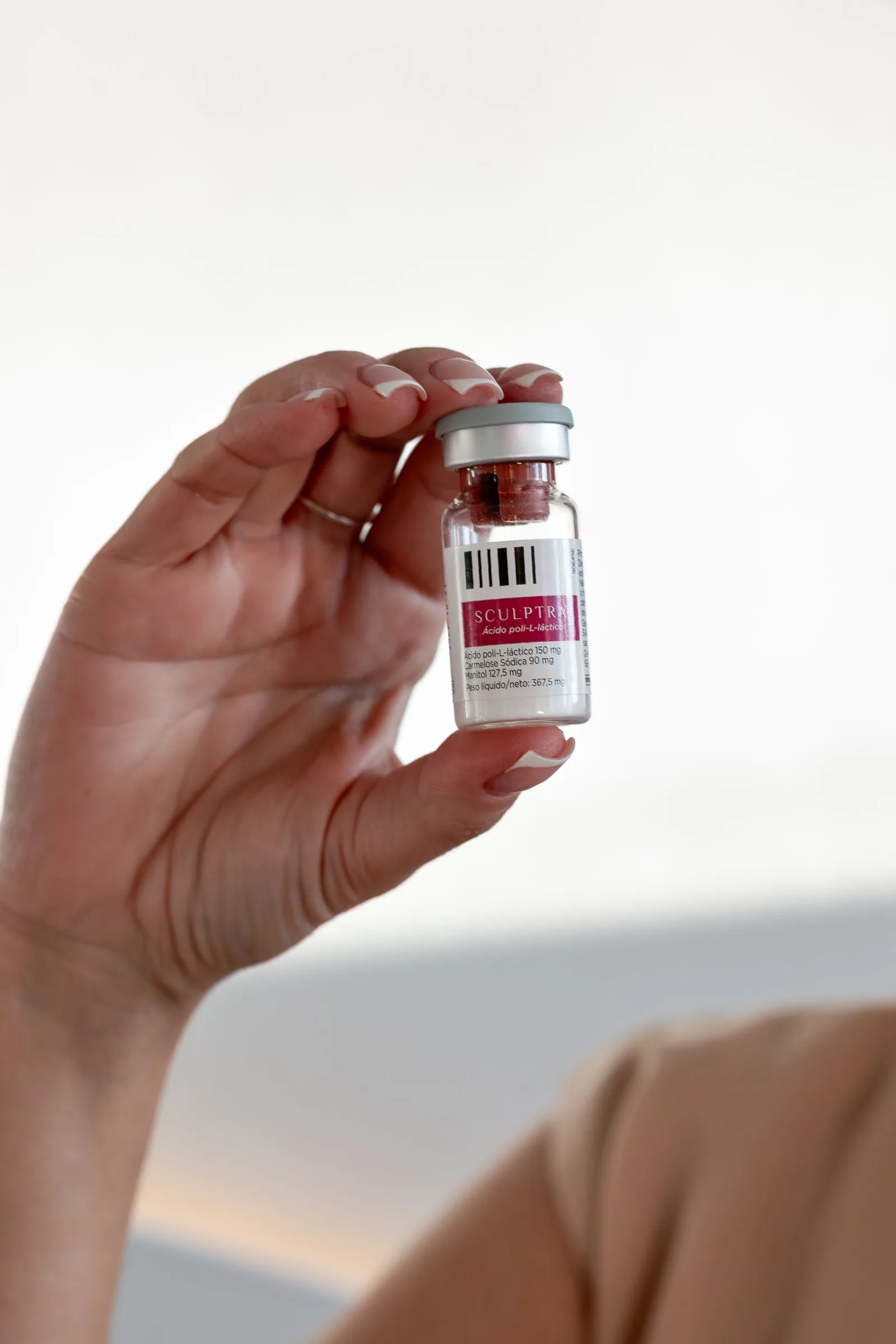
A vial of Sculptra, a poly-L-lactic acid powder made by Galderma, which is mixed with sterile water before it is injected.
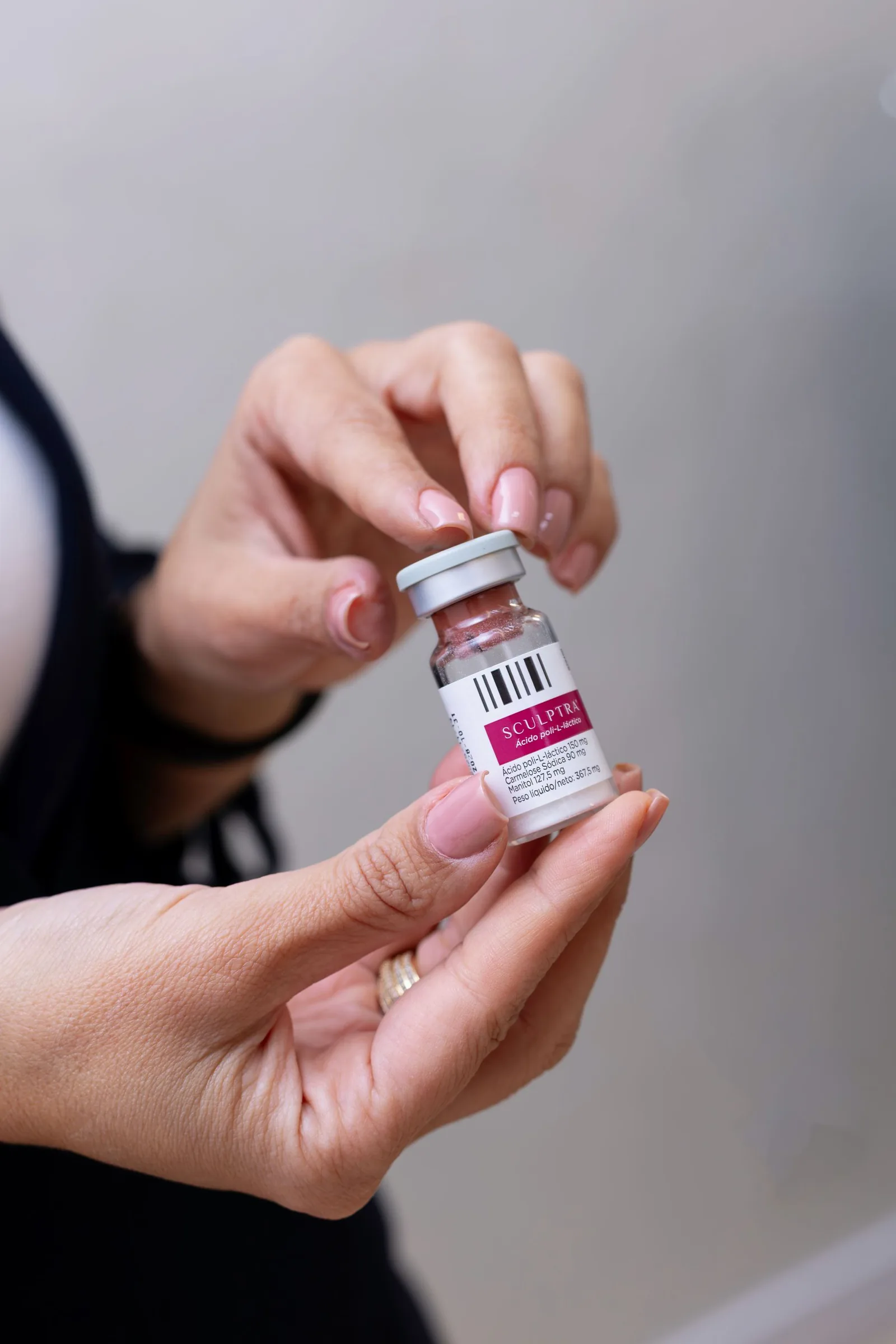
The Sculptra vial is checked before preparation; the provider reviews you about three to four weeks after each session to decide on more.
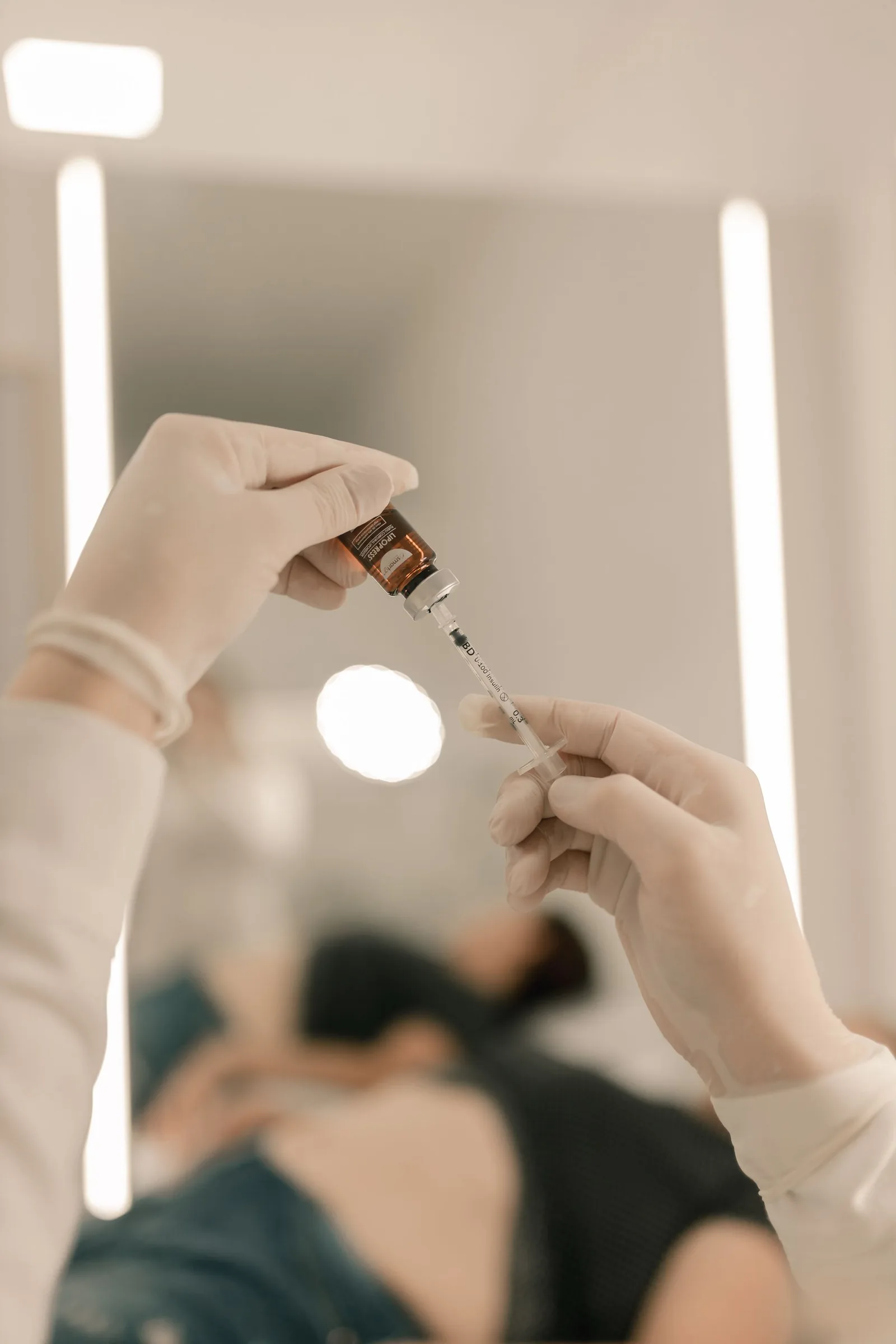
Just before injecting, the clinician draws the prepared product from its vial into a syringe while the patient rests on the treatment bed.
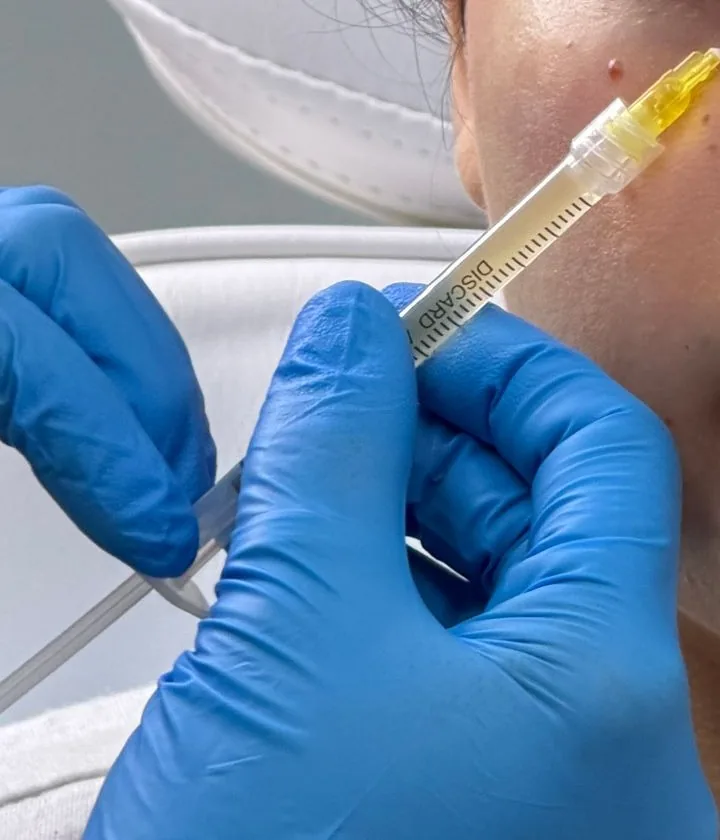
A gloved clinician injects into the cheek through a fine needle; a topical or local anaesthetic may be used to ease discomfort.
Device and procedure images are provided by the manufacturers / licensed stock; they do not show COMEDI patients.
At a glance
- How it works
- Tiny particles are injected under the skin. The body gradually breaks them down and lays new collagen around them, so the change builds over time.
- Ingredients
- PLLA (Sculptra), PCL (Ellansé) or calcium hydroxylapatite (Radiesse). All three are broken down by the body over time.
- Sessions & interval
- PLLA is typically given as about three treatments a month apart. Gel-based products such as Ellansé and Radiesse also give some immediate volume.
- When it shows
- With PLLA, results appear gradually over months; the Sculptra manufacturer says from as early as one month.
- How long it lasts
- Manufacturers state up to 2 years for Sculptra and up to 24 months for Ellansé, depending on the version used and the individual.
- Good to know
- The US FDA notes that removing a filler can be difficult or impossible for some materials, and that lumps under the skin are a possible side effect.
Injectables differ in when a change shows and how long it lasts. Products that relax muscle, add volume or support skin quality each have a different purpose.
Change appears gradually rather than immediately, and it cannot be dissolved the way hyaluronic acid fillers can.
Real cases
A case only helps when you can see the conditions behind it.
Sign in to see the before & after photos
Free. We use your Google name and email only to answer questions about these cases. Clinic names are shared in your private consultation.
 Before
 After
- Sessions
- 2 sessions (example)
- Combined
- None
- Photo timing
- 3 months after (example)
 Before
 After
- Sessions
- 2 sessions (example)
- Combined
- None
- Photo timing
- 3 months after (example)
 Before
 After
- Sessions
- 2 sessions (example)
- Combined
- None
- Photo timing
- 3 months after (example)
- SessionsOne session, or the result of a course
- CombinedWhether other treatments or surgery were done together
- Photo timingHow long after the procedure the photo was taken
What to ask in a consultation
Questions about whether it suits you and what the alternatives are.
Often considered when
- Cheeks with many superficial lines, or a few to many shallow wrinkles, are the cheek pattern the Sculptra patient labeling describes as suitable for correction.
- People with a healthy immune system who are happy to see change build over several weeks and to return for review visits: Sculptra is intended for people with healthy immune systems, and its effect is not immediate.
- Adults over 21 with moderate to severe loss of jawline contour: this is an approved use of Radiesse (+), the version mixed with lidocaine.
- Volume loss in the backs of the hands, or, with Radiesse diluted in saline, wrinkles of the décolleté in people aged 22 and over, as the Radiesse labeling describes.
Checks in Korea
- Korea's MFDS advises checking the approved purpose of a cosmetic filler product in its medical device database (emed.mfds.go.kr) by searching the item name 조직수복용생체재료 or 조직수복용재료.
- In a notice dated 6 March 2019, MFDS listed breast enlargement and volume enlargement of body parts such as the buttocks or calves as unapproved purposes for cosmetic fillers, with no product approved for them at that time. If a body area is proposed, ask which approved purpose covers it and check the current listing.
- MFDS lists product moving to unintended areas and temporary or permanent skin nodules among possible filler side effects, and advises treatment by a doctor experienced in injection and checking the product's labelling or attached document.
- Q01Which product fits my concern, and how does it differ from the other options?
- Q02If I am not happy with the change, can it be adjusted or reversed?
- Q03Who will perform the treatment, and what is their specialty?
- Q04Which device or product will be used, and is it the original I asked about?
- Q05How many sessions are usually planned, and can they fit into my stay?
- Q06What should I avoid before and after — sun, alcohol, flights, exercise?
- Q07What is included in the written estimate, and what could change after the consultation?
Check these yourself at the consultation
- Ask which product will be used and how many vials or syringes per session.
- Ask to see the sealed vial or syringe and its box, and check the product name and lot number.
- Ask how many sessions are planned, how far apart, and when you should expect to see a change.
Recovery & schedule
Check swelling, daily routine, activity limits and review visits separately.
At a glance
- Numbing
- A topical or local anaesthetic may be used. In a US Sculptra study, 71% of patients reported some pain after the first injection and 14% moderate pain; most pain settled within 24 hours.
- Right after a Sculptra session
- Swelling and the water used to mix Sculptra can make the area look corrected straight away. This usually settles within several hours to a few days, and the original line may reappear before the gradual change begins.
- Review between sessions
- The Sculptra labeling says the provider should see you about 3–4 weeks after each session to decide whether more is needed. Safety and effectiveness were studied only for a course of up to four sessions.
- Radiesse touch-up
- The Radiesse patient guide says a touch-up may be needed and is usually given about 2 weeks to 1 month after the first injection. The number of sessions and the amount per session are decided with your doctor.
- How long it lasted in studies
- In one Radiesse study of 117 patients, 78.6% showed improvement 6 months after treatment, and 35 still showed improvement at least 30 months after their last injection. Results differ from person to person.
- Later scans
- Radiesse particles show on CT scans and may show on X-rays; Sculptra may be visible on ultrasound and MRI. Both labels ask you to tell your doctors and radiologists that the product is there.
- 01Swelling & bruising
In the Sculptra studies, swelling, redness, pain or tenderness and bruising were mostly mild to moderate and disappeared within 1–2 weeks, though injection-related reactions can last 14 days or longer. The Radiesse labeling describes mainly short-term (under 7 days) bruising, redness and swelling, and the area may feel firm for several weeks.
- 02Back to routine
According to the Sculptra labeling, most patients get back to their activities immediately, and make-up may be applied a few hours later if there is no open wound or bleeding.
- 03Activity limits
For the first 24 hours, avoid or minimise hard exercise, strong sun, UV lamps, tanning beds and extreme temperatures (Sculptra). For Radiesse, the advice is about 24 hours and until any swelling or redness has gone.
- 04Follow-up & flying home
A Sculptra course means a review about 3–4 weeks after each session, and a Radiesse touch-up usually falls 2 weeks to 1 month after the first injection, so later visits may not fit one trip. Sculptra post-marketing reports describe lumps appearing from 1–2 months to 14 months after the last session, so ask how the clinic will check on you once you are home.
Published guidance; your own clinic sets the actual plan.
Before your visit day
What clinics ask of international patients, in one place.
- Bring your passportClinics register international patients with their passport, and any estimate or prescription is issued in the name on it.
- Patients under 19Adulthood in Korea starts at 19. For a younger patient, clinics generally ask a parent or legal guardian to consent in writing, and many ask them to attend. Tell us the patient's age when you write, and we check what the clinic needs.
- Coming with someoneA family member or friend can usually join you in the consultation room. Treatment and recovery areas follow each clinic's rules, so we check this before your visit. If more than one person is booking, tell us what each person is interested in.
- Language helpCoordinators reply in English, Japanese, Chinese and Korean. Interpretation on the day is arranged for your dates, and we confirm in writing what it covers before you travel.
- Medicines and allergiesWrite down the medicines you take and any allergies. The clinic asks about both before any treatment.
What changes the price
The same treatment can be quoted differently depending on the items below.
What differs from clinic to clinic
- Which product for which area
- Sculptra and Radiesse are labelled for different areas: Radiesse (+) for jawline contour and Radiesse for the backs of the hands and, diluted, the décolleté; Sculptra for smile lines and fine cheek wrinkles. Which products a clinic stocks shapes what it proposes for your concern.
- How Sculptra is prepared
- Practitioners mix a Sculptra vial with anything from 4 mL or less to 31 mL or more of sterile water. A review notes recommendations to increase the mixing volume to reduce lumps, and the US Sculptra studies tested the product diluted in a larger volume with lidocaine added, so how a clinic prepares it is worth comparing.
- Radiesse dilution
- Radiesse is labelled for use in the décolleté when diluted with saline, and the brochure marks a 1:2 dilution for that area. Consensus recommendations describe saline dilution (1:1) and hyper-dilution (1:2 to 1:6) of CaHA, so whether a clinic uses it undiluted or diluted, and at what ratio, depends on your goal.
- Injector experience and technique
- The Sculptra labelling says the first session should be under-corrected, and that the risk of lumps may rise when large volumes are injected in one place, especially deep smile lines. The FDA recommends a licensed provider with experience in dermatology or plastic surgery, so ask how much product the doctor places per area and per session.
- Planning around your trip
- A Sculptra course of up to four sessions with reviews 3–4 weeks apart can span months. Clinics differ in whether they compress the plan, split it across trips, or check progress remotely.
- Sessions in the course
- How many sessions are planned and how many vials or syringes each one uses, so you can see the total for the whole course rather than one visit.
- Mixing volume and lidocaine
- For Sculptra, how much sterile water each vial is mixed with and whether lidocaine is added, since practitioners use anything from 4 mL or less to 31 mL or more.
- Radiesse undiluted or diluted
- Whether Radiesse is used as it comes for contour, or diluted with saline for skin quality, and at what ratio.
- Review and touch-up visits
- Whether the 3–4 week reviews (Sculptra) or a touch-up within about a month (Radiesse) are included in the quote.
- Care if lumps appear
- Whether assessment and treatment of lumps that appear months later are covered, and how this works after you go home.
- Product
- Product name and manufacturer, and how authenticity is shown
- Amount
- Units, syringes or vials used
- Areas & sessions
- Number of areas and planned sessions
- Numbing & care
- Numbing cream, soothing care and whether a touch-up is included
Prices are set by the clinic after a consultation. Ask for an itemised, written estimate before you book, and check what is included and what could change.
Often charged separately
Ask whether each of these is in your estimate.
| Item | What to ask |
|---|---|
| Consultation fee | Whether the consultation is charged, and whether that amount comes off the treatment price. |
Clinics in Korea build a treatment estimate from the area, the amount used or the number of sessions.
The final figure is set after the doctor sees you at the consultation.
Ask for an itemised, written estimate that marks each item above as included or not, so you can compare two quotes on the same basis.
VAT before you compare quotes
The VAT refund for foreign visitors' cosmetic procedures covered only procedures received by 31 December 2025, so procedures received now are not refunded. Plan your budget without it, and ask each clinic whether VAT is included in the written quote so you compare the same total.
Ask COMEDI, for example
Clinics in Seoul differ in equipment, technique, specialist focus and what the price includes. Send us your question and we compare partner clinics for you.
- “Which partner clinics use Sculptra or Radiesse for my concern, and how many vials or syringes would the whole course need?”
- “How do they prepare Sculptra: how much water do they mix it with, and do they add lidocaine?”
- “Can the course fit my stay, or how would reviews work after I fly home?”
- “Does the quote include touch-ups and care if a lump appears later?”
Precautions & aftercare
General information. Follow the written instructions from your treating doctor for anything specific to you.
Side effects and precautions for Sculptra & collagen stimulators are in one place at the top of this page.
Aftercare for this procedure
- After Sculptra, massage the treated area for 5 minutes, 5 times a day, for 5 days, as the labeling instructs.
- In the first 24 hours, use ice or an ice pack wrapped in cloth to reduce swelling; do not put ice directly on the skin.
- Tell your doctor if you have recently had, or plan, laser treatment, a chemical or mechanical peel or hair removal: the Sculptra labeling notes a higher risk of redness or swelling after recent skin treatments, and the Radiesse labeling notes swelling may occur if such treatments follow the injection.
- Tell the doctor if you have had cold sores (herpes), since injection can trigger a flare.
- Keep the product name with you and mention it before any CT, X-ray, MRI or ultrasound of the face.
- Tell the clinic about allergies, pregnancy or breastfeeding, medicines (including those that affect clotting) and earlier injectable treatments.
- Contact the clinic immediately for severe pain, a change in skin colour or any change in vision.
- Keep a record of the product name, amount and date.
Information only. Suitability, risks, recovery and price are assessed by the treating doctor in a consultation.
Sources for this section 7
- A Patient's Guide to Treatment with SCULPTRA (Rev. April 2023) — Galderma Laboratories
- RADIESSE Patient Information Guide (nasolabial folds) — Merz North America
- RADIESSE and RADIESSE (+) Important Safety Information, patient brochure (April 2026) — Merz North America
- Dermal Fillers (Soft Tissue Fillers) — US Food and Drug Administration
- Christen MO. Collagen Stimulators in Body Applications: A Review Focused on Poly-L-Lactic Acid (PLLA) — Clinical, Cosmetic and Investigational Dermatology 2022 (PMC9233565, full text via Europe PMC)
- Lin JY, Lin CY. Adjusting Thickness before Injection: A New Trend for Preparing Collagen-stimulating Fillers — Plastic and Reconstructive Surgery Global Open 2021 (PMC8225369, full text via Europe PMC)
- 성형용 필러 시술 시 주의사항은? — 식품의약품안전처(대한민국 정책브리핑)
Related questions & guides
Worth reading alongside this page.
Notes from people who used COMEDI
Written after a consultation we arranged, and matched to that request.
Common questions
How much does Sculptra & collagen stimulators cost in Korea?+
Prices are set by each clinic after a consultation and depend on the technique, area and your needs. Ask for an itemised, written estimate before you book — it should list what is included and what could change. We help you request and compare estimates.
Can foreigners get Sculptra & collagen stimulators in Korea?+
Yes. Many Seoul clinics see international patients. We help with clinic information, consultations in your language, written estimates and interpretation on the day.