
Facelift
Tightens the deeper tissue and skin of the mid and lower face.

- Type
- Surgical
- Usually by
- Plastic surgeon
- Category
- Facelift & rejuvenation
- First step
- Consultation
Information only. Suitability, risks, recovery and price are assessed by the treating doctor in a consultation.
Side effects and precautionsWhat to know about Facelift before you book16
Reactions that usually settle, signs to tell the clinic about straight away, and times to wait. Your doctor goes through the risks that apply to you at the consultation.
Known risks
- Bleeding under the skin (haematoma), facial nerve injury, numbness around the ear, hair loss near the scars, poor wound healing (more likely in smokers), blood clots and infection.
Usually settles on its own
- Numbness around the ear. A 2021 review says the great auricular nerve is the most commonly injured nerve during facelift surgery, with a reported incidence as high as 7%, and notes that even when this nerve is deliberately cut in another operation (parotidectomy), most patients regain normal sensation within 1 year.
- Temporary weakness or unevenness of facial movement right after surgery. A 2021 review says this may come from the local anaesthetic, which wears off in hours, and that nerve dysfunction persisting beyond the initial period should resolve within 3 to 4 months. Recovery time varies from person to person.
Tell the clinic promptly
- Bleeding under the skin (haematoma). A 2021 review calls it the most common facelift complication requiring a return to the operating room and notes male patients are at greater risk. Report one-sided swelling or pain to the clinic at once.
- Facial nerve injury with weakness, which ASPS lists among the risks. A 2025 meta-analysis of 67 publications (15,404 patients) estimated a pooled motor nerve damage rate of 0.66%, and pooled permanent motor and sensory nerve damage rates of 0.047% and 0.045%. Ask your surgeon how weakness that does not improve will be checked at follow-up.
- Poor wound healing and skin loss, which ASPS lists and which the 2021 review links strongly with smoking.
- Infection. The 2021 review cites a 0.89% incidence of infection after facelift surgery in a 2020 database review.
- Prolonged swelling, which ASPS lists among the risks.
- Deep vein thrombosis and cardiac or pulmonary complications, which ASPS lists among the risks.
- Temporary or permanent hair loss at the incisions, stitches surfacing through the skin, unfavourable scarring and asymmetry, which ASPS lists among the risks.
Wait or rethink when
- If your main concern is loose skin with fine wrinkles, freckles or rough areas. BAAPS says these benefit more from a chemical peel or laser resurfacing than from a facelift.
- Smoking. ASPS lists being a nonsmoker as a candidate criterion, and a 2021 review cites a series of 1,186 facelifts in which active smokers were 12.46 times more likely than nonsmokers to suffer skin slough (loss of skin) after surgery.
- Medical conditions that impair healing, which ASPS names in its candidate criteria.
- Taking warfarin, clopidogrel or other blood thinners. In a 2021 review, the senior author's own practice protocol does not consider patients on these medicines surgical candidates. That is one surgeon's rule, so tell your surgeon about these medicines and ask how they handle it.
- Taking aspirin or other anti-inflammatory painkillers (NSAIDs) without telling the surgeon. The same review says patients are advised to stop them 2 weeks before surgery; follow your own surgeon's instructions.
- A history of high blood pressure that has not been discussed with the surgeon. The same review lists a history of hypertension and high blood pressure readings before and during surgery as predictive risk factors for bleeding under the skin (haematoma).
Sources for this section 17
- NHS - Facelift (rhytidectomy)
- Cervicofacial Rhytidectomy - StatPearls
- NHS - Cosmetic surgery abroad
- Facelift: Recovery — American Society of Plastic Surgeons
- Facelift: Risks and Safety — American Society of Plastic Surgeons
- How to Prevent and Treat Complications in Facelift Surgery, Part 1: Short-Term Complications (Aesthet Surg J Open Forum 2021) — PMC
- Facelift Surgery and Nerve Injury: A Systematic Review and Meta-Analysis (Aesthetic Plast Surg 2025) — PMC
- Facelift: Candidates — American Society of Plastic Surgeons
- Facelift: Procedure Steps — American Society of Plastic Surgeons
- Facelift: Cost — American Society of Plastic Surgeons
- Facelift and necklift — British Association of Aesthetic Plastic Surgeons (BAAPS)
- Comparison of Deep SMAS Lift and MACS in Facelift: A Meta-Analysis (Medicina 2026) — PMC
- Evolution of Superficial Muscular Aponeurotic System Facelift Techniques (JPRAS Open 2024) — PMC
- Methods for Minimizing Bleeding in Facelift Surgery: An Evidence-based Review (Plast Reconstr Surg Glob Open 2021) — PMC
- The Safety and Complication Rate of Deep Plane Facelift Under Local Anesthesia (Aesthet Surg J Open Forum 2026) — PMC
- 의료 해외진출 및 외국인환자 유치 지원에 관한 법률 제6조 — 국가법령정보센터
- 의료법 제27조(무면허 의료행위 등 금지) — 국가법령정보센터
What is it?
The purpose, the change you can expect and the limits.
Tightens the deeper tissue and skin of the mid and lower face.
SMAS facelift · mini lift
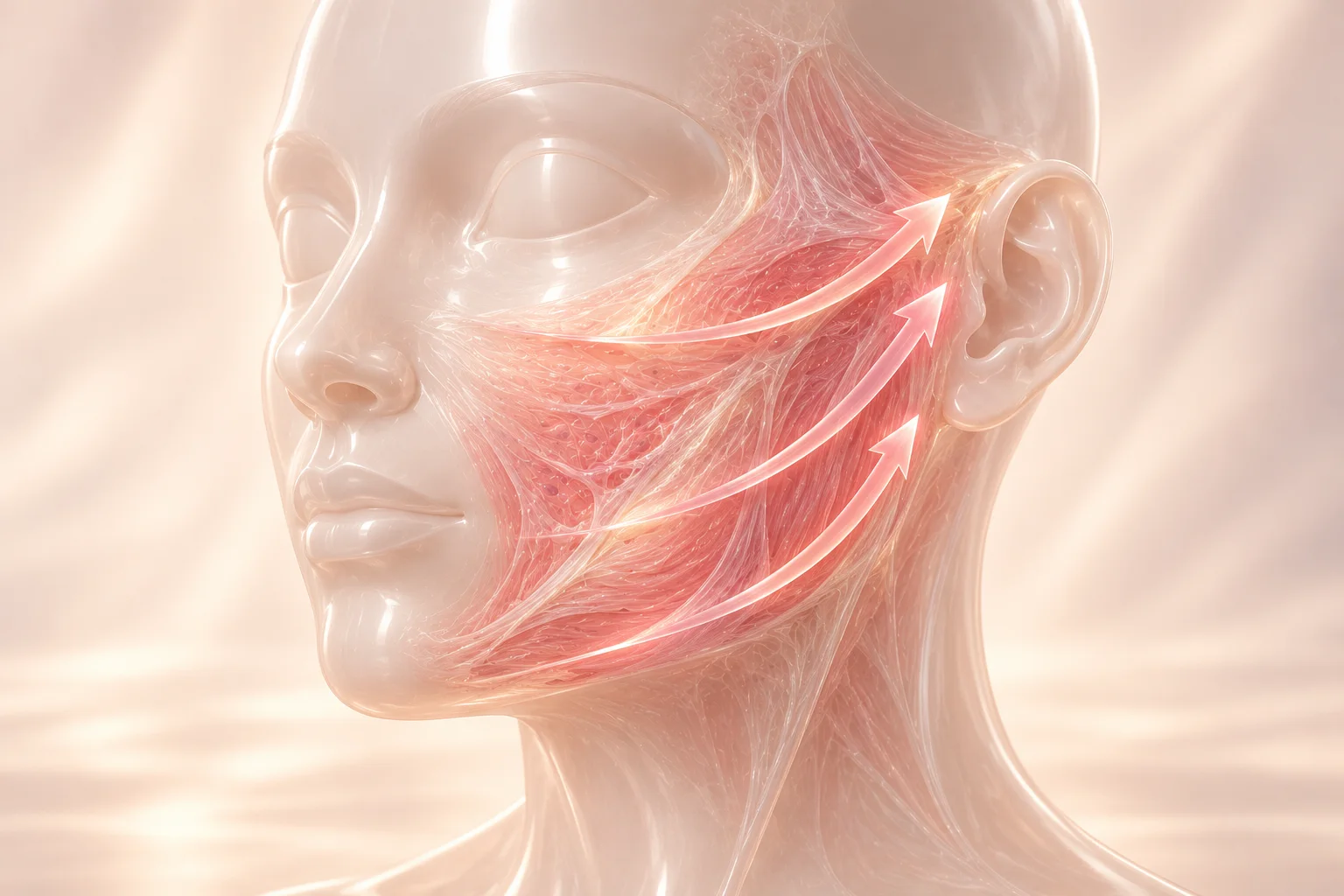
Techniques & materials
- 01SMAS plication or imbrication
The firm layer under the facial skin (SMAS) is folded or trimmed and stitched in a lifted position before the skin is redraped.
- 02Extended SMAS facelift
The SMAS is lifted as a separate flap from the skin, which also lets the surgeon reposition the cheek fat pad.
- 03Deep-plane facelift
The surgeon works beneath the SMAS and lifts skin, SMAS and cheek fat together as one layer.
- 04Short-scar (mini) facelift
A shorter incision that stops at the earlobe; it allows less correction of the neck than a full facelift.
- 05MACS lift
Two or three looped stitches placed through a cut in front of the ear suspend the cheek and jowl tissue.
Clinics do not all carry the same devices, products or techniques. Ask which one will be used, by name, before you book.
How it is done, in photos
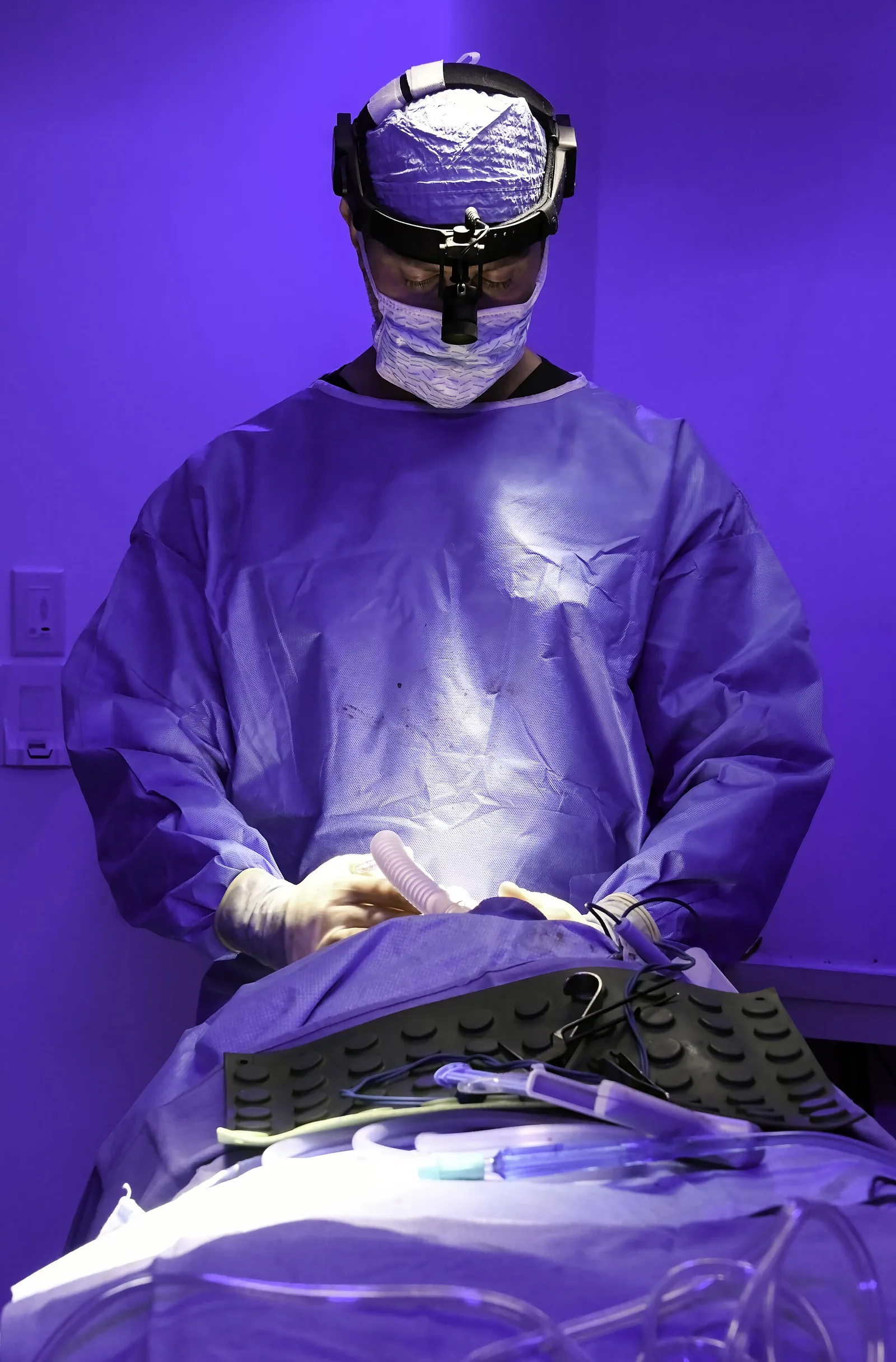
The surgeon works with a headlight and magnifying loupes while the patient lies fully draped; ASPS lists intravenous sedation or general anaesthesia for a facelift.
Photo: Richard Balikian MD / CC BY 4.0 / CC BY 4.0 via Wikimedia Commons
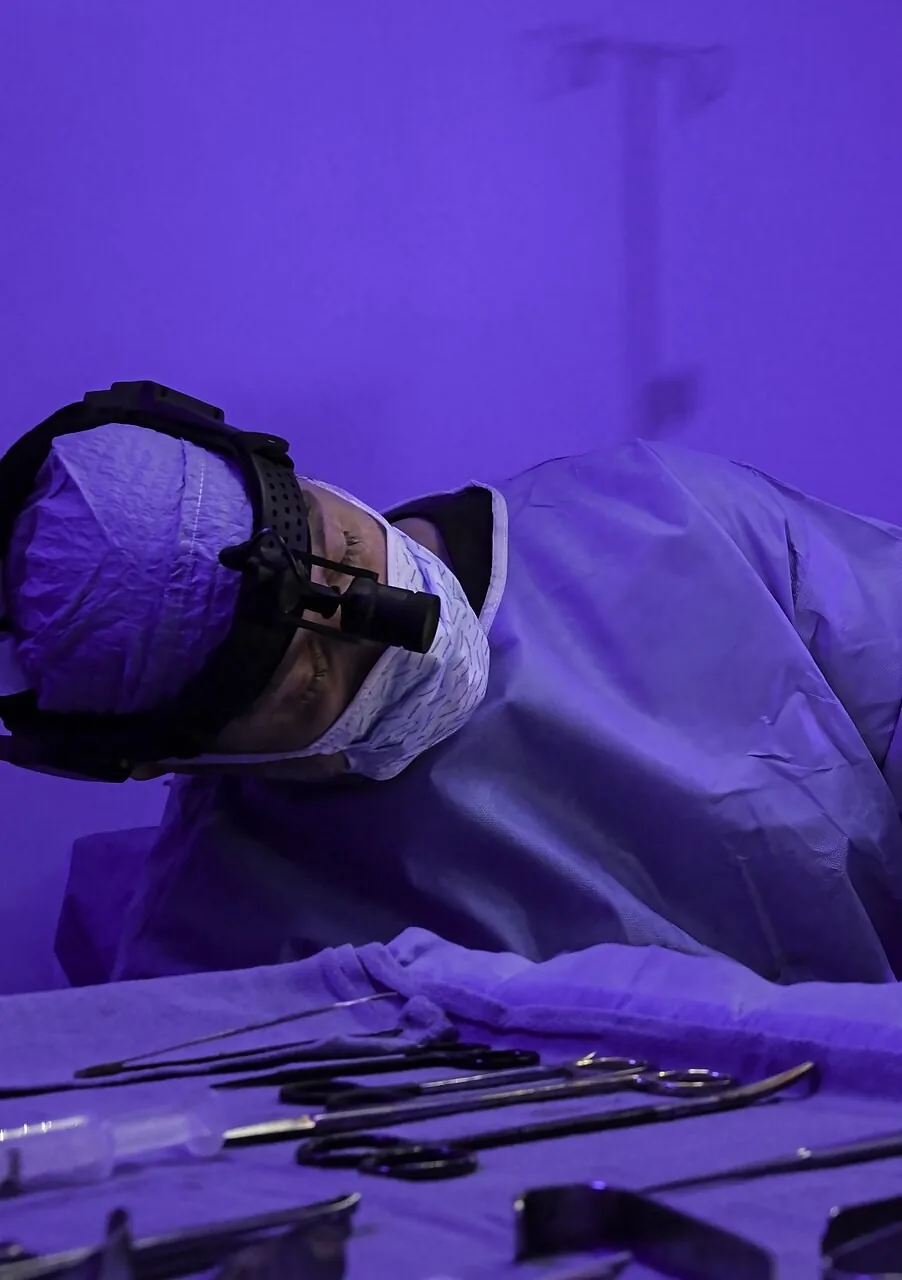
Fine instruments sit beside the operating table; how long the operation takes depends on the technique, such as SMAS, deep-plane or MACS lift, and what is combined.
Photo: Richard Balikian MD / CC BY 4.0 / CC BY 4.0 via Wikimedia Commons
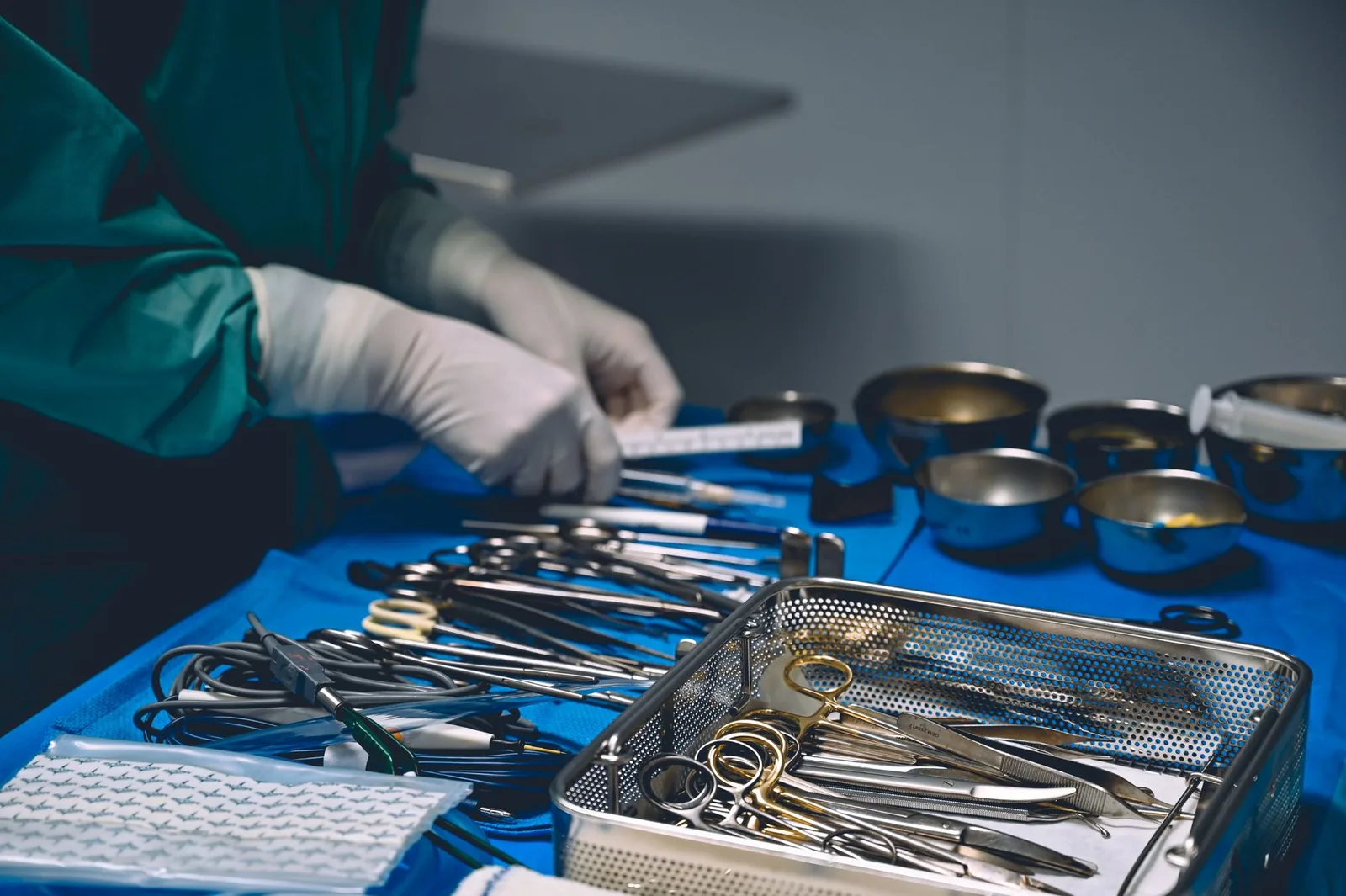
Before the operation a gloved team member sets out the sterile instrument set, including a ruler, on the operating table.
Device and procedure images are provided by the manufacturers / licensed stock; they do not show COMEDI patients.
At a glance
- Approach
- Incisions run from the temple hairline, down in front of the ear, under the earlobe and behind the ear. The deeper layer is tightened, spare skin is removed, and a cut under the chin may be added.
- Anaesthesia
- Generally general anaesthesia; sometimes local anaesthesia with sedation.
- Operating time
- Generally 2 to 3 hours, depending on the technique and the clinic.
- Hospital stay
- Most people stay overnight. If a drain is used it is usually removed after about a day.
- Stitches & recovery
- Stitches are generally removed after 7 to 14 days unless they dissolve. Bruising lasts at least two weeks, and the NHS advises waiting 7 to 10 days after facial surgery before flying.
Lifting and fat grafting change the position or volume of sagging tissue. They do not stop ageing, and where scars sit and how much fat survives differ from person to person.
It does not stop ageing, and skin texture or volume may need separate treatment.
Real cases
A case only helps when you can see the conditions behind it.
Sign in to see the before & after photos
Free. We use your Google name and email only to answer questions about these cases. Clinic names are shared in your private consultation.
 Before
 After
- Sessions
- Surgery (example)
- Combined
- None
- Photo timing
- 6 months after surgery (example)
 Before
 After
- Sessions
- Surgery (example)
- Combined
- None
- Photo timing
- 6 months after surgery (example)
 Before
 After
- Sessions
- Surgery (example)
- Combined
- None
- Photo timing
- 6 months after surgery (example)
- SessionsOne session, or the result of a course
- CombinedWhether other treatments or surgery were done together
- Photo timingHow long after the procedure the photo was taken
What to ask in a consultation
Questions about whether it suits you and what the alternatives are.
Often considered when
- People whose face and neck have started to sag but whose skin still has some elasticity and whose bone structure is strong and well defined. BAAPS names these skin and bone conditions when describing who a facelift suits.
- People bothered mainly by loose skin around the lower half of the face (mainly the jowls) and neck. The NHS describes this as what the procedure is designed to reduce, and BAAPS says a facelift improves the lower half of the face, particularly the jawline.
- Healthy people without medical conditions that impair healing, who do not smoke and who have a positive outlook and realistic expectations, which are the candidate criteria listed by the American Society of Plastic Surgeons (ASPS).
- Age alone is not the deciding point. BAAPS says most people who have facelifts are in their 40s to 60s, but facelifts can be done successfully on people in their 70s or 80s.
Checks in Korea
- Under Korea's Medical Service Act (Article 27), no one who is not a licensed medical professional may perform medical procedures, and medical professionals may not perform procedures outside the scope of their licence.
- Under Korean law, a medical institution that wants to attract foreign patients must register, have at least one specialist for each department in which it attracts foreign patients (unless the department is not one of the specialties set by Presidential Decree), and belong to medical malpractice liability insurance or a medical liability mutual aid association. Registration is valid for 3 years from the date of registration.
- Q01For my degree of sagging, what extent of surgery is appropriate, and how does it differ from non-surgical options?
- Q02Where will the incisions be, and what will the scars look like?
- Q03Who is the operating surgeon, and what is their specialty?
- Q04What type of anaesthesia is used, and who monitors it?
- Q05How many follow-up visits are needed before it is safe for me to fly home?
- Q06What are the possible risks and complications, and how are they handled if I am abroad?
- Q07What is included in the written estimate — revisions, medication, garments, stitches out?
Check these yourself at the consultation
- Which technique is planned (SMAS, deep plane, short scar) and what it will and will not change.
- Whether the surgeon you consult performs the whole operation.
- How long you should stay before flying, and who to contact if swelling or bleeding appears after you leave.
Recovery & schedule
Check swelling, daily routine, activity limits and review visits separately.
At a glance
- Anaesthesia options
- ASPS lists intravenous sedation and general anaesthesia as the choices. A 2026 series of deep-plane face and neck lifts done under local anaesthesia reported low complication rates over 90 days. Which options a clinic offers differs, so ask before booking.
- Operating time by technique
- A 2026 meta-analysis of four studies (286 patients) found the MACS lift took significantly less operating time than the deep SMAS lift, with no significant difference in haematoma or patient satisfaction. The time planned for you depends on the technique and what is combined.
- When the change shows
- ASPS says the visible improvements appear once swelling and bruising subside, and the NHS says it could take up to 6 to 9 months to see the full effect. Healing differs from person to person.
- How long it lasts
- A 2024 review of SMAS facelift techniques reports that most patients across all techniques had satisfactory long-term results without the loose skin returning. The face keeps ageing, so ask your surgeon what to expect in your case.
- 01Swelling & bruising
ASPS says a bandage may be placed around the face to minimise swelling and bruising, and small tubes may draw off excess blood or fluid. The NHS advises not showering or getting the bandages wet for the first 2 days.
- 02Back to routine
The NHS says it takes about 2 to 4 weeks to fully recover from a facelift and that you need to take this time off work.
- 03Activity limits
The NHS advises avoiding strenuous activity, saunas and massages for at least 2 weeks.
- 04Follow-up & flying home
A 2021 review notes that 90 percent of haematomas occur in the first 24 hours after surgery, so plan to stay close to the clinic at first. ASPS suggests asking when the drains and stitches will be removed; confirm those visits and the flying advice above before booking your return.
Published guidance; your own clinic sets the actual plan.
Before your visit day
What clinics ask of international patients, in one place.
- Bring your passportClinics register international patients with their passport, and any estimate or prescription is issued in the name on it.
- Patients under 19Adulthood in Korea starts at 19. For a younger patient, clinics generally ask a parent or legal guardian to consent in writing, and many ask them to attend. Tell us the patient's age when you write, and we check what the clinic needs.
- Coming with someoneA family member or friend can usually join you in the consultation room. Treatment and recovery areas follow each clinic's rules, so we check this before your visit. If more than one person is booking, tell us what each person is interested in.
- Language helpCoordinators reply in English, Japanese, Chinese and Korean. Interpretation on the day is arranged for your dates, and we confirm in writing what it covers before you travel.
- Medicines and allergiesWrite down the medicines you take and any allergies. The clinic asks about both before any treatment.
What changes the price
The same surgery can be quoted differently depending on the items below.
What differs from clinic to clinic
- Which technique is offered
- A 2024 review states the optimal SMAS approach remains unclear, and a 2026 meta-analysis found no significant difference in haematoma or satisfaction between deep SMAS and MACS lifts, though MACS was shorter. With no single agreed best method, it is worth comparing which technique each surgeon proposes and why.
- Training and track record
- The 2024 review says surgeons should have extensive training and experience in SMAS techniques, and the NHS suggests asking how many facelifts a surgeon has performed where there have been complications.
- Anaesthesia set-up
- ASPS describes intravenous sedation or general anaesthesia, while some surgeons perform deep-plane lifts under local anaesthesia. Ask which options each clinic offers and who gives the anaesthesia.
- Bleeding-prevention protocol
- A 2021 evidence review covers blood pressure control, tranexamic acid, fibrin sealants and giving pain, anxiety and nausea medicines preventively rather than only on request, and notes one study found no difference in haematoma rate with or without drains. Which measures a clinic uses varies, so ask about theirs.
- Face only or face and neck
- ASPS describes a separate neck lift incision that wraps behind the ear, and the NHS says a facelift targets the jowls and neck. Whether the neck is treated in the same operation changes the plan and the quote.
- Overnight care and review visits
- Because most haematomas appear in the first 24 hours, how the first night is monitored and when drains and stitches come out matter for a visitor with a fixed return date.
- Technique
- Whether the quote is for SMAS plication, an extended SMAS or deep-plane lift, a short-scar lift or a MACS lift.
- Neck work
- Whether neck tightening, a separate cut under the chin or a neck lift is included or priced separately.
- Surgeon's fee
- ASPS says the surgeon's fee is based on experience, the type of procedure and location, so ask who operates and what the fee covers.
- Bleeding-control measures
- Whether drains, tranexamic acid or fibrin sealant are used and whether any is charged separately.
- Added skin treatment
- Whether a peel or laser resurfacing for fine wrinkles is suggested alongside and how it is priced.
- Extent
- Face, neck, brow and any combined procedures
- Anaesthesia & stay
- Type of anaesthesia and whether you stay overnight
- Fat grafting
- Donor site and number of grafted areas
- What is included
- Tests, medication, compression band, review visits and the revision policy
Prices are set by the clinic after a consultation. Ask for an itemised, written estimate before you book, and check what is included and what could change.
Often charged separately
Ask whether each of these is in your estimate.
| Item | What to ask |
|---|---|
| Consultation fee | Whether the consultation is charged, and whether that amount comes off the surgery price. |
| Stitch removal and check-ups | How many follow-up visits are included, and how check-ups work once you have flown home. |
Clinics in Korea build a surgery estimate from the technique, the type of anaesthesia and the care around the operation.
The final figure is set after the surgeon examines you.
Ask for an itemised, written estimate that marks each item above as included or not, so you can compare two quotes on the same basis.
VAT before you compare quotes
The VAT refund for foreign visitors' cosmetic procedures covered only procedures received by 31 December 2025, so procedures received now are not refunded. Plan your budget without it, and ask each clinic whether VAT is included in the written quote so you compare the same total.
Ask COMEDI, for example
Clinics in Seoul differ in equipment, technique, specialist focus and what the price includes. Send us your question and we compare partner clinics for you.
- “Which partner clinics do deep-plane, SMAS or MACS lifts, and why would they suggest one for me?”
- “Is neck work included in each quote, or priced separately?”
- “How is the first night monitored, and is an overnight stay part of the plan?”
- “I have 14 days in Seoul. Can drain and stitch removal and a review fit before I fly?”
Precautions & aftercare
General information. Follow the written instructions from your treating doctor for anything specific to you.
Side effects and precautions for Facelift are in one place at the top of this page.
Aftercare for this procedure
- Keep your head propped up with pillows for a couple of days while resting, as the NHS advises, to reduce swelling.
- Ask whether medicines for pain, anxiety and nausea are given preventively after surgery or only when you ask for them. A 2021 review reports that preventive (prophylactic) delivery has been shown to lower the haematoma rate compared with giving them only on patient request (0% versus 7%).
- Ask how your blood pressure will be checked in the first days; reviews link raised blood pressure with haematoma after facelift.
- Ask for written instructions on caring for the drains and on the specific concerns to look for, which ASPS says your surgeon should give you.
- Stop aspirin and other NSAIDs before surgery only as your surgeon instructs; one review describes stopping them 2 weeks ahead.
- Tell the clinic about conditions such as high blood pressure or diabetes, medicines, smoking and earlier facial surgery or treatments.
- Contact the clinic immediately for sudden swelling on one side, severe pain or a change in skin colour.
- Ask how to look after the scars and for how long.
Information only. Suitability, risks, recovery and price are assessed by the treating doctor in a consultation.
Sources for this section 15
- Facelift: Candidates — American Society of Plastic Surgeons
- Facelift: Procedure Steps — American Society of Plastic Surgeons
- Facelift: Recovery — American Society of Plastic Surgeons
- Facelift: Risks and Safety — American Society of Plastic Surgeons
- Facelift: Cost — American Society of Plastic Surgeons
- Facelift (rhytidectomy) — NHS
- Facelift and necklift — British Association of Aesthetic Plastic Surgeons (BAAPS)
- How to Prevent and Treat Complications in Facelift Surgery, Part 1: Short-Term Complications (Aesthet Surg J Open Forum 2021) — PMC
- Facelift Surgery and Nerve Injury: A Systematic Review and Meta-Analysis (Aesthetic Plast Surg 2025) — PMC
- Comparison of Deep SMAS Lift and MACS in Facelift: A Meta-Analysis (Medicina 2026) — PMC
- Evolution of Superficial Muscular Aponeurotic System Facelift Techniques (JPRAS Open 2024) — PMC
- Methods for Minimizing Bleeding in Facelift Surgery: An Evidence-based Review (Plast Reconstr Surg Glob Open 2021) — PMC
- The Safety and Complication Rate of Deep Plane Facelift Under Local Anesthesia (Aesthet Surg J Open Forum 2026) — PMC
- 의료 해외진출 및 외국인환자 유치 지원에 관한 법률 제6조 — 국가법령정보센터
- 의료법 제27조(무면허 의료행위 등 금지) — 국가법령정보센터
Related questions & guides
Worth reading alongside this page.
Notes from people who used COMEDI
Written after a consultation we arranged, and matched to that request.
Common questions
How much does Facelift cost in Korea?+
Prices are set by each clinic after a consultation and depend on the technique, area and your needs. Ask for an itemised, written estimate before you book — it should list what is included and what could change. We help you request and compare estimates.
Can foreigners get Facelift in Korea?+
Yes. Many Seoul clinics see international patients. We help with clinic information, consultations in your language, written estimates and interpretation on the day.