
Lowerblepharoplasty
Addresses under-eye bags by removing or repositioning fat, through the inner or outer eyelid.

- Type
- Surgical
- Usually by
- Plastic surgeon
- Category
- Eyes
- First step
- Consultation
Information only. Suitability, risks, recovery and price are assessed by the treating doctor in a consultation.
Side effects and precautionsWhat to know about Lower blepharoplasty before you book13
Reactions that usually settle, signs to tell the clinic about straight away, and times to wait. Your doctor goes through the risks that apply to you at the consultation.
Known risks
- Reported risks include the lower lid being pulled down or turning outward, swelling of the eye surface, dry eyes, double vision, bleeding and infection. Bleeding behind the eye and loss of vision are rare but serious.
Usually settles on its own
- Bruising, which an NHS leaflet (source 2) says is common and often unpredictable but usually resolves within 2 weeks.
- Blurred vision, which an NHS leaflet covering upper or lower eyelid surgery (source 4) says is usually only temporary.
- Dry, gritty eyes, especially with pre-existing dry eye; the NHS leaflet (source 2) says this usually improves with lubricant drops.
- Temporary patches of numbness on the lids, listed in the NHS leaflet (source 4).
Tell the clinic promptly
- Swelling of the eye surface (chemosis), which can last for several weeks or months after lower-lid surgery according to the NHS leaflet (source 2).
- The lower lid sitting too low or turning outward. EyeWiki says turning outward can happen if a lax lower lid is left uncorrected, and the 2025 review reports a low 0.4% incidence of symptomatic lid malposition with both approaches.
- Double vision from injury to a small eye muscle under the lower lid, which EyeWiki lists among the complications.
- Severe bleeding into the lids or behind the eye. The NHS leaflet (source 2) says this happens rarely and puts the risk of loss of vision at about 1 in 22,000 per side; EyeWiki says bleeding behind the eye must be treated as an emergency and that patients are told which symptoms would indicate bleeding or infection, so make sure you know them before you leave the clinic.
Wait or rethink when
- Dry eye that is not under control. EyeWiki lists uncontrolled dry eye syndrome as a reason not to operate.
- Active thyroid eye disease, which EyeWiki lists as a relative contraindication.
- Severe or unstable medical conditions, which EyeWiki lists as a contraindication.
- Goals that surgery cannot achieve. EyeWiki puts unachievable goals and unrealistic expectations first in its list of contraindications.
Sources for this section 12
- NHS – Eyelid surgery (blepharoplasty)
- American Society of Plastic Surgeons – Eyelid Surgery: Procedure Steps
- American Society of Plastic Surgeons – Eyelid Surgery: Risks and Safety
- EyeWiki (American Academy of Ophthalmology) – Lower Eyelid Blepharoplasty
- Blepharoplasty — Cambridge University Hospitals NHS Foundation Trust
- Upper or lower eyelid blepharoplasty (Ref 0275, Issue 5) — Queen Victoria Hospital NHS Foundation Trust
- Transconjunctival or Transcutaneous Approach for Fat-preserving Lower Lid Blepharoplasty? (Plast Reconstr Surg Glob Open 2025) — PMC
- Blepharoplasty — Leeds Teaching Hospitals NHS Trust
- Eyelid Surgery: Recovery — American Society of Plastic Surgeons
- Eyelid Surgery: Candidates — American Society of Plastic Surgeons
- 의료 해외진출 및 외국인환자 유치 지원에 관한 법률 제6조 — 국가법령정보센터
- 의료법 제27조(무면허 의료행위 등 금지) — 국가법령정보센터
What is it?
The purpose, the change you can expect and the limits.
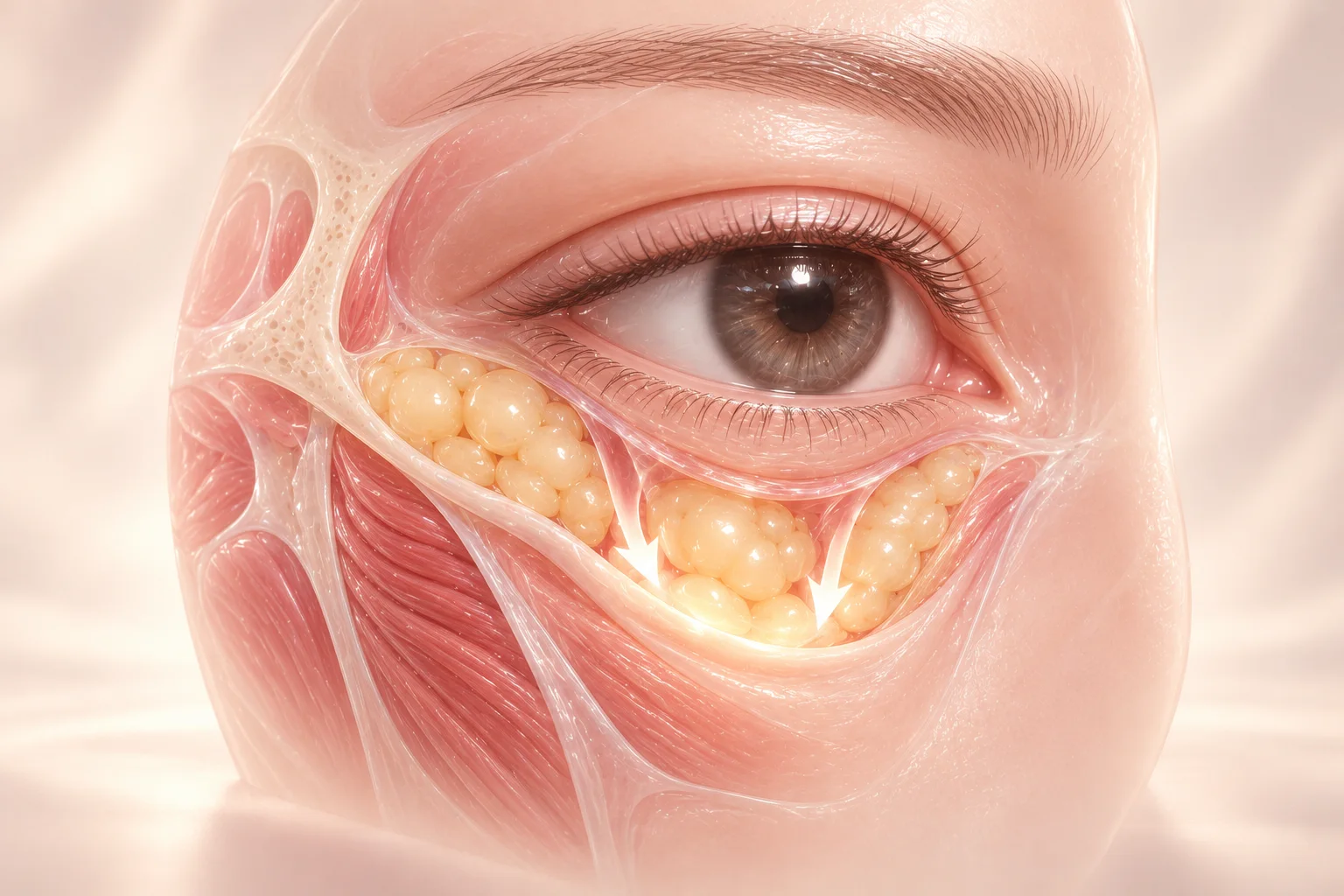
Addresses under-eye bags by removing or repositioning fat, through the inner or outer eyelid.
Under-eye bag removal · fat repositioning
Techniques & materials
- 01Transconjunctival approach
The cut is made on the inside of the lower lid, leaving no skin scar; it is generally used when the main issue is bulging fat rather than loose skin.
- 02Skin incision below the lashes (subciliary approach)
The cut is made just under the lower lash line so that loose skin can be removed as well as fat adjusted.
- 03Fat removal
Part of the fat that bulges forward under the eye is taken out to flatten the bag.
- 04Fat repositioning
Instead of being removed, the fat is moved down to fill the hollow below the bag; current practice tends to preserve tissue in this way.
- 05Canthopexy (lid-support stitch)
A supporting stitch at the outer corner tightens a lax lower lid; it is added when the lid is loose before surgery.
Clinics do not all carry the same devices, products or techniques. Ask which one will be used, by name, before you book.
How it is done, in photos
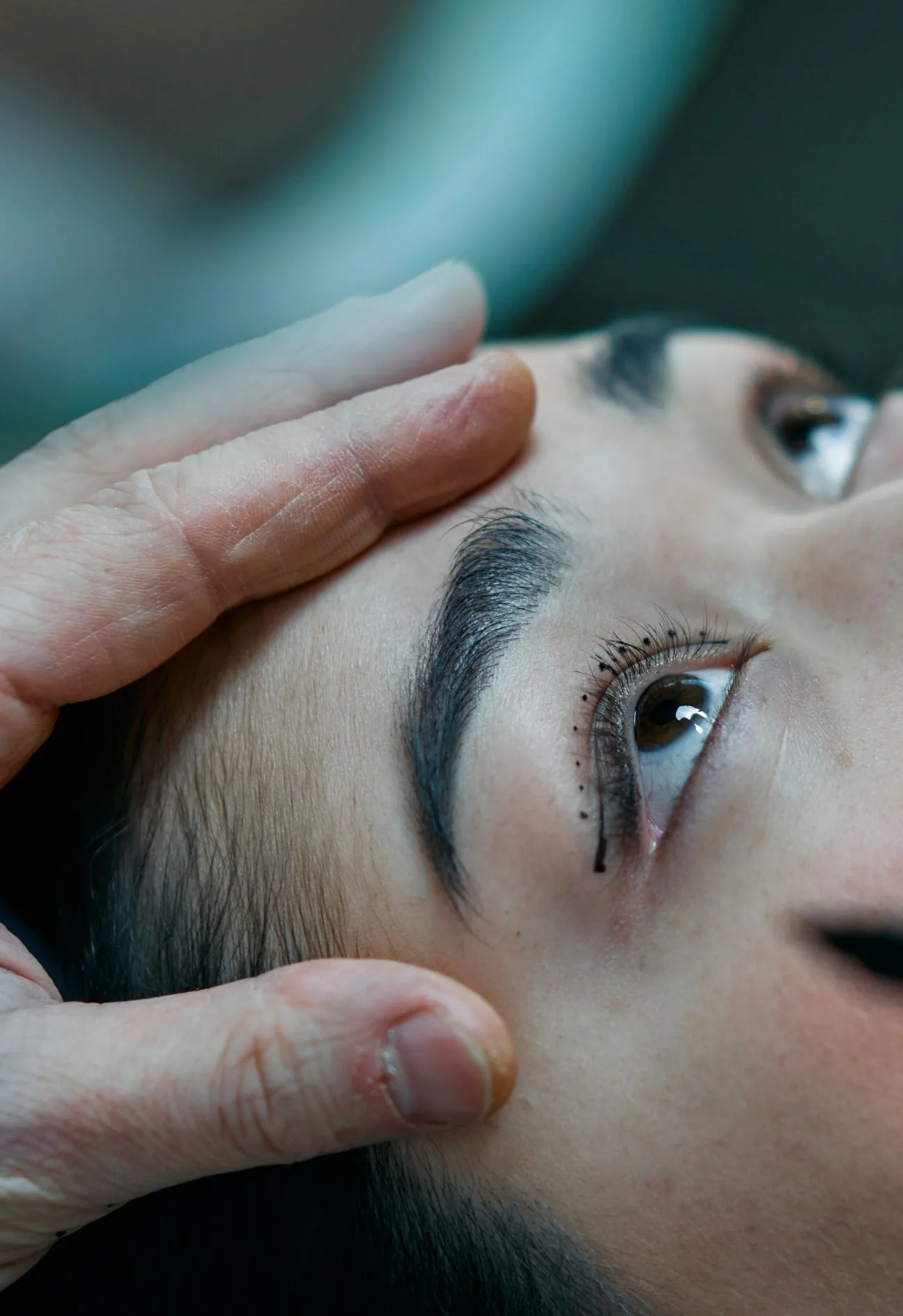
Dotted marks along the lower lash line and outer corner plan a cut just below the lashes, the route used when loose skin also needs removing.
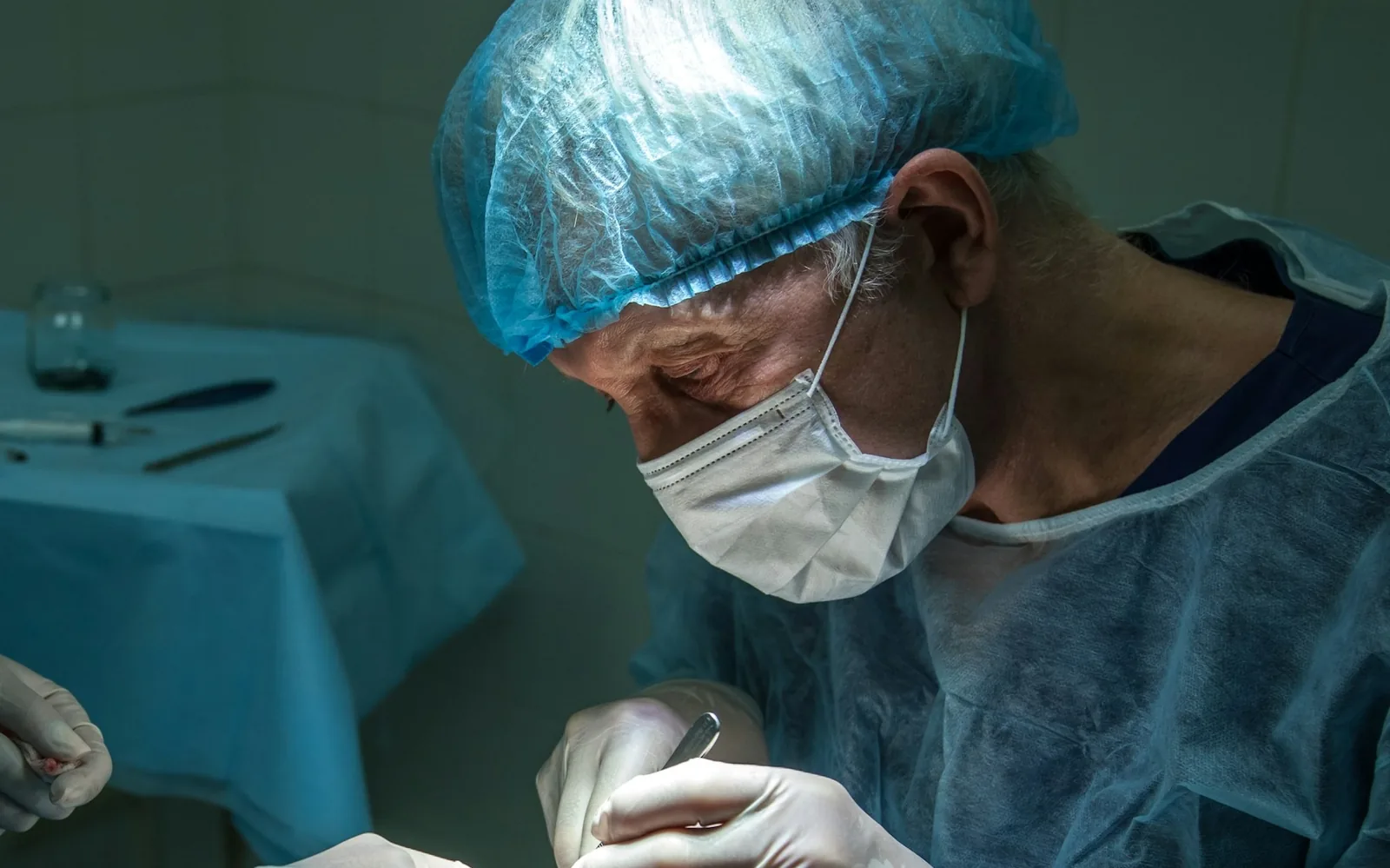
Lower-lid surgery can be done under local anaesthetic, with or without sedation, or under general anaesthetic, depending on the clinic and the patient.
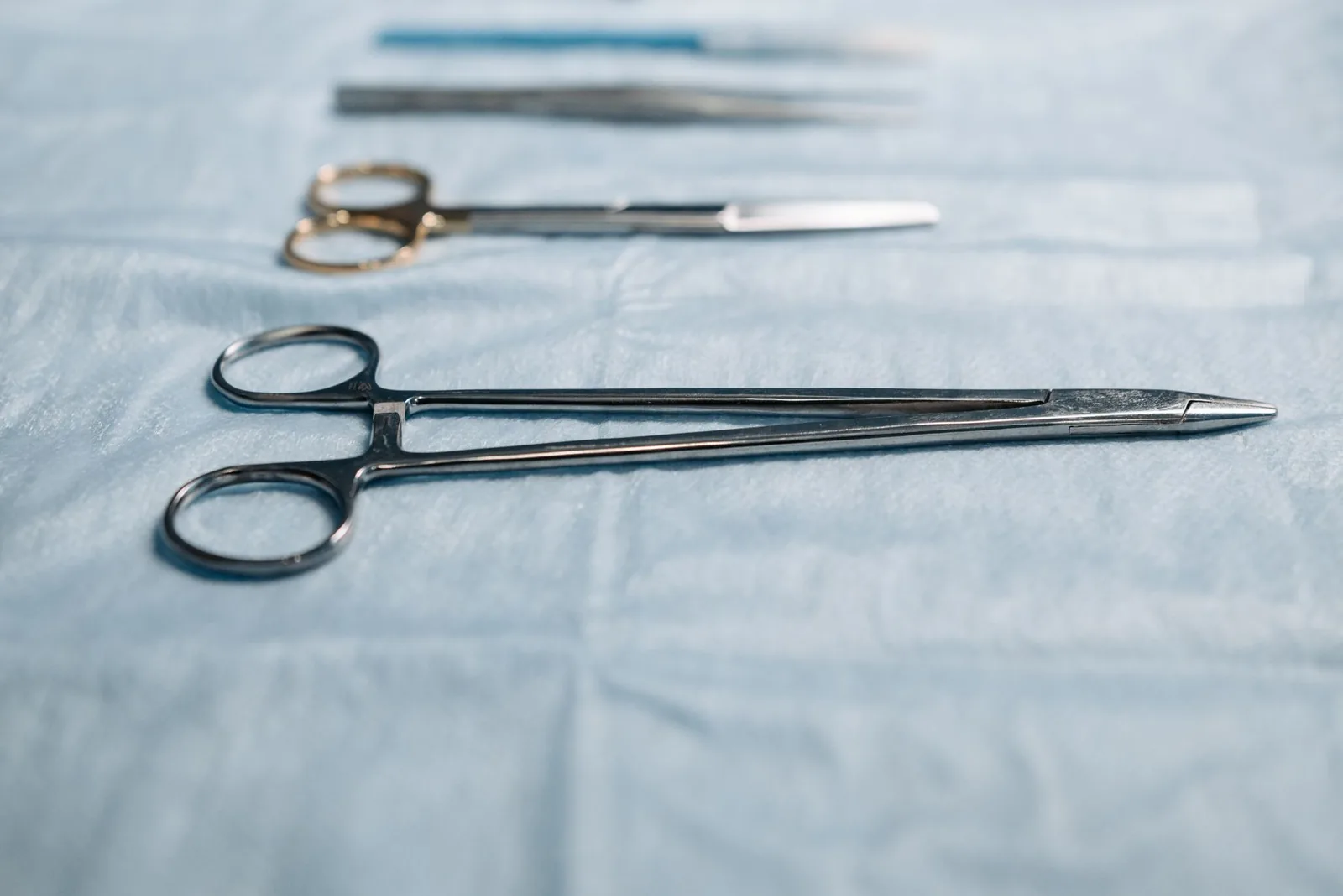
A needle holder and fine scissors on a sterile drape; skin stitches after the below-the-lashes approach are generally removed about 5 to 7 days later.
Device and procedure images are provided by the manufacturers / licensed stock; they do not show COMEDI patients.
At a glance
- Approach
- The cut is placed either inside the lower lid or just below the lashes. The inside route is used mainly for fat; the skin route is used when loose skin also needs removing.
- Anaesthesia
- It can be done under local anaesthetic, with or without sedation, or under general anaesthetic. The choice depends on the clinic and the patient.
- Operating time
- Eyelid surgery generally takes around 45 minutes to 2 and a half hours, depending on what is being done and whether other procedures are added.
- Hospital stay
- Most people go home the same day. This can differ by clinic and by the patient's condition.
- Stitches & recovery
- Skin stitches are generally removed about 5 to 7 days after surgery. Bruising and swelling can last for some weeks, and many people take around 2 weeks off work, depending on their job.
The method is chosen from the structure of your eyelids and the amount of skin and fat. The shape settles as swelling goes down, which takes time, and the two sides may not be perfectly identical.
Dark circles caused by pigment or blood vessels may not improve with surgery.
Real cases
A case only helps when you can see the conditions behind it.
Sign in to see the before & after photos
Free. We use your Google name and email only to answer questions about these cases. Clinic names are shared in your private consultation.
 Before
 After
- Sessions
- Surgery (example)
- Combined
- None
- Photo timing
- 3 months after surgery (example)
 Before
 After
- Sessions
- Surgery (example)
- Combined
- None
- Photo timing
- 3 months after surgery (example)
 Before
 After
- Sessions
- Surgery (example)
- Combined
- None
- Photo timing
- 3 months after surgery (example)
- SessionsOne session, or the result of a course
- CombinedWhether other treatments or surgery were done together
- Photo timingHow long after the procedure the photo was taken
What to ask in a consultation
Questions about whether it suits you and what the alternatives are.
Often considered when
- People whose main concern is under-eye bags from fat pushing forward. EyeWiki (American Academy of Ophthalmology) lists bulging lower-lid fat, wrinkled or excess lower-lid skin, a pronounced groove running from the inner corner of the eye down the cheek, and lower-lid asymmetry among the reasons for the operation.
- People with a hollow below the bag as well as the bag itself. An NHS patient leaflet (source 3) explains that fat may be moved rather than removed, particularly if there are pre-existing hollow areas.
- Relatively young people who do not need skin removed or the lid tightened. A 2025 review of 24 studies in Plastic and Reconstructive Surgery Global Open concludes that the approach from inside the lid suits this group.
- Healthy non-smokers with realistic goals. The American Society of Plastic Surgeons describes good candidates as healthy people with no medical conditions that can impair healing, non-smokers, people with realistic goals and people without serious eye conditions.
Checks in Korea
- Under Korea's Medical Service Act (Article 27), no one who is not a licensed medical professional may perform medical procedures, and medical professionals may not perform procedures outside the scope of their licence.
- Under Korean law, a clinic that attracts foreign patients must register for it, have at least one specialist under the Medical Service Act for each department in which it attracts foreign patients (except departments that are not a specialty set by Presidential Decree), and belong to medical malpractice liability insurance or a medical liability mutual aid association. Registration is valid for 3 years from the date of registration.
- Q01Which method suits my eyelid structure, and why would you not recommend the others?
- Q02If the result differs from what I expected, when and on what terms is a revision possible?
- Q03Who is the operating surgeon, and what is their specialty?
- Q04What type of anaesthesia is used, and who monitors it?
- Q05How many follow-up visits are needed before it is safe for me to fly home?
- Q06What are the possible risks and complications, and how are they handled if I am abroad?
- Q07What is included in the written estimate — revisions, medication, garments, stitches out?
Check these yourself at the consultation
- Whether the cut will be inside the lid or below the lashes, and why.
- Whether the fat will be removed or repositioned, and whether a lid-support stitch is needed.
- What anaesthesia is used and who gives and monitors it.
Recovery & schedule
Check swelling, daily routine, activity limits and review visits separately.
At a glance
- Eye check before surgery
- EyeWiki lists vision, pupil and eye-movement checks, an assessment of the tear film and eye surface, blink rate and strength, looseness of the lower lid and its outer-corner tendon, and how far the eye sits forward relative to the cheekbone. Ask whether these are done and what they showed.
- Which approach for whom
- A 2025 review concludes that the inside-the-lid approach suits relatively young patients who need no skin removal or lid support, and that whenever a skin incision is needed for any reason, the approach below the lashes is probably more suitable.
- Lid support as part of the plan
- An NHS patient leaflet (source 3) says it is common to add a procedure that tightens the lower lid to reduce the risk of the lid pulling down or turning outward. The 2025 review describes lid tightening as the mainstay of the below-the-lashes approach in virtually all patients.
- When it settles
- An NHS leaflet covering upper or lower eyelid surgery (source 4) says bleeding, bruising and swelling improve within two weeks but may not completely resolve for several months.
- 01Swelling & bruising
An NHS leaflet covering upper or lower eyelid surgery (source 4) says bleeding, bruising and swelling improve within two weeks but may take several months to settle completely. Another NHS leaflet (source 2) says swelling of the eye surface (chemosis) is typically linked to lower-lid surgery and could last for several weeks or months.
- 02Back to routine
The lower-lid guidance we checked gives no single date for going back to work or normal routine. An NHS leaflet that covers lower-lid surgery (source 3) says swelling, bruising and blurry vision are common afterwards, and the American Society of Plastic Surgeons suggests asking 'When can I resume normal activity and exercise?' Agree the answer before you book.
- 03Activity limits
EyeWiki's lower-lid page says strenuous activity is avoided for a period of days or weeks after surgery; how long applies to you is set by your surgeon.
- 04Follow-up & flying home
EyeWiki's lower-lid page says a follow-up visit is planned within a week of surgery, when non-dissolving stitches are removed; an NHS leaflet (source 3) notes that no removal is needed when self-dissolving stitches are used. The American Society of Plastic Surgeons suggests asking when stitches come out and when to return for follow-up; check both against your flight date.
Published guidance; your own clinic sets the actual plan.
Before your visit day
What clinics ask of international patients, in one place.
- Bring your passportClinics register international patients with their passport, and any estimate or prescription is issued in the name on it.
- Patients under 19Adulthood in Korea starts at 19. For a younger patient, clinics generally ask a parent or legal guardian to consent in writing, and many ask them to attend. Tell us the patient's age when you write, and we check what the clinic needs.
- Coming with someoneA family member or friend can usually join you in the consultation room. Treatment and recovery areas follow each clinic's rules, so we check this before your visit. If more than one person is booking, tell us what each person is interested in.
- Language helpCoordinators reply in English, Japanese, Chinese and Korean. Interpretation on the day is arranged for your dates, and we confirm in writing what it covers before you travel.
- Medicines and allergiesWrite down the medicines you take and any allergies. The clinic asks about both before any treatment.
What changes the price
The same surgery can be quoted differently depending on the items below.
What differs from clinic to clinic
- Inside the lid or below the lashes
- Clinics lean towards different approaches. The 2025 review says both can be used safely with comparable outcomes, and that the choice turns on whether skin removal or lid support is needed, so a clinic's usual approach should match your skin, not the other way round.
- Removing, moving or grafting fat
- The 2025 review notes that over-removing fat led to a hollowed-out, more aged look, and that in some patients moving the fat may not be enough and fat grafting would be more applicable. How a clinic handles the hollow under the bag differs.
- Routine lid support
- An NHS patient leaflet (source 3) says adding lid tightening is common, and EyeWiki links an uncorrected lax lid to the lid turning outward. Whether a clinic measures lid laxity and adds support routinely or only when needed varies.
- How thorough the eye check is
- EyeWiki describes a pre-surgery check that includes the tear film, blink strength and how far the eye sits forward. Whether this is done by the operating surgeon at the consultation differs between clinics.
- Stitches and review timing
- EyeWiki's lower-lid page plans a follow-up visit within a week to remove non-dissolving stitches, while an NHS leaflet (source 3) notes that self-dissolving stitches need no removal. Which stitches a clinic uses decides whether a stitch visit has to fit before your flight.
- Fat plan
- Whether fat is removed, repositioned into the hollow, or topped up with a fat graft, and whether a graft is priced separately.
- Lid support
- Whether a lid-tightening stitch at the outer corner is part of the plan and included in the quote.
- Skin removal
- Whether loose lower-lid skin is also removed, which changes the incision and the quote.
- Pre-surgery eye check
- Whether the dry-eye, lid-laxity and vision checks are part of the consultation or charged separately.
- Medicines and dressing
- Whether the ointment, eye drops and any dressing are supplied.
- Method
- Incisional or non-incisional, and any combined procedures
- Anaesthesia
- Local or sedation, and who manages it
- Primary or revision
- Whether this is a first operation or a revision
- What is included
- Tests, medication, stitch removal, review visits and the revision policy
Prices are set by the clinic after a consultation. Ask for an itemised, written estimate before you book, and check what is included and what could change.
Often charged separately
Ask whether each of these is in your estimate.
| Item | What to ask |
|---|---|
| Consultation fee | Whether the consultation is charged, and whether that amount comes off the surgery price. |
| Recovery stay | Whether an overnight stay at the clinic or a recovery facility is in the estimate. |
Clinics in Korea build a surgery estimate from the technique, the type of anaesthesia and the care around the operation.
The final figure is set after the surgeon examines you.
Ask for an itemised, written estimate that marks each item above as included or not, so you can compare two quotes on the same basis.
VAT before you compare quotes
The VAT refund for foreign visitors' cosmetic procedures covered only procedures received by 31 December 2025, so procedures received now are not refunded. Plan your budget without it, and ask each clinic whether VAT is included in the written quote so you compare the same total.
Ask COMEDI, for example
Clinics in Seoul differ in equipment, technique, specialist focus and what the price includes. Send us your question and we compare partner clinics for you.
- “I have bags and a hollow under them. Which partner clinics move the fat rather than remove it, and do any add a fat graft?”
- “Do I need skin removed, or can it be done from inside the lid? I would like opinions from more than one clinic.”
- “Which clinics include lid support and the pre-surgery eye check in the quote?”
- “I have 10 days in Seoul. Where can stitches come out before I fly?”
Precautions & aftercare
General information. Follow the written instructions from your treating doctor for anything specific to you.
Side effects and precautions for Lower blepharoplasty are in one place at the top of this page.
Aftercare for this procedure
- Use cold compresses in the first 48 hours; EyeWiki notes that warm compresses often follow after that, so ask when your clinic wants you to switch.
- Sleep with your head raised on several pillows, as an NHS leaflet (source 2) advises, to help reduce lid swelling.
- Use the ointment or drops you are given; EyeWiki describes them being applied for the first week, and the NHS leaflet (source 2) gives lubricant drops or ointment for grittiness and dryness.
- Protect the healing lids from the sun; the American Society of Plastic Surgeons advises careful sun protection and darkly tinted sunglasses until healing is fully complete.
- Tell the clinic about dry eye, eye conditions or surgery, medicines, smoking and any earlier eyelid surgery.
- Contact the clinic immediately for a change in vision, severe pain or sudden swelling on one side.
- Keep the clinic's contact point and emergency number for after you fly home.
Information only. Suitability, risks, recovery and price are assessed by the treating doctor in a consultation.
Sources for this section 9
- Lower Eyelid Blepharoplasty — EyeWiki (American Academy of Ophthalmology)
- Blepharoplasty — Cambridge University Hospitals NHS Foundation Trust
- Blepharoplasty — Leeds Teaching Hospitals NHS Trust
- Upper or lower eyelid blepharoplasty (Ref 0275, Issue 5) — Queen Victoria Hospital NHS Foundation Trust
- Eyelid Surgery: Recovery — American Society of Plastic Surgeons
- Eyelid Surgery: Candidates — American Society of Plastic Surgeons
- Transconjunctival or Transcutaneous Approach for Fat-preserving Lower Lid Blepharoplasty? (Plast Reconstr Surg Glob Open 2025) — PMC
- 의료 해외진출 및 외국인환자 유치 지원에 관한 법률 제6조 — 국가법령정보센터
- 의료법 제27조(무면허 의료행위 등 금지) — 국가법령정보센터
Related questions & guides
Worth reading alongside this page.
Notes from people who used COMEDI
Written after a consultation we arranged, and matched to that request.
Common questions
How much does Lower blepharoplasty cost in Korea?+
Prices are set by each clinic after a consultation and depend on the technique, area and your needs. Ask for an itemised, written estimate before you book — it should list what is included and what could change. We help you request and compare estimates.
Can foreigners get Lower blepharoplasty in Korea?+
Yes. Many Seoul clinics see international patients. We help with clinic information, consultations in your language, written estimates and interpretation on the day.