
Revisionrhinoplasty
A second operation after a previous rhinoplasty, planned around the existing structure.

- Type
- Surgical
- Usually by
- Plastic surgeon
- Category
- Nose
- First step
- Consultation
Information only. Suitability, risks, recovery and price are assessed by the treating doctor in a consultation.
Side effects and precautionsWhat to know about Revision rhinoplasty before you book16
Reactions that usually settle, signs to tell the clinic about straight away, and times to wait. Your doctor goes through the risks that apply to you at the consultation.
Known risks
- With rib cartilage, the graft can bend over time, and the chest site carries a scar, pain and a risk of air leaking around the lung. Infection, absorption of the graft and the need for further surgery are also reported.
Usually settles on its own
- Breathing difficulty and a stiff, numb nose, which the NHS lists as common after nose reshaping.
- Light nosebleeds for the first few days.
- Bruising, swelling and redness that the NHS says may have faded by about 3 weeks.
- Chest pain after rib harvest that, according to a 2024 review, usually settles at rest after the first week, with discomfort for several weeks.
Tell the clinic promptly
- Permanent breathing difficulty, an altered sense of smell or heavy nosebleeds, which the NHS lists among things that can go wrong.
- A hole in the septum; ASPS describes it as rare and says repair may need further surgery or may not be possible.
- Air around the lung after rib harvest; one surgical team notes it can rarely occur even when no leak was seen during surgery, and a chest tube is then inserted.
- Infection of rib cartilage; the same team says it is not frequent, can occur especially after several revisions, and that with early detection and prompt treatment (intravenous antibiotics, adequate drainage and proper dressing) the graft can be kept; if treatment is late, the infected cartilage may have to be removed.
- With donor rib cartilage, a series of 282 cases reported 2.1% needing antibiotics for redness and 2.1% needing another operation.
- The possibility of further revision surgery (ASPS). The NHS advises contacting the clinic as soon as possible for severe pain or any unexpected symptom.
Wait or rethink when
- Smoking (ASPS lists not smoking as part of being a good candidate).
- Not being physically healthy (ASPS lists being physically healthy as part of being a good candidate).
- Goals that are not realistic (ASPS lists a positive outlook and realistic goals for the improvement of your appearance).
- Not yet being sure why you want further surgery; the NHS advises being sure of your reasons, speaking to your GP first and taking time to decide.
- An infected implant that has not been dealt with yet. One published approach removes the implant and controls the infection first, and the authors note there is no consensus on when the definitive revision should follow.
Sources for this section 16
- Plastic and Aesthetic Research 2019 – Won & Jin, Revision rhinoplasty using autologous rib cartilage in Asians
- Acta Otorhinolaryngologica Italica 2013 – Grafting in revision rhinoplasty (PMC3709529)
- Head & Face Medicine 2025 – Fresh frozen and irradiated homologous costal cartilage allografts in revision rhinoplasty: systematic review (PMC11744856)
- American Society of Plastic Surgeons – Rhinoplasty: Recovery
- American Society of Plastic Surgeons – Rhinoplasty: Procedure Steps
- Nose reshaping (rhinoplasty) — NHS
- Rhinoplasty Risks and Safety — American Society of Plastic Surgeons
- Bagunaid et al. Harvesting Costal Cartilage for Secondary Rhinoplasty: Techniques, Considerations, and Outcomes — Cureus 2024 (PMC11486523)
- Mattos D et al. A Retrospective Single-Surgeon Chart-Review of Fresh Frozen Costal Cartilage in Revision Rhinoplasty — Plastic and Reconstructive Surgery Global Open 2023 (PMC10567024)
- Cosmetic surgery abroad — NHS
- Rhinoplasty Candidates — American Society of Plastic Surgeons
- Chaffoo R. Understanding revision rhinoplasty and why patients seek out this procedure — American Society of Plastic Surgeons, 2019
- Kim HS et al. Problems Associated with Alloplastic Materials in Rhinoplasty — Yonsei Medical Journal 2014 (PMC4205703)
- Jiang A, Chamata ES, Bressler FJ. Revision Rhinoplasty: With Introduction of a Novel Preoperative Assessment Classification System — Seminars in Plastic Surgery 2021 (PMID 34121943)
- 인체조직안전 및 관리 등에 관한 법률 제3조·제13조 — 국가법령정보센터
- Foreign Patient Attraction Information System (MEDICALKOREA) — Korea Health Industry Development Institute
What is it?
The purpose, the change you can expect and the limits.
A second operation after a previous rhinoplasty, planned around the existing structure.
Secondary rhinoplasty
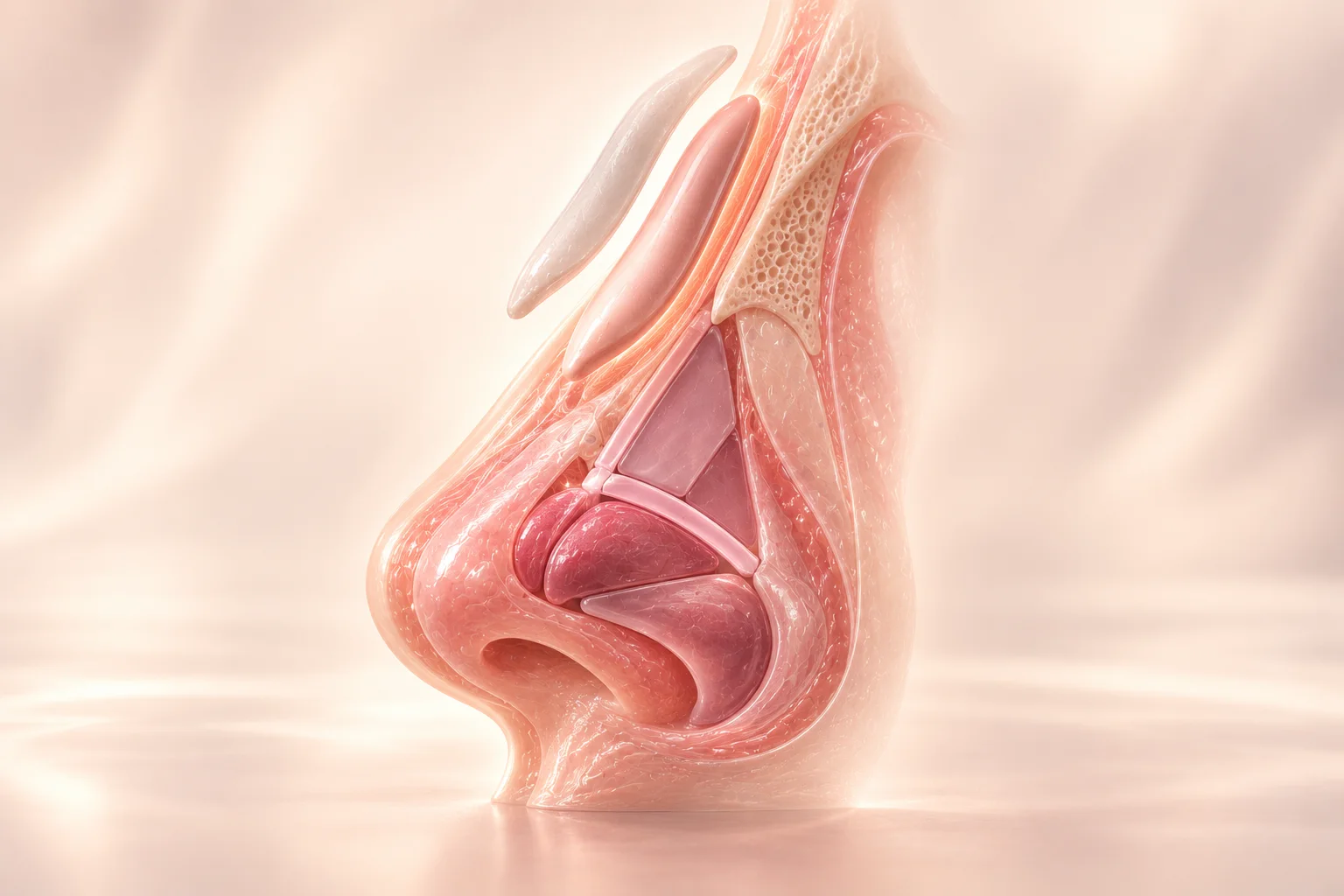
Techniques & materials
- 01Your own rib cartilage
Cartilage taken from the sixth or seventh rib through a short chest cut; it is used when a revision needs more volume and strength than septal or ear cartilage can give.
- 02Your own septal or ear cartilage
Used for smaller corrections when enough cartilage remains after the first operation.
- 03Donor rib cartilage (fresh-frozen or irradiated)
Screened and processed rib cartilage from a deceased donor; it avoids a chest cut, and infection, absorption and bending of the graft have been reported with it.
- 04Temporalis fascia
A thin sheet of the patient's own tissue from the temple, used to cover grafts and smooth the surface of the nose.
Clinics do not all carry the same devices, products or techniques. Ask which one will be used, by name, before you book.
How it is done, in photos
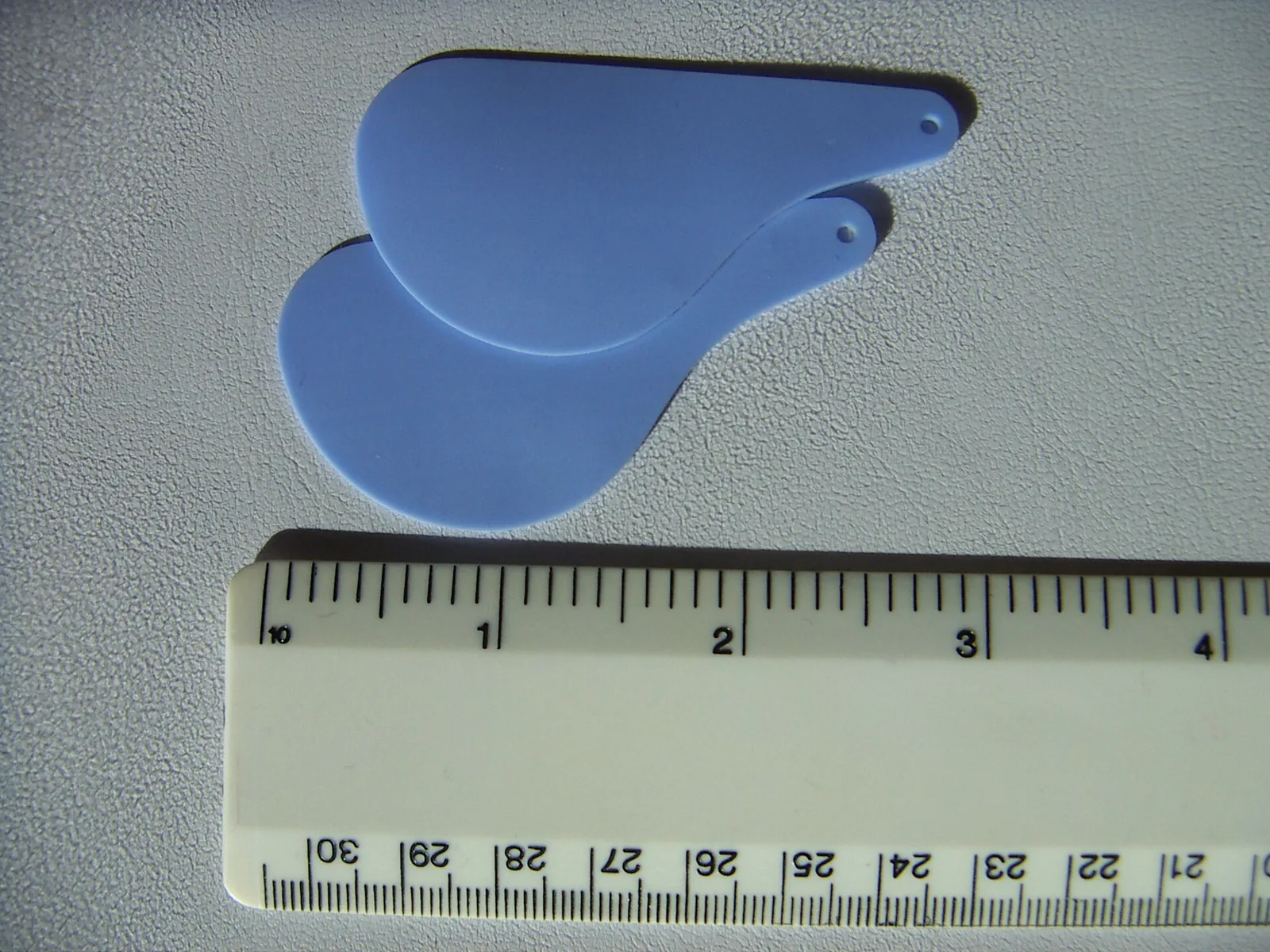
Soft internal nasal splints beside a ruler; after revision nose surgery, stitches and possibly the splint are removed after about a week.
Photo: I.K.Brown / Public domain / Public domain via Wikimedia Commons
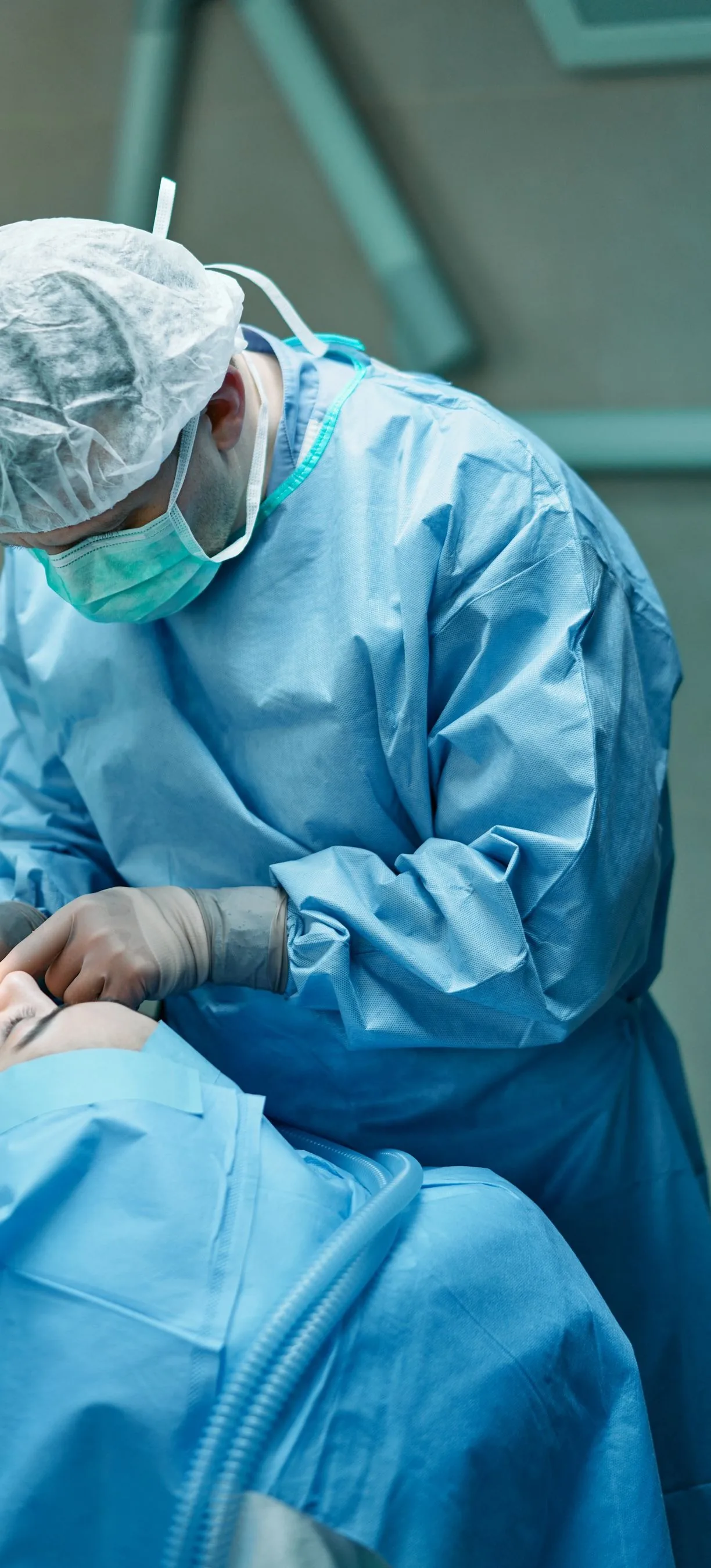
A revision nose operation can take longer than a first one, especially when rib cartilage is taken, so ask for the planned operating time and hospital stay.
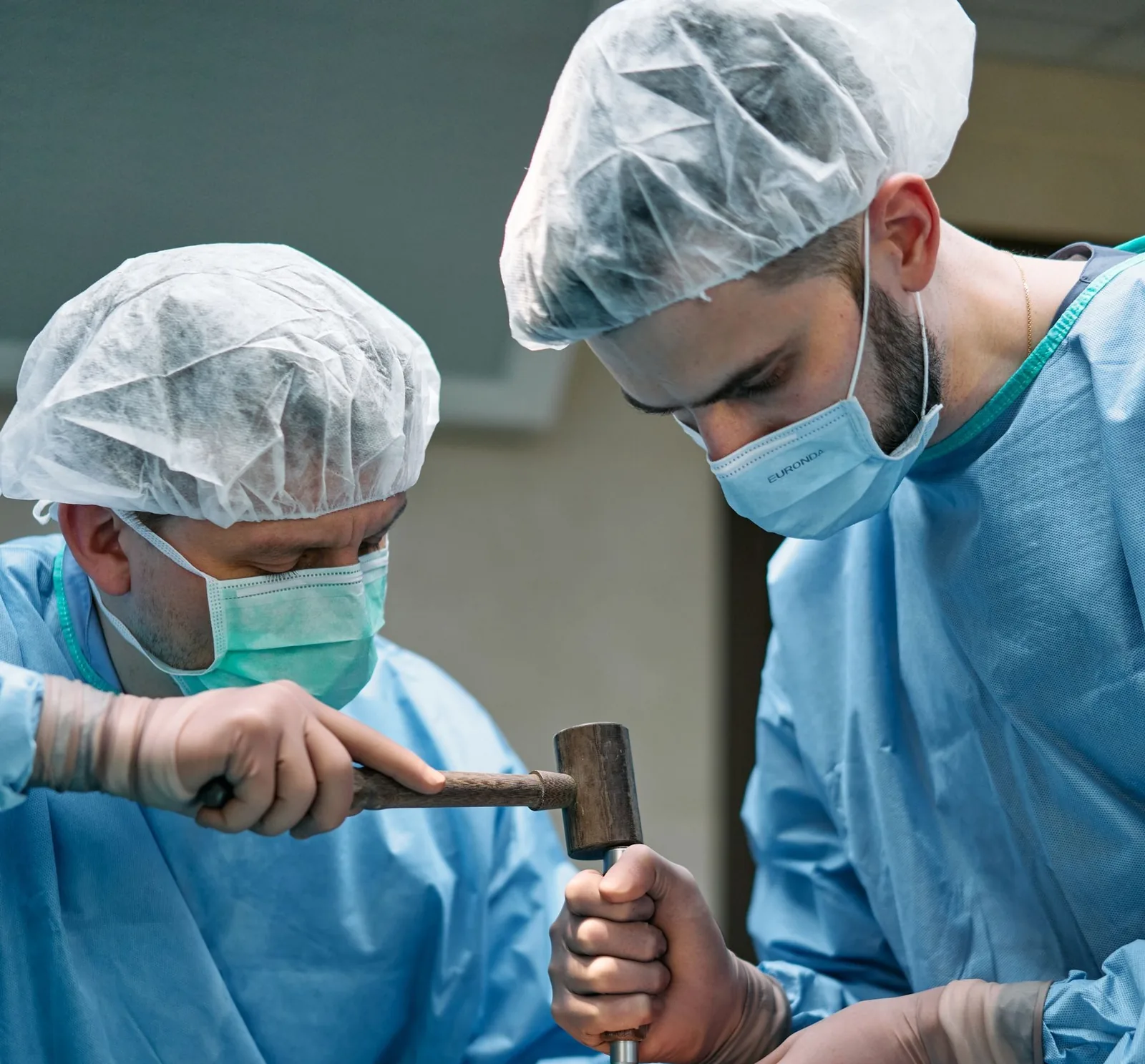
Two surgeons work with a fine chisel and mallet; in revision surgery scarring from the first operation makes the layers harder to find, so planning takes longer.
Device and procedure images are provided by the manufacturers / licensed stock; they do not show COMEDI patients.
At a glance
- Why it is done
- Reasons include a bridge or tip left too low after too much was removed, and problems with an implant such as shifting, infection or the implant showing through the skin. In one published series of Asian patients, implant-related problems accounted for about six in ten revisions.
- Approach & material
- Problems caused by an implant are mostly rebuilt with the patient's own tissue. Rib cartilage is used when septal and ear cartilage are not enough.
- Contracted (short) nose
- A short, tightened nose typically follows repeated operations with implants; a tightening capsule around the implant, long-term pressure on the tip cartilage and ongoing inflammation with scarring are described as causes.
- Anaesthesia
- Nose surgery is done under intravenous sedation or general anaesthetic. Ask what is planned when rib cartilage is to be taken.
- When it can be done
- After a first operation the nose keeps changing as swelling settles, and the final contour can take up to a year to show. How long to wait depends on the reason for revision and is decided by the surgeon after examining the nose.
What is possible depends on skin thickness, the state of your cartilage and any earlier surgery. Swelling takes a long time to settle before the final shape shows.
Tissue changed by earlier surgery makes outcomes less predictable and can limit what is possible.
References 5
- Plastic and Aesthetic Research 2019 – Won & Jin, Revision rhinoplasty using autologous rib cartilage in Asians
- Acta Otorhinolaryngologica Italica 2013 – Grafting in revision rhinoplasty (PMC3709529)
- Head & Face Medicine 2025 – Fresh frozen and irradiated homologous costal cartilage allografts in revision rhinoplasty: systematic review (PMC11744856)
- American Society of Plastic Surgeons – Rhinoplasty: Recovery
- American Society of Plastic Surgeons – Rhinoplasty: Procedure Steps
Real cases
A case only helps when you can see the conditions behind it.
Sign in to see the before & after photos
Free. We use your Google name and email only to answer questions about these cases. Clinic names are shared in your private consultation.
 Before
 After
- Sessions
- Surgery (example)
- Combined
- None
- Photo timing
- 6 months after surgery (example)
 Before
 After
- Sessions
- Surgery (example)
- Combined
- None
- Photo timing
- 6 months after surgery (example)
 Before
 After
- Sessions
- Surgery (example)
- Combined
- None
- Photo timing
- 6 months after surgery (example)
- SessionsOne session, or the result of a course
- CombinedWhether other treatments or surgery were done together
- Photo timingHow long after the procedure the photo was taken
What to ask in a consultation
Questions about whether it suits you and what the alternatives are.
Often considered when
- People who have had rhinoplasty one or more times and want to improve how the nose looks and, often, how it works, which is how an ASPS article defines revision rhinoplasty.
- People whose breathing has become harder after an earlier operation; the same article notes that a bent septum and weak side cartilages are common in revision cases and can narrow the inner airway.
- People who still meet the general ASPS picture of a good candidate: physically healthy, not smoking, with a positive outlook and realistic goals.
- People who accept that scar tissue from the first operation can limit the final result, as the ASPS article explains.
Checks in Korea
- Under Korea's Act on Safety and Management of Human Tissues, cartilage is defined as human tissue, and a tissue bank that manages tissue for transplantation must be licensed by the Minister of Food and Drug Safety. If donor cartilage is proposed, you can ask which licensed tissue bank supplied it.
- Korea's Foreign Patient Attraction Information System (MEDICALKOREA), run by the Korea Health Industry Development Institute, lets you search registered medical institutions and facilitators by name; leaving the name blank lists all registered ones.
- Q01With my nose, which changes are realistic and which are difficult?
- Q02Which material would you use, and why that one?
- Q03Who is the operating surgeon, and what is their specialty?
- Q04What type of anaesthesia is used, and who monitors it?
- Q05How many follow-up visits are needed before it is safe for me to fly home?
- Q06What are the possible risks and complications, and how are they handled if I am abroad?
- Q07What is included in the written estimate — revisions, medication, garments, stitches out?
Check these yourself at the consultation
- What exactly went wrong after the earlier surgery and which material (your own rib, septal or ear cartilage, or donor cartilage) will be used to correct it, and why.
- Whether your nose is ready for revision now or should be given more time, and how that was judged.
- Whether the surgeon you meet performs the operation personally and whether an anaesthetist is present throughout.
Recovery & schedule
Check swelling, daily routine, activity limits and review visits separately.
At a glance
- Operation length & stay
- For nose reshaping in general, the NHS says the operation can take 1.5 to 3 hours and you will probably stay in hospital for 1 or 2 nights. A revision that also involves taking rib cartilage can differ, so ask for the planned time and stay.
- Records from the first operation
- A review of grafting in revision rhinoplasty notes that there is little idea of what was done, or what cartilage is still available, until the area is opened. Bringing your earlier operation notes, implant details and photos gives the surgeon more to plan with.
- Scar tissue
- The same review describes revision nasal surgery as difficult because of scarring after the first operation: the natural layer between the cartilage and skin is lost and landmarks are harder to find. ASPS notes that scar tissue can limit the final outcome.
- Breathing check
- ASPS notes that a nose cannot be made to look good without optimising the airway, and that narrowing inside the nose in revision cases is often opened with cartilage strips called spreader grafts. Expect your breathing to be examined as well as the shape.
- If rib cartilage is planned
- In one Korean surgical team's description, the chest cut is usually 2 cm in thin-skinned patients and 2 to 2.5 cm in thick-skinned patients, placed just above the breast crease in women and directly over the rib in men. A 2024 review describes CT images being used before harvest to measure the cartilage.
- Expectations second time round
- A 2024 review notes that people having secondary rhinoplasty need greater reassurance than before their first operation and are often dissatisfied and doubtful. A 2021 review says careful patient selection, a thorough examination and planning are key. Expect a longer conversation about what can and cannot be changed.
- 01Swelling & bruising
The NHS says bruises, swelling and redness may have faded by about 3 weeks, and light nosebleeds are common for the first few days. ASPS says the contour can take up to a year to refine. If rib cartilage is taken, a 2024 review notes that chest pain at rest usually goes after the first week, but discomfort can last several weeks.
- 02Back to routine
For nose surgery in general, the NHS says you may need up to 2 weeks off work and will probably stay in hospital for 1 or 2 nights.
- 03Activity limits
The NHS says you may be able to swim at about 3 weeks and should be able to resume strenuous exercise at 4 to 6 weeks. With a chest wound, ask separately when lifting and exercise are allowed.
- 04Follow-up & flying home
The NHS describes stitch and possibly splint removal after about a week. For facial cosmetic procedures it advises not flying for 7 to 10 days, warns that air travel and major surgery increase the risk of a blood clot, and advises agreeing where follow-up will be and what happens if there are complications.
Published guidance; your own clinic sets the actual plan.
Before your visit day
What clinics ask of international patients, in one place.
- Bring your passportClinics register international patients with their passport, and any estimate or prescription is issued in the name on it.
- Patients under 19Adulthood in Korea starts at 19. For a younger patient, clinics generally ask a parent or legal guardian to consent in writing, and many ask them to attend. Tell us the patient's age when you write, and we check what the clinic needs.
- Coming with someoneA family member or friend can usually join you in the consultation room. Treatment and recovery areas follow each clinic's rules, so we check this before your visit. If more than one person is booking, tell us what each person is interested in.
- Language helpCoordinators reply in English, Japanese, Chinese and Korean. Interpretation on the day is arranged for your dates, and we confirm in writing what it covers before you travel.
- Medicines and allergiesWrite down the medicines you take and any allergies. The clinic asks about both before any treatment.
What changes the price
The same surgery can be quoted differently depending on the items below.
What differs from clinic to clinic
- Own rib or donor rib
- A US series of 282 cases using fresh-frozen donor rib cartilage reported no clinical warping, absorption or shifting during follow-up, while a 2024 review reports that donor rib reduces chest-site problems and operating time. A Korean team using the patient's own rib reports that it keeps its original volume years after surgery. Which a clinic uses changes the whole plan, including whether you have a chest wound.
- One stage or two after infection
- After an infected implant, one team describes removing it and controlling infection first, notes that there is no consensus on timing, and warns that waiting can let the skin tighten. Whether a clinic rebuilds at once or in two stages differs.
- Experience with your implant type
- In a Korean review of 581 revisions, Gore-tex cases showed 97 tip problems, and removing Medpor was described as extremely complicated compared with other materials. A clinic's experience with the specific material in your nose matters.
- How breathing is handled
- ASPS notes that a bent septum and weak side cartilages are common in revisions and are corrected with spreader grafts. Whether a clinic assesses and quotes breathing work as part of the plan varies.
- Depth of assessment
- A 2021 review proposes grading revision cases by difficulty from a nasal analysis to guide planning. How thoroughly a clinic reviews your history, records and airway before quoting differs.
- Removing the old implant
- Whether taking out a previous implant and the capsule around it is part of the quote.
- Graft source
- Whether your own rib, donor rib, ear or septal cartilage is quoted, and whether a chest harvest is priced separately.
- Covering tissue
- Whether fascia from the temple or other cover for thin skin is included.
- Breathing work
- Whether spreader grafts or septum correction for a narrowed airway are included.
- Hospital nights
- How many nights in hospital are included, especially if rib cartilage is taken.
- Further revision terms
- What happens, and at what cost, if another operation is needed after this one.
- Extent
- Bridge, tip, nostrils and any combined procedures
- Materials
- Your own cartilage, donor tissue or the type of implant
- Anaesthesia
- Type of anaesthesia and whether an anaesthesiologist manages it
- Primary or revision
- Whether this is a first operation or a revision
- What is included
- Tests, medication, splint and stitch removal, review visits and the revision policy
Prices are set by the clinic after a consultation. Ask for an itemised, written estimate before you book, and check what is included and what could change.
Often charged separately
Ask whether each of these is in your estimate.
| Item | What to ask |
|---|---|
| Consultation fee | Whether the consultation is charged, and whether that amount comes off the surgery price. |
| Recovery stay | Whether an overnight stay at the clinic or a recovery facility is in the estimate. |
Clinics in Korea build a surgery estimate from the technique, the type of anaesthesia and the care around the operation.
The final figure is set after the surgeon examines you.
Ask for an itemised, written estimate that marks each item above as included or not, so you can compare two quotes on the same basis.
VAT before you compare quotes
The VAT refund for foreign visitors' cosmetic procedures covered only procedures received by 31 December 2025, so procedures received now are not refunded. Plan your budget without it, and ask each clinic whether VAT is included in the written quote so you compare the same total.
Ask COMEDI, for example
Clinics in Seoul differ in equipment, technique, specialist focus and what the price includes. Send us your question and we compare partner clinics for you.
- “Which partner clinics would use my own rib, and which would use donor rib cartilage?”
- “I have a Gore-tex (or silicone) implant — which clinics regularly remove and rebuild after it?”
- “My earlier implant got infected — which clinics rebuild at once, and which do it in two stages?”
- “Do the quotes include breathing work, hospital nights and terms for another revision?”
Precautions & aftercare
General information. Follow the written instructions from your treating doctor for anything specific to you.
Side effects and precautions for Revision rhinoplasty are in one place at the top of this page.
Aftercare for this procedure
- Before the consultation, gather your earlier operation notes, the type of any implant used, and photos from before and after the first surgery.
- If rib cartilage is taken, ask how to look after the chest wound and expect some discomfort for several weeks.
- Ask for a written record of the graft used, including whether it was your own tissue or donor tissue.
- Plan your flight home no earlier than the NHS-advised 7 to 10 days after facial surgery, and ask the surgeon about blood-clot precautions for the flight.
- Tell the clinic about rhinitis or sinus problems, nasal injury or surgery, medicines and smoking.
- Contact the clinic immediately for heavy bleeding, fever, a change in skin colour or severe pain.
- Agree in advance how the clinic will review your progress from photos after you fly home.
Information only. Suitability, risks, recovery and price are assessed by the treating doctor in a consultation.
Sources for this section 14
- Nose reshaping (rhinoplasty) — NHS
- Cosmetic surgery abroad — NHS
- Rhinoplasty Candidates — American Society of Plastic Surgeons
- Rhinoplasty Risks and Safety — American Society of Plastic Surgeons
- Rhinoplasty Recovery — American Society of Plastic Surgeons
- Chaffoo R. Understanding revision rhinoplasty and why patients seek out this procedure — American Society of Plastic Surgeons, 2019
- Won TB, Jin HR. Revision rhinoplasty using autologous rib cartilage in Asians — Plastic and Aesthetic Research 2019
- Grafting in revision rhinoplasty — Acta Otorhinolaryngologica Italica 2013 (PMC3709529)
- Bagunaid et al. Harvesting Costal Cartilage for Secondary Rhinoplasty: Techniques, Considerations, and Outcomes — Cureus 2024 (PMC11486523)
- Mattos D et al. A Retrospective Single-Surgeon Chart-Review of Fresh Frozen Costal Cartilage in Revision Rhinoplasty — Plastic and Reconstructive Surgery Global Open 2023 (PMC10567024)
- Kim HS et al. Problems Associated with Alloplastic Materials in Rhinoplasty — Yonsei Medical Journal 2014 (PMC4205703)
- Jiang A, Chamata ES, Bressler FJ. Revision Rhinoplasty: With Introduction of a Novel Preoperative Assessment Classification System — Seminars in Plastic Surgery 2021 (PMID 34121943)
- 인체조직안전 및 관리 등에 관한 법률 제3조·제13조 — 국가법령정보센터
- Foreign Patient Attraction Information System (MEDICALKOREA) — Korea Health Industry Development Institute
Related questions & guides
Worth reading alongside this page.
Notes from people who used COMEDI
Written after a consultation we arranged, and matched to that request.
Common questions
How much does Revision rhinoplasty cost in Korea?+
Prices are set by each clinic after a consultation and depend on the technique, area and your needs. Ask for an itemised, written estimate before you book — it should list what is included and what could change. We help you request and compare estimates.
Can foreigners get Revision rhinoplasty in Korea?+
Yes. Many Seoul clinics see international patients. We help with clinic information, consultations in your language, written estimates and interpretation on the day.