
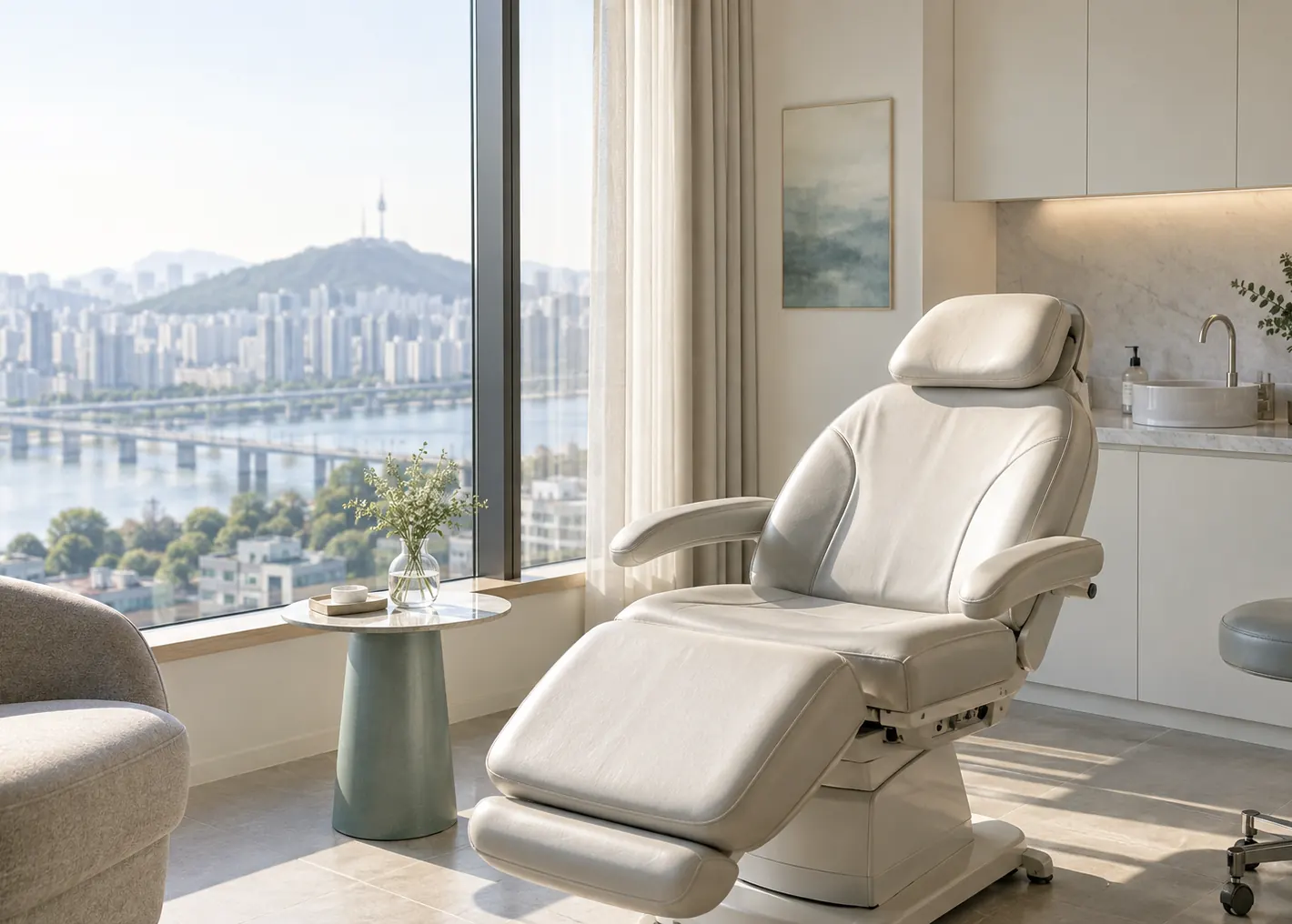
What is a Korean skin booster?
A Korean skin booster is an injection placed within the skin to improve hydration, texture and fine lines, rather than to add volume like a filler. The name covers several different ingredients, and a 2024 review by Korean doctors groups them into hyaluronic acid, polynucleotides and slowly dissolving synthetic polymers. Which one suits you, or whether any does, is a decision for the treating doctor after looking at your skin.
Polynucleotide injections are widely used in Korean clinics: in a survey of 235 board-certified Korean dermatologists who do cosmetic work, 88% said they use them, according to the same review. On our skin boosters page you can see the main products and what each one is made of.
How do Rejuran, Juvelook and Profhilo differ?
| Name | Main ingredient | Made by | Common use |
|---|---|---|---|
| Rejuran Healer | Polynucleotides (PN) from salmon or trout DNA | PharmaResearch, Korea | Skin quality and texture |
| Juvelook | Poly-D,L-lactic acid (PDLLA) mixed with hyaluronic acid | VAIM, Korea | Gradual collagen-type support |
| Profhilo | Hyaluronic acid (high and low molecular weight) | — | Hydration and skin laxity |
Rejuran healer in Korea is a polynucleotide product made for injection into the skin, and the 2024 review describes it as a prominent polynucleotide product in Asian countries. Juvelook belongs to the polylactic acid group, which works by prompting the skin to make collagen over time. Profhilo is a hyaluronic acid product; its worldwide safety data were published in 2020.
In the United States, the hyaluronic acid booster Skinvive by Juvéderm is approved to improve the smoothness of cheek skin in adults over 21. For a product used in Korea, ask the clinic for its Korean approval details and the sealed package, instead of assuming it has the same status at home.
How many skin booster injection sessions fit a short stay in Korea?
A Korean skin booster is usually planned as a series, so a single short trip may cover only part of it. The 2024 review describes standard practice in Korea as 2 mL of polynucleotide every 3 to 4 weeks over three to four sessions, and a European consensus quoted in the same review expects effects to last about 6 to 12 months after three sessions spaced 3 weeks apart.
If you are only in Korea for a few days, tell the clinic your dates first so the plan fits your stay. Ask whether the remaining sessions can be done by a doctor at home, and take the product name and amount with you in writing.
What side effects should I plan around?
Expect small bumps and redness at the injection points for a short time. The review notes that hyaluronic acid placed in the skin can form small 'beads' or papules, most often on the outer cheeks, and that particles of polylactic acid products can, rarely, block a blood vessel and lead to skin damage or vision loss. These are reasons to have a Korean skin booster injected by a doctor who explains the product and the injection depth.
The Skinvive safety information advises keeping strenuous exercise, strong sun or heat and alcohol to a minimum for the first 24 hours. Your clinic's written aftercare for the product it uses takes priority, so ask for it in English.
What should I ask before booking?
- Which product will be used, and can I see the sealed package?
- Who will inject it, and what is their specialty?
- How many sessions do you suggest for my stay?
- What should I avoid afterwards: sun, alcohol, flights?
- What is included in the written estimate?
Check the clinic as well as the product. Korean medical institutions that treat foreign patients must register with the government, and registration requires at least one board-certified specialist per department and medical liability insurance; the MEDICALKOREA registration system lets you search registered institutions by name. The CDC also advises medical tourists to plan for complications with a doctor at home. Our checklists on choosing a Korean skin clinic and Korean skincare treatment cover the wider visit, and Botox in Korea explains how to combine boosters with toxin injections.
How COMEDI helps
COMEDI shares information about partner clinics, passes your questions about products and session plans to them, and arranges a consultation that fits your dates. You receive the clinic's written estimate showing the product, the number of sessions and what is included. To start, read how to book.
Skin boosters & Rejuran: what is used
| Devices, products and methods | |
|---|---|
| Rejuran PharmaResearch, Korea | Contains polynucleotide (PN), purified DNA fragments from salmon, at 20 mg/mL in the product used in published studies. |
| Juvelook VAIM, Korea | Combines PDLLA (a polylactic acid) with hyaluronic acid in a 50 mg vial; registered in Korea as a medical device for temporary improvement of facial wrinkles. |
| Skinvive by Juvéderm Allergan Aesthetics (AbbVie), USA | A hyaluronic acid gel with lidocaine injected as microdroplets into the skin; its US indication is smoother cheek skin in adults over 21. |
| Profhilo IBSA, Italy | Holds 32 mg of high- and 32 mg of low-molecular-weight hyaluronic acid in 2 mL, stabilised by a heat process without chemical cross-linking agents. |
| At a glance | |
|---|---|
| What it is | Injections placed in the skin to improve its quality (hydration, texture, fine lines) rather than to add volume like a filler. |
| Ingredients | The main types are polynucleotide (PN), non- or lightly cross-linked hyaluronic acid, and polylactic acid. Each brand uses a different one. |
| Injection layer | Into the skin or just beneath it, depending on the product, usually as many small injections across the area; Profhilo is placed at five fixed points on each side of the face. |
| Anaesthesia | Numbing cream is commonly applied first; published studies describe about 30 minutes. |
| Sessions & interval | Given as a course. Profhilo's recommended start is two sessions 30 days apart; a published polynucleotide study used two to three sessions three weeks apart. |
| How long it lasts | Varies by product. For Skinvive the manufacturer states about six months. |
Full details and sources: Skin boosters & Rejuran
Facts to check before you book
| Registration | Clinics and agencies that work with international patients must be registered with Korea's Ministry of Health and Welfare. Medical Korea lists 3,114 registered medical institutions and 1,927 registered agencies (as of March 2025), and registered institutions have had to carry medical malpractice liability insurance since 2016. Ask for the registration number before you pay a deposit. [1] |
| Official help line | The Medical Korea Information Center answers on +82-2-1577-7129, daily 09:00 to 18:00 Korea time, and has desks at Seoul Station (B2, Airport Railroad) and Incheon Airport Terminal 1. It gives information on clinics, takes complaints and dispute enquiries, and takes reports of illegal brokers. [2] |
| Entry (US passports) | Countries currently exempt from K-ETA, including the United States, stay exempt until 31 December 2026 (Korea time). You may still apply for a K-ETA: once it is approved, you do not have to fill in the arrival card, but the application fee is charged and is not refunded. Check the entry rules again before you fly. [3] |
| Tax refund | Korea's VAT refund for cosmetic procedures for foreign visitors (Restriction of Special Taxation Act, Article 107-3) applied only to procedures received at registered clinics on or before 31 December 2025, and the refund had to be claimed within three months of the procedure. Procedures received now are not covered, so do not plan your budget around a refund, and ask the clinic whether VAT is included in the written quote. [4] |
| If something goes wrong | The Korea Medical Dispute Mediation and Arbitration Agency accepts mediation applications from foreign patients. Patients living abroad apply by email or fax ([email protected]), and the counselling line is +82-2-1670-2545. Keep your records, receipts and consent forms. [5] |
Checked on 2026-10-07. Rules change, so confirm with the official source before you travel.